


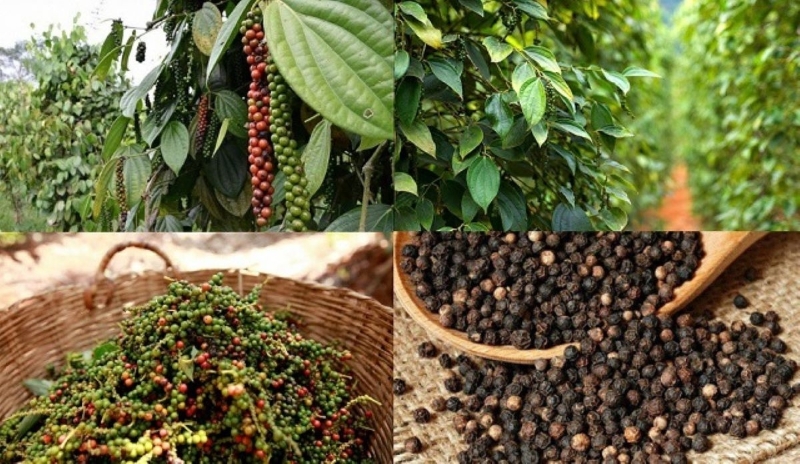
The early months of 2026 are painting a bright picture for Vietnam's pepper industry, as both export volume and value record impressive growth.
According to data from Vietnam Customs, in the first 15 days of March 2026, Vietnam exported 12,613 tons of pepper, generating a turnover of $81 million. Compared to the same period last year, this represents a 46.7% increase in volume and a 35.4% surge in value.
From the beginning of the year through March 15, total exports reached 48,192 tons, earning $312.23 million—up 34.6% and 28%, respectively. Although domestic pepper prices have shown a slight downward trend recently, they remain high at approximately VND136,000/kg ($5.16), as of March 23, helping farmers maintain positive profit margins.
In terms of product structure, black pepper continues to dominate, with export volumes five times higher than those of white pepper. This underscores black pepper’s status as a staple commodity, driven by advantages in output and competitive pricing. However, the rising proportion of white pepper and deep-processed products reflects a strategic shift toward high-value segments.
In the first two months of 2026, the United States and China remained Vietnam’s two largest export markets, accounting for 29.9% and 12.8% of total export volume, respectively.
A notable highlight is the robust growth in the Thai market. In the first two months of 2026, pepper exports to Thailand surged by 125% in volume and 104% in value compared to the same period last year. Vietnam currently holds a near-monopoly on supply in this market, accounting for 99.63% of Thailand's total pepper imports.
According to Assoc. Prof., Dr. Nguyen Dinh Tho (Institute of Strategy and Policy for Agriculture and Environment), the 2024-2025 period marked a pivotal turning point as the Vietnamese pepper industry shifted its focus from volume-driven growth to value-driven growth.
He noted that amid favorable price conditions, Vietnamese export enterprises are actively restructuring their product portfolios. They are focusing on white pepper, organic pepper, and deep-processed products catering to high-end retail chains. Modern technologies—such as steam cleaning, sterilization, fine grinding, and essential oil extraction—are significantly enhancing product value. Simultaneously, heavy investments have been made in EU-standard storage systems, origin traceability for growing areas, and quality inspection processes.
A notable trend is Vietnam’s increasing import of raw pepper from countries such as Brazil, Cambodia, and Indonesia for processing and re-export. In 2025, imports reached 42,688 tons, valued at $266.2 million. This model helps maintain factory capacity year-round, mitigates seasonal risks, and generates added value from price differentials. As a result, Vietnam is not only a major producer but is also emerging as a global hub for pepper processing and transshipment.





 Google translate