


Project funding must link directly to evaluation milestones and measurable outputs, with underperforming initiatives facing immediate cancellation and resource reallocation.
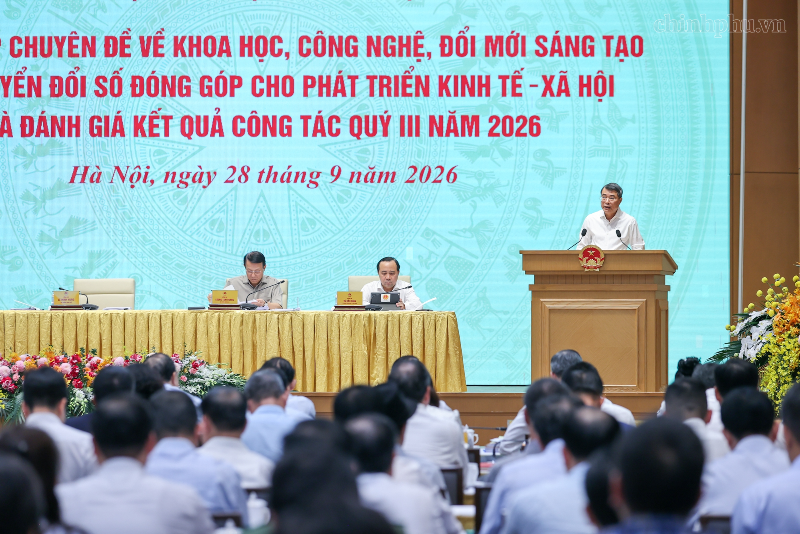
These recommendations were presented at a specialized meeting of the Central Steering Committee on science and technology development, innovation, and digital transformation in Hanoi on September 28, chaired by Prime Minister Le Minh Hung, Head of the Central Steering Committee.
Presenting the screening results through September 27, Deputy Minister of Science and Technology Le Xuan Dinh reported that ministries and agencies submitted 38 proposed tasks valued at VND13.75 trillion ($550 million), with non-state capital comprising 64.4 percent at VND8.86 trillion ($354.4 million).
The Ministry of Science and Technology evaluated 30 of these proposals, approving 22 eligible tasks focused on high-priority domains including space-electronics, high-speed rail tech, energy, and agri-medicine. Fourteen projects have secured official approval.
However, the evaluation uncovered persistent structural issues, including mixed research and capital expenditure budgets, overlapping proposals in AI and digital twins, limited corporate involvement, and vague review criteria.
Local government proposals showed similar gaps. Among 113 proposals submitted by 30 cities and provinces, many relied on generic technology concepts without defining specific core technologies or end-users.
In response, the ministry proposed a three-tiered classification model to streamline provincial tasks. including national and inter-provincial core technology problems directed by the Prime Minister; shared technologies coordinated by central ministries; and localized technology applications managed directly by provincial authorities.
Under the proposed operational framework, strategic technology projects will be monitored using strict technology readiness levels (TRL), intellectual property generation, localization rates, non-state capital mobilization, and commercial revenue. Funding will be released in tranches tied strictly to performance milestones, making project leaders directly accountable for final deliverables.
Concluding the meeting, Prime Minister Le Minh Hung issued key directives to accelerate national technology and digital transformation goals.
First, on resolving delayed tasks, the Prime Minister instructed ministries and agencies to urgently complete 27 overdue tasks and rigorously review all assigned workloads to prevent new backlogs.
Second, on institutional reform, the Ministry of Justice must report on solutions for legal bottlenecks in science and technology by mid-October 2026, while the Ministry of Science and Technology finalizes amendments to decrees guiding the Law on Science and Technology.
Third, regarding digital infrastructure and databases, priority resources must be mobilized to complete national databases for education, social welfare, civil service, and health before November 30, 2026. The judicial database must wrap up by June 2027, followed by the national land database by late 2027. Furthermore, the Ministry of Finance was tasked with coordinating with relevant bodies to attract large-scale foreign direct investment into data centers and high-performance computing clusters tied to technology transfer, while the Ministry of Industry and Trade ensures stable power supply for these centers.
Fourth, on administrative reform and digital public services, key mandates include integrating high-school diplomas and transcripts onto the VNeID digital ID platform, completing free public digital signature systems by mid-October 2026, and finalizing the integration of 82 essential public services by late October. Additionally, cross-border digital identity pilot programs with Singapore and Laos will be launched at major international airports.
Fifth, concerning technology development and commercialization, ministries must expedite approvals for remaining strategic tasks and pilot government first-order schemes for domestic tech products by the second quarter of 2027. The Prime Minister emphasized expanding a modernized “Triple Helix” model connecting government, research institutes, and enterprises, with major corporations taking the lead in creating supportive ecosystems for small and medium-sized enterprises.
Sixth, on resource allocation, strict financial discipline will be enforced to reallocate funds from slow-disbursing entities to high-performing ones. The Ministry of Science and Technology, the Ministry of Finance, and the State Bank of Vietnam were instructed to resolve valuation and collateral mechanisms for intellectual property rights by November 2026.
Seventh, to drive digital economy growth, local authorities and ministries were urged to hold specialized conferences, address sector-specific growth bottlenecks, and support small businesses with accounting software and digital platforms to achieve target double-digit economic growth.






 Google translate