


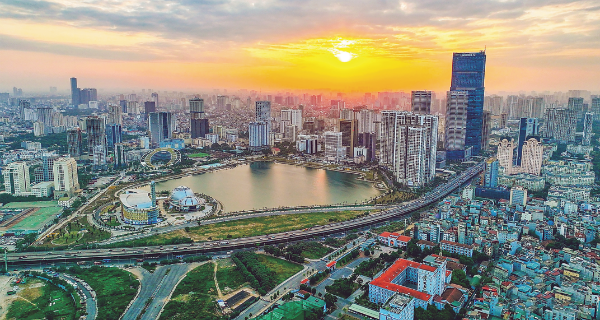
Figures from the National Statistics Office at the Ministry of Finance (MoF) reveal that the construction and real estate sectors have contributed an average of around 10 per cent of Vietnam’s GDP over recent years, which is only about half the regional average. Real estate assets, meanwhile, currently account for some 21 per cent of total economic assets; well below the 35 per cent typical in developed economies. The figures, according to the Vietnam Association of Realtors (VARS), underscore the sector’s significant untapped potential for medium and long-term growth.
Overheated market
In its latest report, VARS noted that Vietnam’s real estate market is increasingly asserting its vital role in the economy, drawing growing attention from the public, investors, and policymakers alike. However, VARS also highlighted persistent weaknesses in the country’s real estate market, warning of unsustainable growth and a potential housing bubble as prices soar far beyond real incomes.
Most new supply targets high-end, investment-oriented projects, including speculative buyers. Even in suburban areas once expected to offer affordable options, prices remain far above average incomes and are only “relatively lower” than in city centers. Meanwhile, the strongest demand lies in the affordable segment. “This imbalance has driven apartment prices in major cities sharply higher, setting new benchmarks that outpace income growth and further erode home ownership opportunities,” the VARS report noted.
Mr. Nguyen Van Dinh, Chairman of VARS, illustrated the affordability challenge: “For a two-bedroom urban apartment priced at VND5 billion ($192,000), a household earning VND50 million ($1,920) a month would need eight years to buy it if they saved all of their income, or 25 years if they set aside no more than one-third on housing.” He added that surging property values mainly enrich existing asset holders, while most people feel poorer as housing costs rise faster than wages. Without timely intervention, VARS warned, this wealth gap could solidify across generations, posing risks to social welfare, urbanization, and sustainable growth.
To cool the market while supporting healthy development, VARS proposed several measures.
First, accelerate the rollout of new legal frameworks and strengthen local enforcement, giving localities more flexibility to tailor policies and efficiently address site clearance bottlenecks while safeguarding residents’ rights.
Second, diversify capital sources to reduce dependence on bank credit by restructuring the corporate bond market and developing national housing funds and real estate investment trusts (REITs).
Third, prioritize affordable and social housing in urban planning, linking development with transport infrastructure such as metro lines, ring roads, and expressways, and building a professional rental market to ease pressure on home ownership.
Fourth, establish early-warning systems and market monitoring tools to detect speculation, supply-demand imbalances, and abnormal price surges, enabling regulators to intervene proactively.
Fifth, develop a unified, transparent national database on land, housing, and real estate transactions to improve policymaking, enhance transparency, and curb speculation and manipulation.
Towards a fairer housing landscape
The Ministry of Construction (MoC) said that, in recent years, Vietnam’s real estate sector, especially in major cities and rapidly-urbanizing areas, has exhibited signs of instability, undermining housing affordability and healthy market development.
Meanwhile, regulatory tools such as taxes, credit policies, land use planning, and State land pricing remain fragmented and ineffective, falling behind market dynamics. As a result, many Vietnamese, particularly young people, workers, and public servants, are finding it increasingly difficult to buy a home.
To address these issues, the MoC is working with other agencies to propose several key actions to the government. These include reviewing and updating housing and real estate regulations to remove bottlenecks; urging localities and developers to accelerate social housing construction to meet the target of 1 million units by 2030; and revising Decree No. 94/2024/ND-CP to establish a unified national housing and real estate database.
The Ministry is also considering a pilot model for State-run “real estate and land use rights trading centers” to increase transparency, and is coordinating with the MoF to finalize the legal framework for a national housing fund.
On November 10, the MoC reported to the Prime Minister on a draft government resolution designed to control and cool property prices. The resolution would create a legal framework to gradually bring housing prices closer to real income levels, especially for low and middle-income groups, while making the market more transparent and limiting speculation and price manipulation. It would also ensure greater policy consistency across land, investment, credit, taxation, and developer selection.
A key measure will be to cap developer profit margins in the affordable segment to help lower costs, expand supply, and correct market imbalances. The goal is to make commercial housing more accessible, stabilize prices, and strengthen social welfare and macro-economic stability.
Building the foundations
Despite the existing challenges, industry insiders remain optimistic about the long-term outlook. According to Mr. Neil MacGregor, Managing Director of Savills Vietnam, the market will be shaped by three key forces over the next decade: a more transparent and stable legal framework; stronger FDI inflows driven by faster approval processes; and rapid infrastructure growth unlocking suburban markets and boosting both affordable housing and logistics development.
“Today, the key foundations for Vietnam’s real estate growth have been established,” he said. “The new Land Law, Law on Housing, and Law on Real Estate Business together create a solid legal framework for healthier, more sustainable development. This will allow regulators to accelerate project approvals, ease supply pressures, and bring more products to the market, which is a crucial step towards stable growth, controlled price increases, and long-term housing sustainability.”
He added that Vietnam’s stable economic outlook, coupled with rapid, coordinated infrastructure investment, will further drive real estate growth. “Emerging trends such as smart urban development, AI integration in property technology, and sustainable construction are reshaping the landscape,” he explained. “Affordable housing will also remain a central focus, supported by stronger public-private partnerships and more comprehensive development strategies.”
Meanwhile, Mr. Troy Griffiths, Deputy Managing Director of Savills Vietnam, believes Vietnam enjoys a rare combination of strong growth, a young population, policy reforms, and large-scale infrastructure investment. “These will form the basis for a decade of sustainable growth in which real estate continues to play a pivotal role,” he said.
He also noted that overall FDI in the third quarter maintained steady and higher-quality growth and FDI in real estate remained quite positive. Notably, Hanoi attracted $3.5 billion in foreign investment, with more than $3.1 billion directed to real estate; clear evidence of strong investor confidence. Alongside this, $49 billion in infrastructure investment is being rolled out, including the North-South Expressway, the Long Thanh International Airport, new ring roads, and LNG projects. Once completed, this network will reshape Vietnam’s urban map, connecting new growth hubs and expanding development into emerging cities. With rapid urbanization, satellite cities will become the next frontier of real estate development.
Mr. Dinh added that despite the short-term challenges, the long-term outlook remains highly promising thanks to strong real housing demand and rapid urbanization. As the economy grows, segments such as residential, industrial, office, and retail real estate are expected to maintain steady demand.






 Google translate