


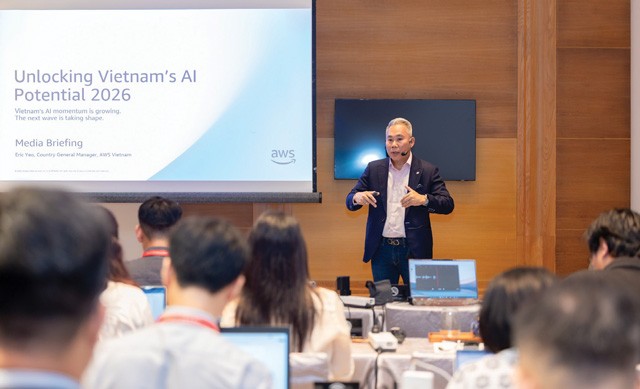
In its latest phase of development, Vietnam has identified science, technology, innovation, and digital transformation as key drivers of economic growth. Speaking at the AWS Cloud and AI Day in Hanoi on September 29, Deputy Minister of Science and Technology Hoang Minh emphasized that, in this process, digital infrastructure, data, data centers, cloud computing, and AI are increasingly becoming vital foundations of the digital economy. “Vietnam is focusing on the synchronized development of connectivity infrastructure, data centers, and computing capabilities,” he added.
Strengthening AI foundations
According to data from the Ministry of Science and Technology (MoST), the country currently has 42 commercial data centers with a total designed capacity of approximately 372 MW. 4G coverage has reached 99.8 per cent of the population, while 5G coverage stands at around 91.9 per cent. These help facilitate the rapid adoption of cloud and AI services.
However, Deputy Minister Minh noted that expanding physical infrastructure or deploying additional standalone AI applications is not the ultimate goal. “Vietnam not only aims to expand infrastructure or introduce more AI applications; but more importantly, it is about fostering an ecosystem where government agencies, enterprises, universities, and research institutions can harness, master, and progressively develop new technologies,” he said.
Based on this orientation, Vietnam is focusing on four key areas. First is to continue to develop cloud infrastructure, data centers, and computing capacity, ensuring reliable, safe, and scalable connections and meeting the growing needs of AI and the digital economy. Next is to develop data and AI platforms safely and effectively, creating conditions for Vietnamese businesses to exploit data and technology to improve productivity, quality, and competitiveness.
In addition, accelerating the development of technological human resources is also an important factor. Vietnam not only needs technology users, but also needs a team capable of developing, integrating, operating, and mastering new technologies. Last and most important is ecosystem development. “We expect Vietnamese businesses to not only use cloud and AI as a service, but to gradually improve their technological capacity, develop new products, services, and business models, and participate more deeply in the global value chain,” the Deputy Minister said.
From an international perspective, H.E. Jennifer Wicks, Ambassador of the US to Vietnam, emphasized the role of technology and technological infrastructure in building an innovative, prosperous, and increasingly digitized economy. “Cloud computing plays a central role in this transformation, providing businesses with the infrastructure needed to innovate, scale, and compete, while also enabling advancements in AI, advanced manufacturing, financial services, e-commerce, and digital government,” Ambassador Wicks said. “Vietnam is at a critical turning point, where highly predictable and transparent regulations can encourage further investment that brings technology and expertise. In turn, these technologies and expertise help boost productivity and enhance innovation and economic opportunities across the country.”
Business adaptability
AI is moving beyond the testing phase in many Vietnamese businesses as more and more organizations begin to put this technology into practice. According to the recent “Unlocking Vietnam’s AI Potential 2026” study, conducted by Strand Partners and Amazon Web Services (AWS), about 26 per cent of Vietnamese businesses, equivalent to 245,000 businesses, have already applied AI in their operations. Of these, 78 per cent expect AI to continue to become a growth driver in the year ahead. Mr. Eric Yeo, Country General Manager of AWS Vietnam, said that, on average, about eight new businesses in Vietnam apply AI every hour.
Businesses that have put AI into operation are also recording notable results. Seventy-three per cent believe that AI plays an important role in overall business strategy and 72 per cent noted increased productivity, higher than the 66 per cent recorded in the previous year. Notably, 64 per cent of businesses said AI helped increase revenue by an average of 15 per cent.
This application momentum is also reflected in business expectations. Sixty-nine per cent of businesses surveyed said AI is a top or high priority, while 84 per cent expect to increase their use of AI in the year ahead. However, 61 per cent of businesses that have applied AI are still in the testing stage. What was critical though was that about 71 per cent said their AI investments have already broken even or turned a profit. “Vietnamese businesses are increasingly shifting from asking whether they should apply AI to finding ways to expand effective solutions,” said Mr. Yeo. “For AI to be deployed on a larger scale, digital infrastructure, data, and computing power become important conditions.”
The differences between industries are also quite clear. In the financial sector, 41 per cent of businesses have applied AI; significantly higher than the average of 26 per cent. Seventy-nine per cent of financial businesses recorded improved productivity. In the healthcare sector, the AI adoption rate reached 23 per cent, of which 69 per cent reported increased productivity.
Another notable trend is the emergence of agentic AI, which means AI systems capable of performing a series of tasks instead of just responding to a single request. About 38 per cent of businesses surveyed said they were aware of this technology. Of those, 8 per cent have integrated AI agents into core processes while 19 per cent are testing or piloting the technology.
Businesses that have deployed AI agents are pulling ahead in their operations. Eighty-one per cent said productivity had improved significantly, 68 per cent noted increased operational efficiency or productivity, 61 per cent said decision-making and execution speed had improved, and 49 per cent found it more convenient to expand operational scale.
However, AWS data shows that Vietnamese businesses still face many barriers when taking AI from testing to large-scale deployment. Only 23 per cent of businesses that have applied AI said they have a formal and comprehensive AI strategy, though promisingly, this number has nearly doubled compared to the 12 per cent recorded in 2025.
The problem of measuring efficiency has also not been resolved. Only 13 per cent of businesses said they had a clear and consistently applied AI ROI measurement framework. Meanwhile, 46 per cent admitted that there is no reliable method to evaluate the effectiveness of investment in AI.
Human resources continue to be another bottleneck. Fifty-four per cent of businesses believe that the lack of digital and AI skills is hindering the application and expansion of technology. Eighty-seven per cent of employers rate the retention of current employees as an important element in their AI strategy, with the proportion of Vietnamese workers participating in AI training last year reaching 26 per cent, up from 19 per cent in 2025.
Notably, the study also found that the most critical skill in the AI era goes beyond technical proficiency - 57 per cent of businesses say judgement will be the most important AI-related skill over the next five years.
AI growth solutions
According to Deputy Minister Minh, Vietnamese businesses need to go beyond using cloud and AI as a service, gradually improve their technological capacity, develop new products, services, and business models, and participate more deeply in the global value chain. During that process, MoST expects international technology corporations to not only provide services but continue to participate in infrastructure investment, human resources training, research, innovation, and ecosystem development in Vietnam.
Ambassador Wicks also affirmed that to achieve the goal of sustainable double-digit growth in the years to come, Vietnam needs to improve productivity across the entire economy, and digital technologies can become a powerful driver for improving productivity. “However, technology alone is not enough,” the Ambassador added. “Vietnam will need a favorable legal environment that continues to encourage innovation, attract investment, and allow the international business community - to deploy new technologies effectively.”
From a business perspective, to accelerate the process of turning AI into economic value, Mr. Yeo believes that Vietnam has built a large foundation and is experiencing rapid growth of AI application businesses. The next step is to help more businesses move from AI experimentation to AI transformation. In addition, Vietnam has abundant human resources and the necessary capacity to develop AI. Besides policy and governance, infrastructure is an important factor. “Countries are also currently adjusting and perfecting policies to support businesses in applying AI and promoting AI sovereignty,” he noted. “These are essential factors to attract investment, combining international standards with domestic expertise.”








 Google translate