


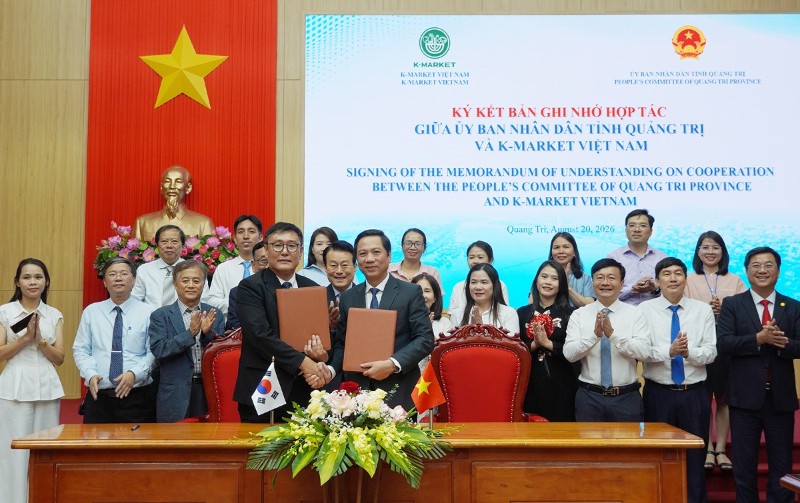
The People’s Committee of Quang Tri Province in central Vietnam has signed a Memorandum of Understanding (MOU) with K-Market Vietnam, paving the way for local agricultural products to enter modern distribution channels and reach international markets, including South Korea.
K-Market Vietnam is a retail chain with over 150 supermarkets and convenience stores nationwide, specializing in Korean food and consumer goods. Following several field surveys in Quang Tri, the company identified high potential in the province’s agricultural offerings and expressed a strong interest in incorporating them into its retail network.
Permanent Vice Chairman of the Quang Tri People’s Committee, Mr. Hoang Nam, noted that the partnership has progressed from preliminary surveys to concrete cooperation regarding specific products, quality standards, and market strategies. The province expects K-Market to serve as a vital bridge between local production and the market, thereby enhancing the value and competitiveness of Quang Tri’s agricultural sector.
Chairman of K-Market Vietnam, Mr. Ko Sang Goo, highly evaluated the province's agricultural potential and reaffirmed his commitment to deepening the partnership. As an immediate first step, K-Market has selected Quang Tri Organic Rice to be stocked across its supermarket system.
“Bringing these products into our distribution network is just the starting point for both parties to expand the agricultural portfolio. This will help Quang Tri’s products gain more exposure to domestic consumers and gradually move toward international markets,” he said.Under the MoU, both sides will work together to promote Quang Tri’s specialties through K-Market’s distribution system. They will also focus on improving product quality, brand building, processing, logistics, and expanding export opportunities.
A highlight of the agreement is the collaboration to develop and commercialize products that have received support from KOICA’s (Korea International Cooperation Agency) ODA programs. This initiative is expected to upgrade the agricultural value chain, increase commercialization capabilities, and secure sustainable outlets for local farmers.


 Google translate