


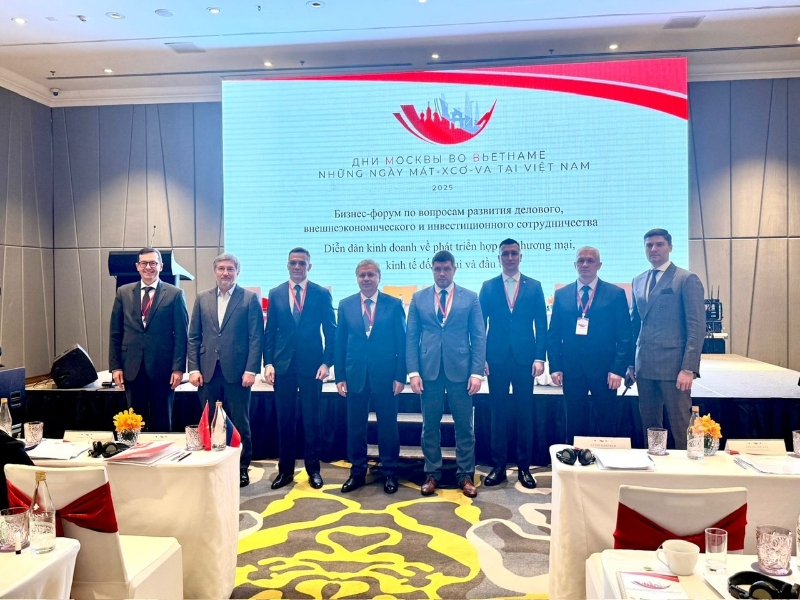
A business forum on trade and investment held in Ho Chi Minh City on December 3 has emerged as a cornerstone of Vietnam-Russia diplomatic and economic activities in 2025.
Hosted as part of the "Moscow Days in Vietnam" program, the event celebrated the 75th anniversary of diplomatic relations between the two nations.
With the presence of Minister of the Government of Moscow and Head of the Department for External Economic and International Relations of Moscow, Sergey Cheremin, the forum serves as the starting point for a series of accelerated cooperative programs between Moscow and Ho Chi Minh City in smart urban development, sustainable mobility, digital economy, and modern trade.
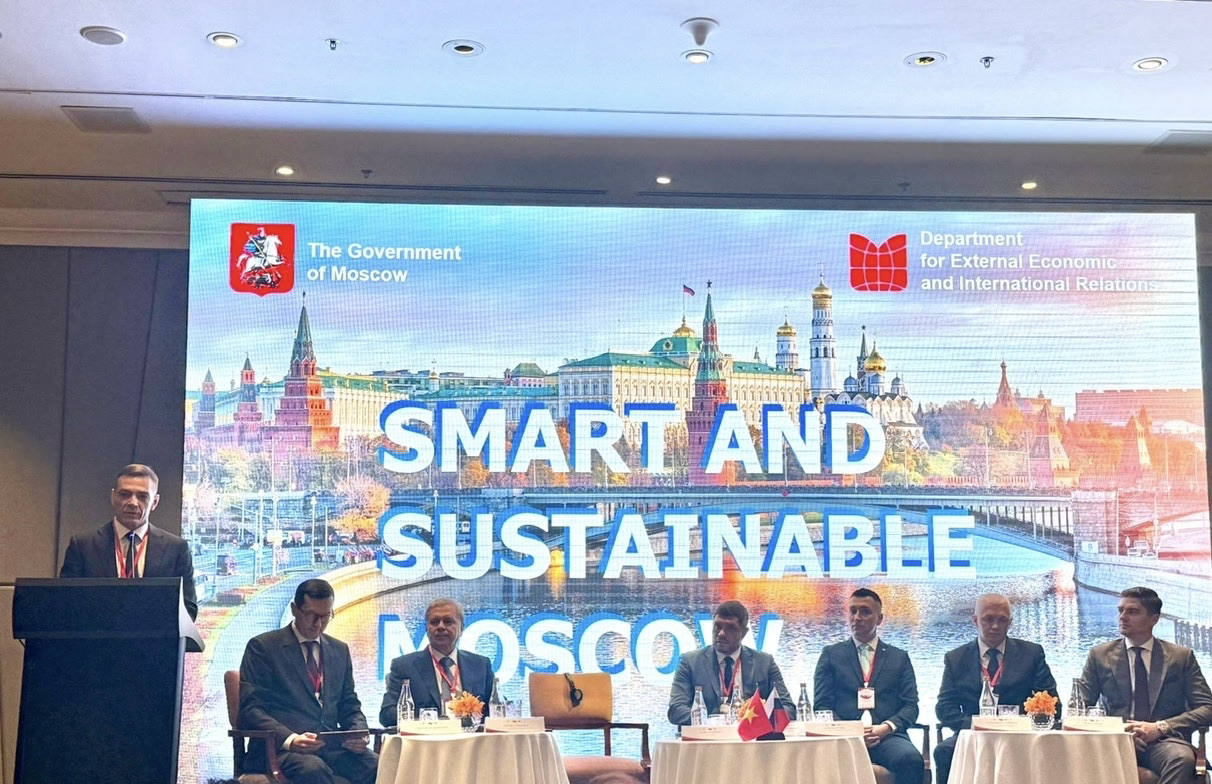
On behalf of the Consulate General of the Russian Federation in HCM City, Deputy Consul General Yury Ivanovich Nemtsov shared examples of Moscow’s metro system, featuring 400-500 stations with modern designs, many resembling “palaces underground.”
“Moscow’s experience as one of the world’s fastest-developing and most-modern cities is valuable for Vietnam’s infrastructure and urban management development,” he said.
Modern urban model for HCMC
Speaking at the forum, Minister Cheremin painted an impressive picture of the Russian capital’s transformation over the past 15 years, from a vast megacity into one of the world’s most modern, safe, and efficient metropolitan areas.
Home to more than 13 million people, Moscow now boasts transport, healthcare, education, and digital infrastructure ranked among the best in Europe. The city has received numerous international awards for smart city development, sustainable transport, and quality of life.
“Yesterday, we signed a new cooperative program between Hanoi and Moscow, and we hope to prepare a similar cooperation program with Ho Chi Minh City in the near future,” he emphasized.
Echoing this, Ms. Cao Thi Phi Van, Deputy Director of the Ho Chi Minh City Investment and Trade Promotion Center, noted that HCM City and Moscow share many similarities in population, scale, and GDP contribution, providing a solid foundation for economic and trade cooperation.
Following its recent administrative expansion, the city now spans 6,772 sq. km with 14 million residents, which is comparable to Moscow, and contributes nearly a quarter of Vietnam’s GDP. The city boasts modern infrastructure, including two major airports, 164 hospitals, over 200 universities and colleges, and 66 industrial parks covering a total of 27,000 ha.
Looking ahead, it is targeting development in five key areas: a financial hub, smart urban development, innovation centers, smart logistics and seaports, and tourism and resort networks. HCM City currently has 127 projects seeking investment, with 20 key projects in high-tech, education, healthcare, and economic sectors.
Ms. Van emphasized that the similarities between HCM City and Moscow, combined with investor networking at forums, will act as a strong platform for the two cities to connect effectively with global markets and unlock new opportunities for investment and trade in the near future.
One of the forum’s most-discussed topics was the development of Moscow’s car-sharing system; an urban mobility model reshaping the city’s transport landscape.
Speaking with VnEconomy / Vietnam Economic Times, Mr. Ilya Koltygin, Head of the Russian Export Center (REC) in Vietnam, said car-sharing vehicles marked with decals will hit the streets of HCM City in the coming months before expanding to other cities.
According Mr. Koltygin, the model has already been successfully implemented in Moscow and other Russian cities. According to data, each shared vehicle can replace about five private cars, helping ease traffic congestion, a crucial factor as major Vietnamese cities like Hanoi and Ho Chi Minh City face growing pressure on infrastructure.
“Car-sharing promotes green transport, reduces emissions, eases congestion, and provides residents with more convenient mobility options,” he said.
With more than 50,000 shared vehicles, Moscow is now the largest car-sharing market in Europe and among the Top 3 globally. Studies in Russia show that a single shared vehicle can replace four to six private cars, significantly reducing congestion, parking demand, and emissions.
Urban cooperation opens a new chapter
Moscow delegates at the forum reaffirmed that its experience in urban development offers valuable lessons for HCM City.
First, as Vietnam’s metro and transport systems continue to grow, Moscow’s rapid transit expansion serves as a sound model. Since 2011, the city has added 123 metro stations and completed an 80-km circular line - the world’s longest - demonstrating efficient large-scale transit development.
Second, the city’s “City Operations Center”, a large data platform coordinating traffic, public services, healthcare, and education, highlights the role of smart technology in urban management. Several countries, including Vietnam, are among Moscow’s priority partners for adopting this model.
Third, Moscow is advancing green transport with the world’s largest electric bus fleet and a river electric craft network on the Moskva River; an approach relevant for HCM City as it develops water-based transport.
Fourth, there are strong opportunities for HCM City to partner in innovation, education, medical technology, and infrastructure.
Mr. Dmitrii Gashchenkov, Deputy Prefect of the Western Administrative Okrug of Moscow, highlighted Moscow’s “innovation heart” in the Western District, which is home to the Skolkovo Innovation Cluster, Moscow State University, major science and technology centers, modern hospitals, new metro links, and pedestrian bridges.
Trade between Moscow-based enterprises and Vietnam currently totals nearly half a billion dollars and is expected to grow with rising demand for high-tech goods, agricultural products, energy cooperation, and urban development.
Concluding the forum, Minister Cheremin emphasized Moscow’s readiness to share expertise and support HCM City across all priority areas.
“We invite Ho Chi Minh City to Moscow - a modern, vibrant, and strategic partner of Vietnam,” he said, signaling plans for a future cooperation program similar to the Moscow - Hanoi agreement signed just a day earlier.
 Google translate