


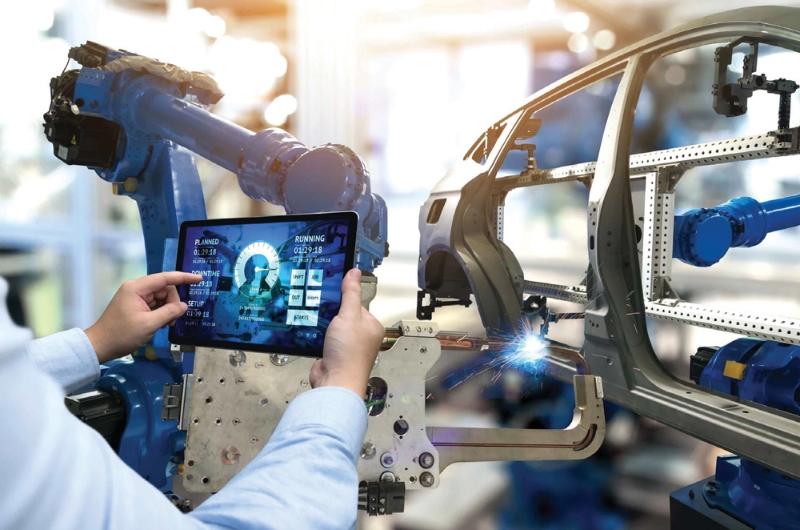
Politburo Resolution No. 57-NQ/TW, dated December 22, 2024, marked a major turning point for science, technology, and innovation in Vietnam. Beyond setting ambitious goals, the Resolution identified science and technology as key drivers of the country’s breakthrough development in the new era. As Vietnam’s economic structure continues to evolve, applying science and technology to industrialization and modernization has become essential to achieving sustainable growth.
Vietnam’s economy is steadily shifting away from agriculture, forestry, and fisheries toward greater contributions from industry, construction, and services. According to the National Statistics Office at the Ministry of Finance, GDP growth reached 8.02 per cent in 2025, with GDP per capita rising to $5,026 and the economy expanding to approximately $514 billion. The sustained contribution of Total Factor Productivity (TFP) to growth in recent years provides a strong foundation for a transition toward a science, technology, and innovation-led growth model.
A combination of institutional reform, strategic technologies, multipolar international cooperation, large-scale transport and energy infrastructure, a modern industrial workforce, highly-skilled talent, and a strong science and technology business ecosystem will provide the foundation for Vietnam to meet its industrialization and modernization targets by 2030 and achieve developed, high-income status by 2045, in line with Politburo Resolution No. 57 and Resolution No. 29-NQ/TW, issued on November 17, 2022.
To strengthen science, technology, and innovation in support of industrialization and modernization, six groups of actions should be implemented simultaneously during the 2025-2030 period.
Finalizing and implementing the new legal framework
Vietnam must move quickly to finalize and implement its new legal framework for science, technology, and innovation, centered on Law No. 93/2025/QH15, National Assembly Resolution No. 193/2025/QH15, and Law No. 71/2025/QH15. Priority should be given to special mechanisms covering financing, procurement, ownership of research outcomes, and greater tolerance for research-related risks.
Politburo Resolution No. 57 targets TFP contributing more than 55 per cent of economic growth, the digital economy at least 30 per cent of GDP, R&D spending reaching 2 per cent of GDP, and at least 3 per cent of annual State budget expenditure allocated to science, technology, innovation, and national digital transformation.
These goals are aligned with the long-term direction of Resolution No. 29, which sets out Vietnam’s industrialization and modernization roadmap through 2030, with a vision to 2045.
To translate Politburo Resolution No. 57 into practice, the 15th National Assembly introduced a series of key legal instruments in 2025. These include Resolution No. 193/2025/QH15, dated February 19, 2025, piloting special mechanisms to accelerate science, technology, innovation, and digital transformation; the Law on Science, Technology and Innovation (Law No. 93/2025/QH15), passed on June 27, 2025; and the Law on Digital Technology Industry (Law No. 71/2025/QH15), approved on June 14, 2025. Together, they form the core legal foundation for institutional breakthroughs during the 2025-2030 period.
The framework was further strengthened by Decision No. 21/2026/QD-TTg, issued by the Prime Minister on April 30, 2026, and effective from July 1, 2026, replacing Decision No. 1131/QD-TTg. The Decision established Vietnam’s list of strategic technologies and strategic technology products, covering ten technology groups and 30 priority products to focus national resources on key breakthroughs.
Together with Decision No. 569/QD-TTg on the Strategy for Science, Technology and Innovation Development through 2030, semiconductor industry policies, and Resolution No. 172/2024/QH15 approving the North-South high-speed railway investment policy, Vietnam has put in place a broadly comprehensive legal foundation for its next stage of development.
Prioritizing resources for strategic technologies
Vietnam should move quickly to channel resources toward strategic technologies that can drive industrial upgrading, productivity, and long-term competitiveness.
Decision No. 21/2026/QD-TTg, issued by the Prime Minister on April 30, 2026, and effective from July 1, 2026, replaced Decision No. 1131/QD-TTg and formally introduced Vietnam’s updated List of Strategic Technologies and Strategic Technology Products. Covering ten technology groups and 30 priority products, the framework provides the country’s most detailed and legally-binding roadmap for directing budget allocation, tax incentives, credit, land access, and international cooperation during the 2026-2030 period.
The ten strategic technology groups include digital technologies, such as AI, big data, digital twins, cloud and edge computing, the Internet of Things (IoT), and blockchain, alongside next-generation mobile networks, robotics and automation, advanced biotechnology and biomedicine, energy and advanced materials, semiconductors, cybersecurity and quantum technologies, marine and sub-surface technologies, aerospace, and high-speed and urban rail systems. A key addition compared with the previous framework is the inclusion of high-speed and urban railway technologies, reflecting Resolution No. 172/2024/QH15 on the North-South high-speed railway project.
The accompanying product list divides 30 priority technologies into two tiers. The first consists of 22 market-ready products with immediate economic impact, including Vietnamese large language models, cloud platforms, 5G/5G-Advanced systems, batteries and battery energy storage systems (BESS), green hydrogen, industrial robotics, and unmanned aerial vehicles (UAVs). The second tier includes eight technologies aimed at creating new growth engines and strengthening strategic autonomy, such as specialized semiconductor chips, quantum technologies, rare earth and advanced mineral processing, Small Modular Reactors (SMRs), low-Earth orbit satellites, and high-speed railway systems.
This two-tier structure creates a clearer policy focus. Technologies with established markets should be deployed rapidly to support productivity and industrial growth, while strategic technologies with longer development cycles require sustained state backing to build national self-reliance.
The framework also helps clarify resource allocation. Market-ready technologies should rely more heavily on private investment and public procurement under Law No. 71/2025/QH15, while strategic autonomy technologies should receive stronger support from the State budget and targeted commissioning under Resolution No. 193/2025/QH15.
Public procurement will be critical to turning this strategy into reality. Government agencies, State-owned enterprises (SOEs), and large infrastructure projects in transport, energy, healthcare, and defense should allocate part of their technology budgets, proposed at a minimum of 10-15 per cent, to domestically-developed strategic technologies, in line with Law No. 93/2025/QH15 and Law No. 71/2025/QH15. Stable demand from public buyers can help stimulate R&D and domestic production, following models used effectively in countries such as the US, China, South Korea, and Russia through major defense and infrastructure programs.
International cooperation strategy
Cooperation strategies have been established under the CHIPS Act and with university-industry networks in the US; with Zhongguancun, Shenzhen, and China’s supply chains; with Rosatom, MEPhI, Skoltech, and the Ninh Thuan project with Russia; with the Yongin cluster and South Korea’s “developmental State” model; with Taiwan (China’s)’s Industrial Technology Research Institute (ITRI); with Israel’s startup ecosystem and Yozma 2.0 Fund; with Singapore’s RIE2025 strategy; and via partnerships with the EU, Japan, and Australia in education, basic research, and energy.
Cooperation between Vietnam and Russia in nuclear energy has been relaunched at the government level. According to the Ministry of Industry and Trade, Vietnam and the Russian Federation signed an intergovernmental agreement on March 23 to develop the Ninh Thuan 1 Nuclear Power Plant in Vietnam. The project will deploy two third-generation-plus VVER-1200 pressurized water reactor units with a combined capacity of approximately 2,400 MW.
World Nuclear News reported that the project will be modeled on the new reactor units at the Leningrad Nuclear Power Plant, with Rosatom serving as the principal technology contractor. Beyond power generation, the agreement presents a strategic opportunity for Vietnam to access advanced nuclear technology while deepening cooperation in training, research, and technology transfer in areas such as nuclear physics, materials science, control engineering, and radiation safety.
Russia also maintains longstanding strengths in fields relevant to Vietnam, including nuclear physics, plasma and laser science, vaccine technology, agriculture in harsh environments, theoretical mathematics and physics, and engineering education.
Decades of educational and scientific cooperation between Vietnam and the former Soviet Union, and later the Russian Federation, have created a large network of Vietnamese experts trained at Russian universities, research institutes, and corporations. Many now work in Vietnam or are part of the overseas Vietnamese community, representing a valuable talent pool that could be mobilized through bilateral science and technology partnerships and talent-attraction mechanisms under Law No. 93/2025/QH15.
Parallel energy and science-technology programs
A central reality of the digital age is that science, technology, and energy can no longer be developed separately. As the digital economy, AI, and advanced manufacturing become major growth drivers, energy security and technological security are increasingly intertwined. Data centers, semiconductor fabs, 5G/6G networks, and AI systems all depend on stable, large-scale, and low-emission electricity supplies. This link should be reflected in all science, technology, and energy planning from 2025 onward.
On April 15, 2025, the Deputy Prime Minister approved Decision No. 768/QD-TTg revising the National Power Development Plan for 2021-2030, with a vision to 2050 (National Power Development Plan VIII, or PDP8). The plan aims to strengthen national energy security while supporting economic growth. Commercial electricity demand is projected to reach 500.4-557.8 billion kWh by 2030 and 1.238-1.375 trillion kWh by 2050. Installed power capacity for domestic demand is expected to rise to 183,291-236,363 MW by 2030 and 774,503-838,681 MW by 2050.
PDP8 outlines a more diversified and lower-emissions energy mix by 2050. Solar power is expected to account for 35.3-37.8 per cent of total capacity, offshore wind 14.7-16.6 per cent, onshore and nearshore wind around 10.9 per cent, nuclear power 1.4-1.7 per cent, hydropower 4.8-5.2 per cent, and battery energy storage systems (BESS) 11.5-12.4 per cent. The remainder will come from gas-fired power, biomass, converted coal facilities, imports, and other sources. Renewable energy, excluding hydropower, is projected to account for 28-36 per cent of capacity by 2030 and as much as 74-75 per cent by 2050. Investment in the power sector during 2026-2030 is estimated at approximately $136.3 billion.
Within this structure, nuclear power and liquefied natural gas (LNG) will remain essential to ensuring stable baseload and backup supply. Ninh Thuan 1 and Ninh Thuan 2 are expected to deliver a combined capacity of 4,000-6,400 MW between 2030 and 2035, including two initial VVER-1200 reactors with total capacity of 2,400 MW. LNG power, projected to account for roughly 3.5 per cent of total capacity by 2050, will provide flexible backup for intermittent renewable energy.
To better align energy and science-technology development, Vietnam should focus on four priorities. First, AI data centers, semiconductor fabs (fabrication plants), and high-tech zones should be planned alongside baseload power projects, including nuclear, LNG, and 500 kV transmission networks, to ensure electricity is available when technology facilities come online. Second, the strategic technology list under Decision No. 21/2026/QD-TTg should give greater priority to enabling energy technologies, including advanced materials, battery storage, smart grids, and high-voltage direct current (HVDC) systems. Third, Vietnam should develop a joint workforce pipeline combining energy engineering and information technology skills to address severe global shortages in talent for data centers and semiconductor manufacturing. Fourth, financing mechanisms under Resolution No. 193/2025/QH15 should be extended to integrated energy-technology projects, rather than limited to standalone science and technology initiatives.
In a world where AI models, large language models, and semiconductor fabs function as electricity-intensive systems, Vietnam cannot realistically aim to become a regional technology hub without matching power capacity. Developing science, technology, and energy in parallel is therefore not simply a policy ambition, but a prerequisite for long-term growth.
Triangular innovation ecosystem
Vietnam should accelerate the development of an integrated innovation ecosystem linking universities, research institutes, businesses, and the State. This includes building 5-10 internationally-competitive research universities, restructuring major institutes into institute-industry partnerships, identifying lead technology firms in strategic sectors, and developing 2-3 integrated high-tech zones with clear regional specialization.
A common lesson from the US, South Korea, Taiwan (China), Israel, and China is that innovation ecosystems succeed only when research universities, institutes, technology companies, and governments work closely together. In Vietnam, however, these actors have largely operated in silos over the past three decades, constrained by legal and financial barriers between public research and private industry. Politburo Resolution No. 57-NQ/TW and Law No. 93/2025/QH15 have created a founzdation to address these gaps, but the priority for 2026-2030 is to turn policy into workable institutional models.
Vietnam should focus resources on developing 5-10 leading research universities to international standards. Potential candidates include the Hanoi University of Science and Technology, Vietnam National University Hanoi, Vietnam National University Ho Chi Minh City, the Ho Chi Minh City University of Technology, the University of Danang, the Vietnamese-German University, VinUniversity, and other institutions with comparable research capacity.
At the same time, major public research institutes, particularly the Vietnam Academy of Science and Technology (VAST) and the Vietnam Academy of Social Sciences (VASS), should be restructured toward institute-industry partnership models inspired by Taiwan (China)’s ITRI and Russia’s Skoltech, with stronger commercialization and business collaboration.
On the industry side, Vietnam should identify 5-10 lead enterprises in each strategic technology category under Decision No. 21/2026/QD-TTg to serve as national technology champions. These firms should commit at least 3 per cent of annual revenue to R&D and support the growth of domestic supply chains. In return, they should receive access to research commissioning, risk-sharing mechanisms, venture financing incentives, and public procurement support under Resolution No. 193/2025/QH15.
To coordinate this ecosystem, Vietnam should establish a National Science and Technology Council with cross-sector authority, bringing together representatives from the Ministry of Science and Technology, leading universities, major institutes, flagship enterprises, and independent experts. The council would advise the government on strategic technology priorities, R&D funding, and the implementation of national technology missions.
Highly-skilled workforce
Building a highly-skilled workforce will be critical to achieving Vietnam’s science, technology, and innovation ambitions. A flagship priority should be training 50,000 semiconductor engineers by 2030, centered on six leading universities, while strengthening efforts to attract overseas Vietnamese talent and foreign experts. At the same time, industrial practices such as 5S, Kaizen, Just-in-Time (JIT), Genchi Genbutsu, Hansei, and Shokunin should be integrated into vocational training and business management.
In the semiconductor sector, Decision No. 1017/QD-TTg, approved on September 21, 2024, established a national workforce program targeting at least 50,000 engineers by 2030, with a vision to 2050. Complementing this, Decision No. 1018/QD-TTg approved Vietnam’s Semiconductor Industry Development Strategy, focused on three pillars: chip design, packaging and testing, and semiconductor manufacturing.
To improve effectiveness, the 50,000-engineer target should be divided into three skill groups. Around 15,000 engineers should be trained in integrated circuit (IC) design through leading domestic universities and internships at international design centers. Another 25,000 engineers should focus on assembly, testing, outsourced semiconductor assembly and test (OSAT), and production-line operations, linked to major investors such as Amkor, Hana Micron, and Samsung.
Vietnam should also launch workforce programs for other strategic technologies, linked to domestic research universities, leading international institutions, technology firms, and global organizations. Three talent channels should be developed in parallel: international-standard training in Vietnam supported by scholarships, overseas education tied to return commitments, and stronger recruitment of overseas Vietnamese professionals and foreign experts through reforms under Law No. 93/2025/QH15 and related regulations.
Together, institutional reform, strategic technologies, diversified international cooperation, modern infrastructure, industrial discipline, skilled talent, and a strong science and technology business ecosystem can provide the foundation for Vietnam to achieve its industrialization and modernization goals by 2030 and become a developed, high-income country by 2045, in line with Politburo Resolution No. 57-NQ/TW and Resolution No. 29-NQ/TW.
(*)Professor Nguyen Quoc Sy is from the National Research University, Moscow Power Engineering Institute, in the Russian Federation, and Director of the VinIT Institute of Technology.






 Google translate