


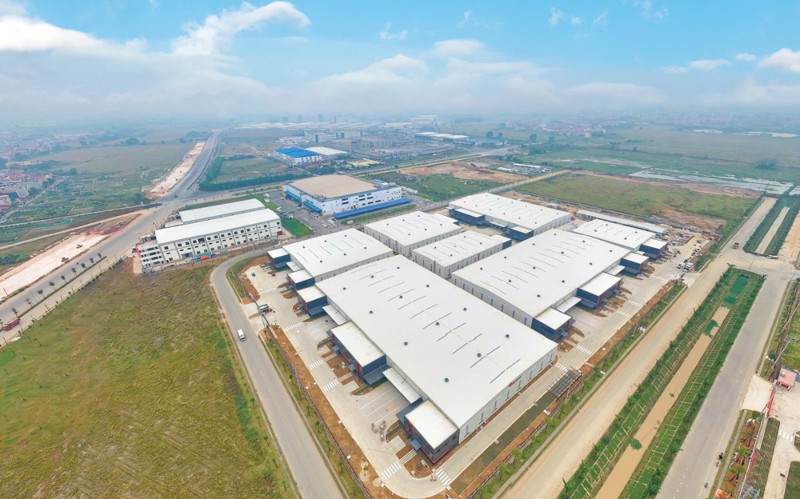
Despite posting impressive production recovery and attracting billions of dollars in FDI each year, industrial parks (IPs) in northern Vietnam are facing a daunting challenge: a serious shortage of skilled technical and managerial personnel. The biggest challenge now is no longer attracting investment but rather improving the local workforce’s capabilities to meet global requirements.
According to analysis from Deloitte, the ongoing global supply chain shift continues to make northern Vietnam a strategic destination for major technology corporations. A series of large-scale FDI projects have chosen the country’s northern region as their headquarters, notably Foxconn with its $383 million project in Bac Ninh province, Samsung’s additional $1.5 billion investment in Thai Nguyen, and projects in Phu Tho belonging to BYD ($890 million) and Posco Future M ($282 million). This remarkable growth has driven and is driving significant demand in the labor market.
For example, according to the Singapore Chamber of Commerce Vietnam (SingCham Vietnam), Singaporean investors today are looking for talent that can support automation, advanced manufacturing, digital technologies, and increasingly complex supply chains. This requires stronger technical and vocational training, greater industry exposure during education, and closer alignment between what employers need and what graduates are learning.
At the same time, soft skills are becoming increasingly important. Problem-solving, communication, adaptability, and leadership capabilities will be critical as Vietnam attracts more sophisticated industries. Ultimately, investors are not just looking for workers; they are looking for talent that can drive productivity, innovation, and sustainable growth.
Worker shortages
According to Mr. Wesley Chua, Board Member of SingCham Vietnam, investors traditionally assessed locations based on land costs, labor costs, and tax incentives, but the conversation is now changing. More companies are asking whether they can build and sustain a workforce over the long term. Investors want confidence that they can recruit, retain, and scale their operations over the next five to ten years. In some cases, the availability of talent and manual workers influences site selection as much as traditional cost considerations. “As a result, workforce considerations are becoming a strategic factor in investment decisions,” he continued. “The focus needs to shift from simply increasing the size of the workforce to enhancing its capabilities.”
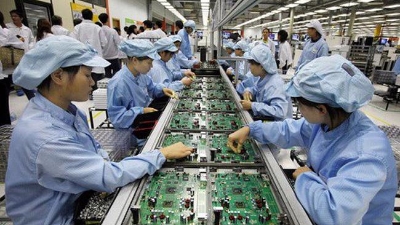
There are indeed significant obstacles in the labor market. Deloitte’s analysis shows that as of the beginning of 2026, businesses in the northern region needed more than 86,000 workers. Of this, the demand for unskilled workers accounts for 65 per cent, or some 56,000 people, while those with a technical secondary education account for 15 per cent, or around 13,000 people, and college / university graduates 20 per cent, or some 17,000 people. However, a serious mismatch is currently emerging between supply and demand.
The shortage is particularly acute in the high-skilled workforce segment. The semiconductor industry currently has only about 5,600 IC (integrated circuit) engineers, or just one-ninth of the target of 50,000 by 2030 and meeting only 20 per cent of actual annual demand.
At the “Workforce Insight Snapshot 2026” event held recently by SingCham Vietnam and industrial real estate company KTG Industrial managed by BKIM, Ms. Thoa Vo, Human Capital Lead at Deloitte Consulting SEA, said recruitment competition between factories within the same IP can be intense. “Unskilled workers are easy to recruit but difficult to retain, while engineers and middle managers are extremely scarce,” she explained. “Rising personnel costs are forcing businesses to shift their focus to optimizing productivity rather than relying on the advantage of cheap labor, as previously.”
Mr. Koh Eng Meng, Head of Investment & Asset Management at Boustead & KTG Industrial, said that some of their customers have struggled with recruitment. This is especially evident among small and medium-sized enterprises (SMEs) or even smaller companies with lower visibility. “Workforce readiness in northern Vietnam is not merely an HR problem; it is a structural challenge,” he continued. “The challenge is complex and multi-stratum. At the enterprise level, HR teams cannot single-handedly resolve regional transport bottlenecks, poor ventilation, or market obscurity.”

By working together, stakeholders can create a stronger talent pipeline, improve workforce readiness, and ensure that Vietnam remains competitive as it moves toward higher-value industries.

Many Singaporean manufacturers also said that finding workers is only part of the challenge. Retention, workforce stability, and access to skilled talent are becoming increasingly important, particularly in established industrial clusters in Vietnam’s northern region. Companies are competing not only for technicians and engineers but also for experienced supervisors and middle management talent.
Strategic plans
Deloitte noted that the labor market in IPs will witness three core shifts this year. In terms of quality, businesses are strongly shifting toward recruiting skilled workers, given that 61 per cent of unemployment benefit applicants are unskilled. Regarding incomes and job-hopping, cost pressures are causing 60 per cent of workers to consider changing jobs within six months, and 58.7 per cent consider competitive salaries and benefits a top priority. In regard to environmental, social, and governance (ESG) practices and the work environment, young workers (Gen Z) prioritize a transparent work environment, comprehensive benefits (60.4 per cent), and competitive compensation (59.2 per cent).
Mr. Bao Do, Manager for the Engineering & Manufacturing Sector, said that businesses need to quickly shift their competitive advantage from “cheap labor costs” to “workforce capabilities.”
To address the skills gap, he proposed a comprehensive workforce development strategy based on the 3B model: Build - Proactively plan and train internal succession for management positions based on professional competence and operational discipline; Buy - Optimize recruitment for technical, quality, and supply chain positions through realistic market-based compensation benchmarks; and Bind - Build career advancement paths, flexible compensation policies, and a humane work environment to retain key personnel. “Proactive cooperation between businesses and local vocational schools, combined with an automation orientation over the next three to five years, will be key to helping factories in IPs achieve sustainable breakthroughs,” he affirmed.
KTG Industrial adapts to workforce shifts through location intelligence and holistic access. When selecting and developing sites such as its key assets in Bac Ninh and Dong Nai province in the southern region, the company analyzes residential clusters and workforce demographics just as rigorously as logistics routes. Placing facilities closer to population centers drastically cuts commute times. If a worker faces a grueling two-hour commute to work, for example, they will eventually leave. By reducing transport friction, KTG Industrial helps its tenants expand or co-locate closer to their effective hiring radius and therefore improve retention.
An IP must also attract managers, engineers, and expatriates. Therefore, KTG Industrial positions its assets near vibrant residential and commercial hubs, ensuring that key decision-makers and technical leaders have access to high-quality living, leisure, and community infrastructure.
FDI companies are increasingly under pressure to react quickly to changing global trends, and they cannot afford long ramp-up periods while waiting for staff. By offering plug-and-play, high-specification ready-built factories embedded within a live workforce pool, it helps tenants de-risk their initial setup and allows them to go live smoothly.
“Developers sit at the exact intersection of local workforce pools, physical infrastructure, and multinational corporate networks,” Mr. Meng added. “It is our responsibility to leverage that position, combining location intelligence, shared recruitment infrastructure, and sustainable building baselines to build true operational resilience. For FDI companies unfamiliar with Vietnam’s investment environment, developers must actively demonstrate that, to support production lines effectively, infrastructure, location, and ecosystem must work in lockstep.”
Given the practical challenges, no single stakeholder can solve this challenge alone. Mr. Chua pointed out that business associations can help articulate the evolving needs of investors. Educational institutions can adapt curricula and training programs. Industrial park developers can help improve workforce accessibility and living conditions. And local authorities can play an important coordinating role in aligning workforce development with economic development priorities. “What investors are looking for today is not simply workforce availability but workforce sustainability,” he added. “By working together, stakeholders can create a stronger talent pipeline, improve workforce readiness, and ensure that Vietnam remains competitive as it moves toward higher-value industries.”
From SingCham’s perspective, the opportunity is clear: if Vietnam can continue to strengthen its talent ecosystem, it will remain one of the most compelling investment destinations in the region for many years to come.







 Google translate