


Mordor Intelligence has projected that the global AI in retail market will grow from $18.64 billion in 2026 to $82.72 billion by 2031, representing a compound annual growth rate (CAGR) of 34.7 per cent during the period. Meanwhile, Fortune Business Insights has estimated that the market will increase from $9.36 billion in 2024 to $85.07 billion by 2032, for a CAGR of 31.8 per cent.
The retail industry is undergoing a profound transformation as businesses worldwide, including in Vietnam, accelerate the adoption of digital technologies to optimize operations, better understand customers, and respond more effectively to market changes.
Part of the shopping journey
A range of factors are driving this remarkable expansion, with the growing use of AI to achieve business objectives emerging as one of the most significant. Retailers have moved beyond pilot projects to full-scale implementation, synchronizing pricing, promotions, and inventory across all sales channels in real time.
Omnichannel retailers are increasingly integrating large language models (LLMs) into existing data systems, boosting average basket values by more than 20 per cent through personalized shopping experiences. Meanwhile, innovations such as computer vision-based checkout systems and AI-powered supply chain management are reducing labor costs and food waste. Together, these advances are sustaining double-digit growth in retail AI, even as stricter privacy regulations, rising energy costs, and talent shortages increase implementation risks.
According to McKinsey & Company, up to 52 per cent of retail activities can now be automated, with cashiers, entry-level customer advisors, and order processing roles among the most vulnerable to replacement. The World Economic Forum estimates that 44 per cent of retail skills will change over the next five years, largely driven by AI. Meanwhile, multinational consulting firm EY found that 82 per cent of people worldwide have actively used AI over the past six months, with 67 per cent using it as part of their customer experience.
In the US, retailers such as Kroger, Carrefour, and Tesco have introduced shelf-scanning robots developed by Simbe Robotics to monitor inventory levels and pricing accuracy in real time. In Europe, new research from Bayes Business School in the UK found that shoppers using smart shopping carts spend an average of 32 per cent more than those using conventional carts.
Across Asia, retailers in China, Japan, South Korea, and Singapore have made AI a central pillar of their digital transformation strategies. China continues to lead retail AI adoption, with companies such as Alibaba and JD.com integrating the technology into nearly every stage of the customer journey. Singapore continues to encourage AI adoption through training subsidies, tax incentives, and digital transformation programs. Meanwhile, Japan and South Korea are leveraging AI to ease labor shortages driven by aging populations.
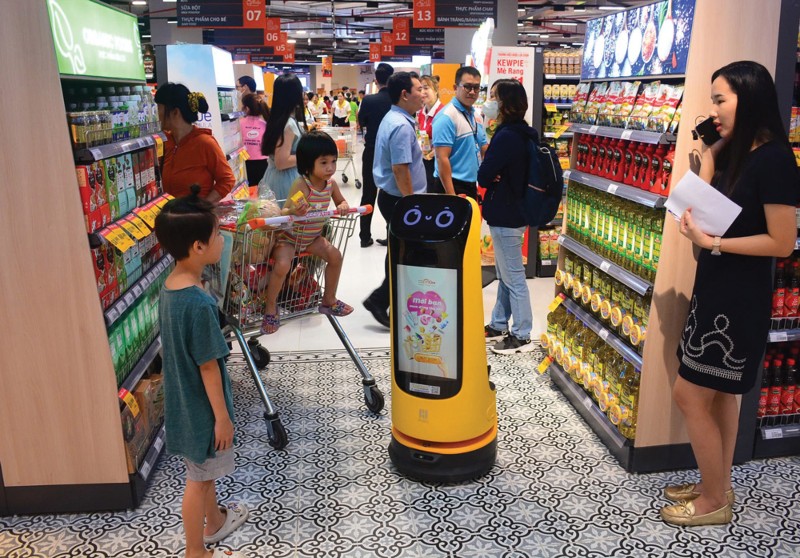
In Vietnam, Saigon Co.op officially opened its Coopmart Thong Nhat supermarket in Thu Duc city, Ho Chi Minh City, in late 2025, introducing AI-powered robots to assist shoppers. “Customers can issue voice commands or interact directly with the robot, which guides them to the desired product category while recommending related promotions,” said Mr. Nguyen Ngoc Thang, Deputy General Director of Saigon Co.op.
Similarly, WinMart has deployed self-checkout kiosks at selected supermarkets in Hanoi and Ho Chi Minh City, while GS25 has been piloting facial recognition payment technology.
According to the Vietnam E-Commerce Association, more than 80 per cent of e-commerce businesses in Vietnam now use chatbots or automated customer service systems. A large proportion of these companies report that chatbots handle most routine customer interactions, from product recommendations to order completion.
- The latest Visa Consumer 360 study, which surveyed 1,000 consumers in Vietnam, revealed that Vietnamese consumers are entering the next phase of digital commerce with a level of confidence and readiness that sets them apart in the Asia-Pacific.
- As confidence grows, consumers are increasingly embracing digital-first shopping and payment methods, positioning Vietnam at the forefront of the region’s evolving commerce landscape. The country also stands out for its strong interest in AI-assisted shopping and cross-border payments.
- Visa Consumer 360 found that 57 per cent of Vietnamese consumers are open to using AI agents to shop online, compared with the Asia-Pacific average of 50 per cent. These tools can streamline product searches, comparisons, and purchases, although concerns over data privacy, accuracy, and unauthorized payments remain, highlighting the importance of trust as AI becomes more deeply integrated into everyday commerce.
At the same time, NielsenIQ found that more than 70 per cent of Vietnamese consumers are willing to embrace automated shopping experiences when available. These figures underscore AI’s growing role as a competitive advantage for retailers.
People still at the center
As retail systems become capable of remembering, tracking, and analyzing virtually every purchasing decision, new concerns inevitably arise. Are consumers being monitored too closely? Shoppers often have little way of knowing whether AI-generated recommendations genuinely reflect the best product for their needs or simply prioritize items backed by larger advertising budgets. As a result, many governments are tightening regulations governing consumer data and AI applications in retail.
Culture presents another challenge, as shopping remains a deeply social activity. In Japan, the philosophy of “omotenashi” has long defined the country’s service culture. In China, concepts of personal relationships and social status continue to shape purchasing decisions, particularly in premium market segments.
Across Thailand, Vietnam, and Indonesia, friendly face-to-face interactions between sales staff and customers remain an essential part of the retail experience.
Ms. Nguyen Phi Van, Chairwoman of Retail & Franchise Asia in Vietnam, believes technology can enhance customer experiences but cannot fully replace the human element. Consumers may interact with machines, but they still seek reassurance that a real person ultimately stands behind each transaction. A chatbot may provide rapid responses, but it cannot assume responsibility.
According to Mr. Lam Quang Nam, Vice Chairman of the Vietnam Software and IT Services Association (VINASA), in this new stage of development, AI and people will work together within a collaborative ecosystem. He argued that while companies may adopt the same technologies, only some succeed in creating a lasting competitive advantage, whereas others fail to realize the anticipated benefits. “This is not a journey from people to machines,” he said. “It is a transition from using AI as a tool to redesigning how businesses operate in the digital era.”
The Vietnam - Asia DX Summit 2026 in May heard that Vietnam’s enterprise AI market is expected to expand at a CAGR of 31 per cent between 2026 and 2034, while 78 per cent of the country’s online population already uses AI.
Vietnam’s retail sector also benefits from an increasingly supportive policy environment. Politburo Resolution No. 68 provides new momentum for private sector development, while Politburo Resolution No. 57 promotes innovation and digital transformation. Together, these initiatives are expected to improve businesses’ access to capital, technology, markets, and other strategic resources, enabling retailers to accelerate their digital transformation in the years ahead.









 Google translate