


As Vietnamese businesses generate more data and expand their use of AI, many are exploring hybrid storage models that combine on-premises infrastructure with public cloud services.
Ms. Jola Le, Vietnam Country Manager at Synology, said the two approaches serve complementary needs, with the right balance depending on an organization’s workloads, security requirements, and business continuity priorities. “For many Vietnamese businesses, a hybrid approach is practical: retain critical or frequently-accessed data locally while using cloud services for selected applications and off-site protection,” she explained.
This model allows businesses to maintain greater control over sensitive data while benefiting from the flexibility of cloud services, helping them balance performance, security, and cost.
Balancing control and flexibility
Public cloud platforms such as Amazon Web Services (AWS), Google Cloud, and Microsoft Azure offer extensive services, flexible computing resources, and global infrastructure, making them well suited to cloud-native applications, fluctuating workloads, and geographically-distributed operations. On-premises storage, by contrast, gives organizations greater direct control over where data is stored, who can access it, and how it is managed and protected.
According to Ms. Jola, businesses should assess the full lifecycle costs of each model rather than comparing initial investments alone. “An on-premises deployment requires upfront investment in hardware and drives, along with electricity, maintenance, replacement planning, IT support, and an off-site backup strategy,” she said. “Cloud storage generally reduces the initial infrastructure commitment, but ongoing charges for capacity, data transfer, retrieval, support, and related services can become significant depending on usage.”
For businesses handling sensitive information or running performance-intensive applications, keeping frequently accessed data close to operational teams can deliver local-network performance while maintaining direct oversight of the infrastructure. However, this approach also requires investment in hardware, maintenance, physical security, connectivity, and capacity planning.
Cloud services can reduce upfront infrastructure costs, but recurring fees may accumulate over time. For organizations with predictable data growth, frequent access to large files, and existing IT infrastructure, on-premises storage may offer greater visibility into long-term costs. A hybrid model allows businesses to allocate workloads between local infrastructure and cloud services according to their operational needs, rather than relying exclusively on either environment.
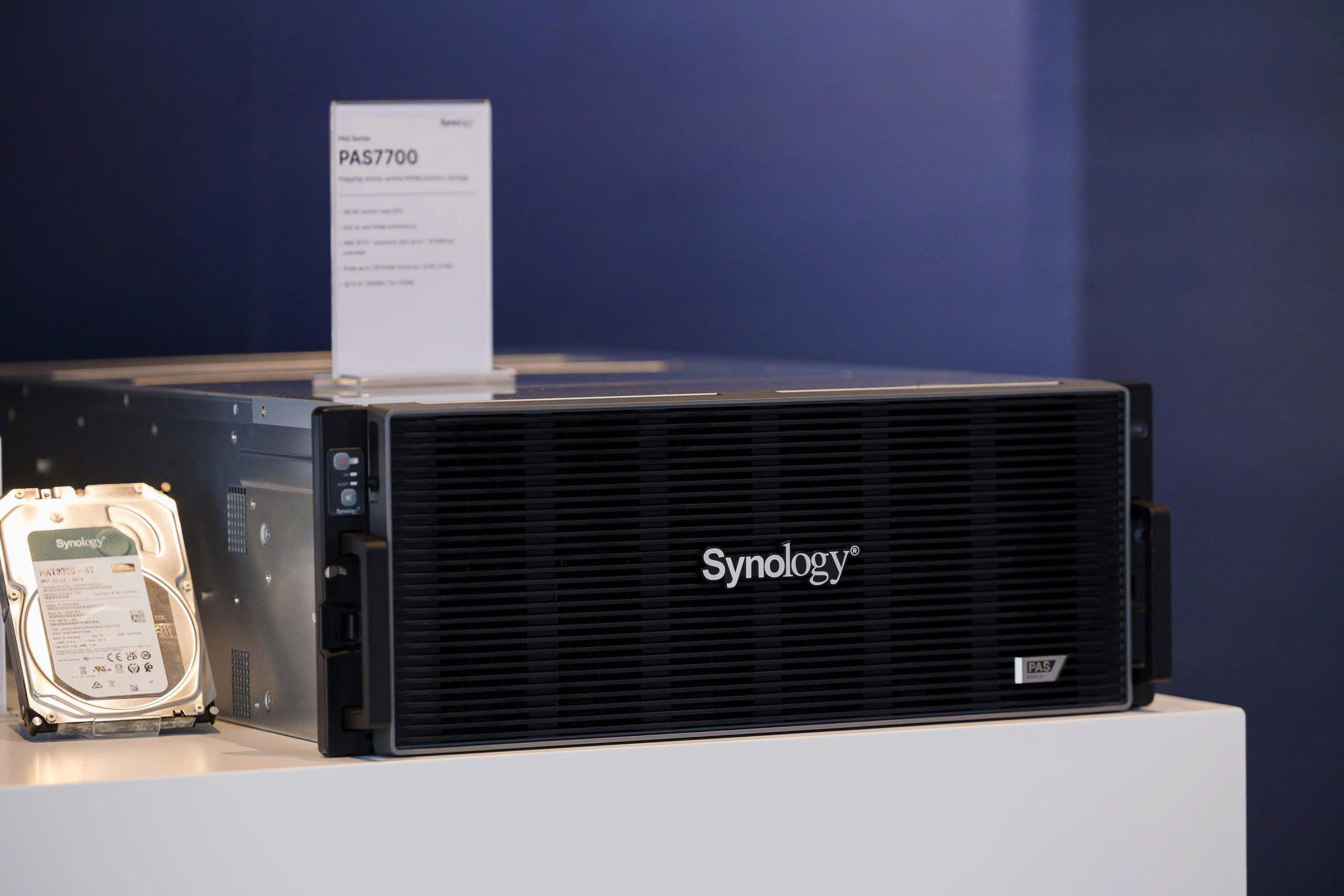
As businesses modernize their infrastructure, performance, scalability, and availability become increasingly important for applications that cannot tolerate prolonged disruption. Synology’s enterprise portfolio includes the PAS7700, an all-flash NVMe storage system designed for demanding enterprise workloads.
The PAS7700 features an active-active architecture in which both storage controllers operate concurrently. The system is designed to deliver high performance, scalability, and continuous availability for mission-critical applications that require reliable access to data. Its all-flash NVMe design targets workloads requiring fast data access, while its scalable architecture accommodates changing capacity and performance requirements as businesses grow.
These capabilities are relevant to organizations running data-intensive operations. Manufacturers, for example, may depend on timely access to production records and operational systems, while professional services firms need reliable access to confidential documents. Larger enterprises may also need to centralize storage and data protection across multiple locations.
Synology’s portfolio also includes scalable business storage solutions and ActiveProtect, which provides centralized data protection and recovery. Together, these offerings address different requirements, from day-to-day data access to safeguarding information and restoring operations following disruptions.
The choice of infrastructure ultimately depends on workload characteristics, projected data growth, and the level of resilience required. Rather than applying a single architecture to every application, businesses can retain latency-sensitive or frequently-accessed data on-premises while using public cloud services for selected applications, additional capacity, and off-site data protection. This approach can help organizations balance performance, control, and cost while retaining the flexibility to adapt as their needs evolve.
Vietnam’s evolving data storage needs

The shift toward remote work and geographically-distributed operations has increased demand for secure access to business information beyond the office. Synology supports centralized data management, controlled remote access, and file sharing across locations, allowing organizations to establish access policies based on team responsibilities and information sensitivity.
This approach can provide many of the conveniences associated with cloud-based services while allowing businesses to retain greater control over their storage infrastructure. Employees can access approved information from authorized devices without carrying physical storage equipment. However, remote access still depends on system availability, internet connectivity, network configuration, and sufficient bandwidth.
Effective data protection also requires more than deploying storage hardware. Organizations need clear procedures for access management, security updates, backup verification, and recovery. As systems become more complex or business-critical, dedicated IT oversight or support from a qualified service partner becomes increasingly important.
Ms. Jola expects businesses to remain a major driver of demand for private and hybrid storage solutions in Vietnam, particularly small and medium-sized enterprises seeking more structured data governance and larger organizations developing multi-site infrastructure. Professional content creators and small studios managing substantial volumes of media files may also find these solutions relevant.
Ultimately, the key consideration is not simply where data is stored, but whether organizations can maintain control, resilience, and flexibility as their operations evolve.
Alongside its focus on enterprise storage and data protection, Synology is strengthening its local service support. On October 22, the company announced a partnership with FPT Services (FPT Information System Services Co., Ltd), authorizing the Vietnamese company to provide warranty and technical support for Synology products in Vietnam.
Under the agreement, FPT Services will receive, inspect, and process warranty claims and provide related services in accordance with Synology’s established procedures, standards, and scope of authorization.
The partnership aims to safeguard customer interests and enhance Synology’s after-sales services in Vietnam, providing local support as businesses increasingly rely on data infrastructure for daily operations and long-term digital development.





 Google translate