


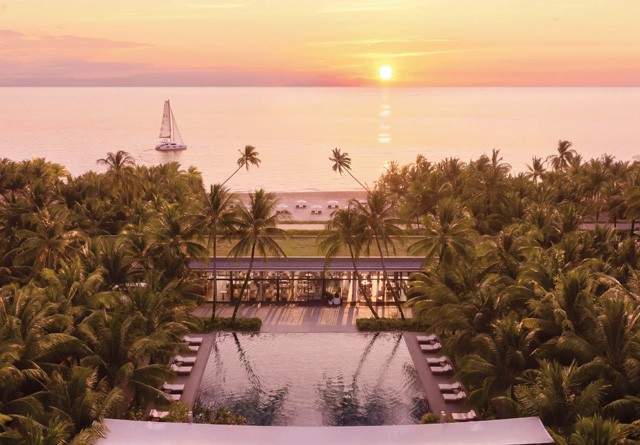
The Politburo recently issued Resolution No. 26-NQ/TW, setting out a direction for developing Vietnam’s tourism into a key economic sector in the new era. Among the targets for 2030 is a figure appearing for the first time in a Politburo resolution on tourism: around 1.5 million tourism accommodation rooms. This is the highest quantitative target ever set for the country’s accommodation capacity.
Supply gap
According to published data, the country’s accommodation capacity increased from around 256,000 rooms in 2011 to around 780,000 rooms in 2021, for an average increase of some 52,000 rooms a year. This period included the rapid development of tourism apartments and villas between 2015 and 2019.
The Vietnam Real Estate Market Research Institute (VARS IRE) at the Vietnam Association of Real Estate Brokers (VARS) estimates that, using 2021 as the starting point, the market would need to add around 720,000 rooms over the nine-year period, or about 80,000 rooms a year, to reach 1.5 million by 2030. This is around 1.5-times the pace recorded in 2011-2021, though comprehensive accommodation capacity data for 2022-2026 has not yet been published.
According to the Ministry of Culture, Sports and Tourism, the country had around 40,000 accommodation establishments with approximately 800,000 rooms at the beginning of 2026. Using this as the starting point, another 700,000 rooms would need to be added over five years, from 2026-2030 - about 140,000 rooms a year, or nearly three-times the pace of the previous decade.
The two calculations produce different figures but point to the same conclusion: the accommodation development model of the past decade will not be enough to meet the new target.
From 2017, when Politburo Resolution No. 08-NQ/TW on the development of tourism into a spearhead industry was issued, through June 2026, the country had approximately 146,438 tourism apartments and villas. The entire stock developed over nearly two decades represents only 9.8 per cent of the 1.5 million-room target. More importantly, most of these units have been built but are not operating as accommodation properties in any meaningful sense.
This points to two realities. First, tourism apartments and villas cannot close most of the gap; hotels, large-scale integrated developments and other accommodation formats will still need to provide most of the new capacity. Second, Vietnam cannot reach 1.5 million rooms through traditional hotel development alone without mobilizing private capital through transferable products.
One notable fact is that around 5,250 tourism apartments were offered for sale nationwide in the second quarter of 2026, but only 145 were successfully transacted, just one in every 36 units brought to market. This shows that, amid weak market liquidity, the challenge is not simply to add accommodation supply. It is also to resolve legal issues, unlock capital, and improve the operating efficiency of existing resort assets.
More than 88 per cent of primary supply in the second quarter of 2026 consisted of inventory carried over from previous launches. Many projects have not yet received certificates, preventing secondary investors from transferring or mortgaging their units, while operators lack capital. Bringing these assets back into operation would not require additional land or significant construction capital. It would primarily require resolving legal obstacles. This is the fastest and least expensive source of additional accommodation capacity available under Politburo Resolution No. 26.
Ambitious target
The Resolution places tourism among the sectors expected to “contribute to the goal of double-digit growth,” with targets of 45-50 million international visitors and 160 million domestic travelers by 2030 set. Vietnam welcomed nearly 21.2 million international visitors in 2025, according to the National Statistics Office at the Ministry of Finance, and 15.9 million in the first eight months of 2026, up 14.4 per cent year-on-year. Visitor numbers are growing faster than room supply, and the accommodation target is intended to ensure that supply keeps pace.
VARS-IRE estimates that adding 720,000 rooms would require around VND1,080-1,800 trillion ($41.5-69.2 billion), based on investment costs of VND1.5 billion-VND2.5 billion ($57,692-$96,154) per room. These costs cover construction and equipment but exclude land acquisition and connecting infrastructure. This translates into VND120-200 trillion ($4.6-7.7 billion) a year over the period.
To put the scale into perspective, total tourism receipts exceeded VND1,000 trillion ($38.5 billion) for the first time in 2025. Building the additional rooms alone would require capital equivalent to one to nearly two years of the tourism industry’s total receipts, excluding land costs.
The State budget cannot cover this amount, while domestic businesses cannot shoulder it alone. This is why three capital mobilization directions outlined in Politburo Resolution No. 26 are particularly significant. First, tourism would be added to the list of sectors eligible for investment incentives. Second, the resolution calls for “converting the value of tourism resources into development resources through appropriate tools and methods for mobilizing capital in the capital market.” Third, it proposes controlled pilot mechanisms to attract international capital into tourism and resort development.
For developers, the second direction is particularly significant. For the first time, a Politburo resolution opens the door to financial instruments linked to tourism operating cash flows, such as tourism real estate investment funds and securitization of operating revenues. If institutionalized, these could provide a long-term source of capital to supplement the two sources on which the segment has relied over the past decade: bank credit and customer pre-payments.
Politburo Resolution No. 26 also provides a clearer spatial development framework than Politburo Resolution No. 08. The three growth poles are Hanoi, Ho Chi Minh City, and Da Nang, while Phu Quoc is gradually emerging as a new growth pole. The country will have ten key tourism centers and 20 national tourism zones, while large-scale accommodation facilities will be encouraged outside urban areas. By product type, four groups will be affected differently.
Tourism apartments and villas stand to benefit most directly from policies allocating land and introducing controlled pilots, but the extent of the benefit will depend on resolving land-use rules and certificate issuance.
Serviced apartments and office-apartment developments will benefit from the policy direction targeting “long-stay visitors and remote workers,” a group appearing for the first time in a Politburo resolution.
Hotels and integrated tourism, cultural, sports, entertainment, and retail developments will benefit from the focus on ecosystems and the nighttime economy. This is a segment for strategic investors with strong financial and management capabilities.
Emerging accommodation formats such as farmstays, agricultural accommodation, and community-based lodging are also expected to receive support, but the lack of a legal framework means the risk of unplanned development remains.
Geographically, Phu Quoc stands to benefit the most, but it is also where the risks of land-price inflation and development outpacing infrastructure capacity will need to be closely managed. The three growth poles will require more serviced apartments, upscale hotels, and multifunctional developments than individually-sold tourism apartments. Meanwhile, the ten tourism centers and 20 national tourism zones represent an opportunity for large-scale projects outside urban areas, provided the list is announced early enough to give investors greater certainty.
Three milestones to watch
However, not everyone views the accommodation target as a real estate opportunity. During 2015-2019, the market at times reversed the sequence: building rooms first and then looking for guests, selling products based on profit guarantees rather than actual operating performance. The result is much of the inventory seen today. Politburo Resolution No. 26 sets accommodation, visitor, and total tourism revenue targets together, and the three figures need to be considered as a whole. Rooms without guests are a cost, not capacity.
One limitation of the calculation above should also be acknowledged. The 1.5 million-room target does not yet come with a statistical definition: does it include homestays, homes with rooms for rent, agricultural accommodation, and other formats? A broader definition would narrow the gap, while counting only classified accommodation establishments would make it wider. Tourism authorities need to clarify this soon, because every capital and land-use plan starts with this definition.
For developers and brokerage firms, there are three milestones to watch over the next 12 months. First, the list of ten key tourism centers and 20 national tourism zones should be announced, together with corresponding commercial and service land targets in provincial planning and land-use plans. Second, the draft amended Law on Real Estate Business, currently under consultation, should use a consistent name for this product category and clarify whether it will include provisions on profit guarantees and operating agreements. Third, unified guidance should be issued nationwide on granting certificates for non-residential structures on commercial and service land.
Until these three steps are taken, 1.5 million rooms will remain a figure only on paper, while the market will continue to record transactions in the hundreds against a target measured in millions.
(*) Dr. Nguyen Van Dinh is Vice Chairman of the Vietnam Real Estate Association, Chairman of the Vietnam Association of Real Estate Brokers (VARS), and Director of the Vietnam Real Estate Market Research Institute (VARS IRE).



 Google translate