


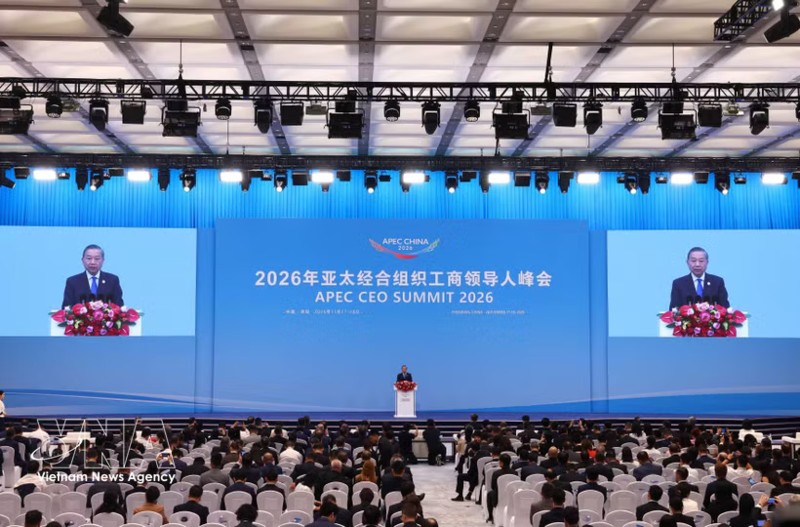
General Secretary and President To Lam of Vietnam has urged APEC businesses and international investors seeking to expand cooperation in strategic sectors, establish long-term strategic partnerships, share knowledge and technology, strengthen business capacity and create new value, reported the Vietnam News Agency.
In his remarks at the APEC CEO Summit 2026 on November 18 as part of the 2026 APEC Economic Leaders’ Week in Shenzhen, China, the top Vietnamese leader said Vietnam is committed to protecting investors’ legitimate rights and interests and building a stable, transparent and predictable business environment.
He affirmed that the country will continue strengthening institutions, upgrading infrastructure, developing high-quality human resources, and working closely with businesses to address their challenges, stressing that the success of the business community is also the success of Vietnam.
Sharing Vietnam’s 40-year Doi moi (Renewal) journey with the business community, he described it as a historic decision that fundamentally transformed the country’s development trajectory, creating a dynamic, globally integrated economy and significantly improving living standards for its people.
From an economy that faced numerous challenges, with limited productive capacity and weak international integration prior to the launch of Doi moi, Vietnam has emerged as one of the world’s 32 largest economies, with GDP exceeding $500 billion. The country is now a key global manufacturing and export hub, particularly in electronics and processing and manufacturing industries, while its modern services sector continues to expand rapidly.
The key lessons from this journey, he noted, are that reform generates momentum for development, openness creates new opportunities, and international integration enables economies to prosper together.
Vietnam’s Doi moi has strongly aligned with APEC’s vision and has benefited greatly from the forum’s support. From being a latecomer to international integration, the country has evolved into an active and responsible partner, working alongside other members to strengthen cooperation frameworks and shape the region’s future development.
As it enters a new era of growth, Vietnam has chosen a development model founded on self-reliance, innovation, inclusiveness, sustainability, and international integration, laying a solid foundation for achieving its long-term development aspirations toward 2045.
He noted that this development model is closely aligned with APEC’s priorities, particularly in unlocking new growth drivers through science and technology, innovation, and digital transformation; advancing comprehensive reforms to mobilise and utilise development resources more effectively; and ensuring that development is linked to people’s well-being by upholding humanistic values and harnessing the soft power of culture.
At the same time, Vietnam remains steadfast in pursuing a foreign policy of independence, self-reliance, self-strengthening, peace, friendship, cooperation and development. The country continues to diversify and multilateralise its external relations, proactively advance comprehensive and effective international integration, and promote dialogue, build trust and deepen cooperation among nations.
General Secretary and President Lam highlighted three major shifts that are reshaping the global development landscape and profoundly affecting businesses worldwide.
First, the simultaneous and persistent occurrence of multiple crises has created an environment of chronic instability and uncertainty, eroding economic resilience and weakening trust among countries.
Second, the rapid advancement of artificial intelligence is transforming economies and societies on an unprecedented scale, creating both significant opportunities and complex challenges.
Third, the limitations of traditional growth models, combined with widening social inequalities, are undermining public confidence in national institutions and international organisations.
Against this backdrop, he called on APEC members to pursue three strategic priorities: leading efforts to foster an open and inclusive trade and investment environment; generating new momentum for regional economic integration and connectivity while unlocking emerging development opportunities; and placing the prosperity of people and businesses at the heart of cooperation initiatives.
He also stressed that APEC should continue to serve as an open and constructive platform for strategic dialogue, helping bridge differences, reduce tensions and promote practical, mutually beneficial solutions to shared challenges.
General Secretary and President Lam called on businesses to continue leading innovation and technology adoption and improving productivity; proactively expand investment, connect markets and build resilient, sustainable value chains; and share knowledge, technology and development opportunities, particularly with small and medium-sized enterprises.
More importantly, the business community should engage more deeply in policymaking and implementation, proposing practical solutions to ensure that APEC truly becomes a space for cooperation, innovation and shared prosperity.
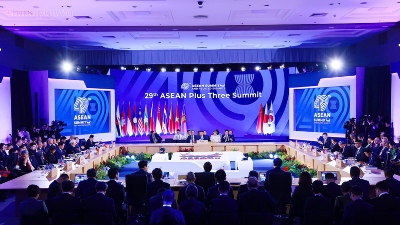
The APEC CEO Summit is a major annual event on the APEC calendar, providing a platform for dialogue between leaders and the business community on strategic issues affecting regional and global economic development. It also helps strengthen links between policymaking and the practical needs of businesses.
This year’s summit brought together nearly 2,000 delegates, including senior leaders of APEC economies and representatives of leading businesses from around the world and the Asia-Pacific region. Among them were 115 companies ranked among the world’s 500 largest corporations by revenue.
 Google translate