


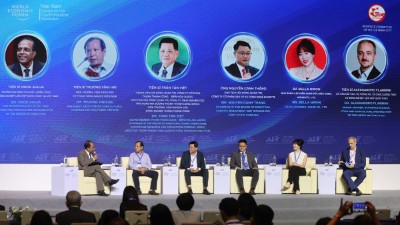
During the discussion session “Repositioning Vietnam - ASEAN in Global Value Chains” on October 27, co-organized by the World Economic Forum (WEF) and the Fourth Industrial Revolution Center in Vietnam (C4IR), in the framework of the Autumn Economic Forum 2026 in Ho Chị Minh City, representatives from businesses, international organizations, and regulatory agencies pointed out that attracting investment in the ASEAN region is just the beginning.
The greater challenge is how domestic enterprises can participate more deeply in the regional production network, enhance added value, and better utilize the capital and technology flows moving into ASEAN.
ASEAN attracts investors but internal connectivity remains limited
According to Mr. Kyriakos Triantafyllidis, Head of Growth and Strategy, Centre for Advanced Manufacturing and Supply Chains, under the World Economic Forum (WEF), ASEAN currently has about 700 million people, with a combined economic scale of $4.3 trillion. By 2025, the region was expected to attract $245 billion in FDI, a 10 percent increase from the previous year.
The proportion of foreign-origin value in Vietnam's exports increased from about 33 percent in 2010 to nearly 50 percent in 2022. This indicates that Vietnam's exports are increasingly dependent on imported materials, components, and inputs.
To create more value domestically, Vietnam needs to enhance the capacity of local enterprises to participate more deeply in supply chains and become tier-1 suppliers for FDI corporations. On a regional scale, intra-ASEAN trade accounts for only about one-fifth of the region's total trade turnover, indicating that member economies still have significant room to strengthen connectivity and production cooperation.
These issues require ASEAN not only to continue attracting investment and expanding exports but also to develop the capacity of local enterprises, strengthen supply chain links within the region, and participate more deeply in high-value stages such as technology, design, and product innovation.
Expert perspectives on trade and investment potential
Mr. Sacha Dray, an Economist at the World Bank in Economic Policy Unit for Vietnam, agreed that ASEAN has a favorable foundation for trade and investment development, with abundant labor, high trade openness, and an extensive network of trade agreements. However, the region has not yet fully exploited the benefits of integration.
In terms of production, ASEAN has deeply participated in the global value chain, from automobile and electric vehicle production in Thailand, assembly in Vietnam, to semiconductor manufacturing, testing, and packaging in Malaysia and Singapore. However, the intra-regional value chain remains limited: global value chain participation based on regional links accounts for only about one-third in ASEAN, compared to 70 percent in the EU.
Specifically, of ASEAN’s total export turnover of about $2 trillion, only 22 percent is consumed within the region, compared to about 60 percent in the EU. This makes ASEAN economies more dependent on external demand, while also limiting the ability to spread benefits among countries in the region.
According to Mr. Dre, the income disparity among member countries - where the gap between the poorest and richest nation reaches up to 70 times, compared to eight times in the EU- also creates uneven market demand and resource allocation. To bridge this gap, he suggested increasing cross-border investment among ASEAN countries, connecting foreign enterprises with local suppliers, and removing non-tariff barriers.
Business views on ASEAN’s appeal
From a business perspective, Ms. Jessica Nguyen, General Director, Country Holding Officer, and Board Chairwoman of ABB Vietnam, believes that ASEAN’s appeal comes from three factors: market size; increasingly developed production capacity; and regional connectivity.
According to her, ASEAN no longer competes solely on low labor costs. Evidence is that Vietnam, Thailand, Malaysia, and Indonesia are investing more in advanced manufacturing, digitization, and developing technical human resources. At the same time, trade agreements and regional connectivity allow businesses to build supply chains across multiple countries instead of being limited to a single market.
Trust in the supply chain is built through quality, traceability, reliability, and product consistency. These are the conditions for Vietnamese suppliers to transition from fulfilling orders to becoming partners with higher technical and management capabilities.
However, after more than 32 years of operation in Vietnam, ABB observed that technology and machinery can be acquired relatively quickly, whereas operational and management capabilities take time to build. “The long-term value that multinational corporations bring is not just automation equipment, but also operational knowledge, global standards, and the ability to build resilient supply chains,” Ms. Nguyen emphasized.
Policy recommendations for supplier development
From a state management perspective, Ms. Pham Quynh Mai, Deputy Director General of the Multilateral Trade Policy Department under the Ministry of Industry and Trade, noted that reducing tariffs is not enough to promote regional trade. ASEAN countries need to address behind-the-border barriers, including customs procedures, standards, certifications, logistics, and differences in rules of origin among trade agreements.
According to her, the time and costs incurred at each stage, from sourcing materials, organizing production, meeting rules of origin to transportation and delivery, all affect the efficiency of the entire supply chain. Therefore, ASEAN needs to enhance information exchange, improve enforcement capacity, and limit the duplication of inspection and certification procedures.
For Vietnam, she proposed building a national supplier development program involving the Ministry of Industry and Trade, local governments, industry associations, and FDI enterprises. This program would help small and medium-sized enterprises access finance for technology investment, production upgrades, and workforce training.
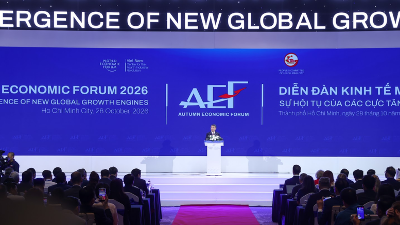
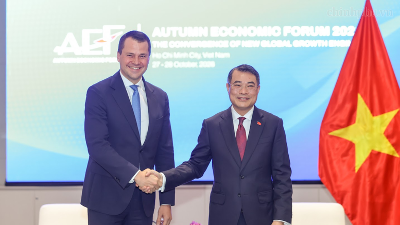
The Autumn Economic Forum 2026, themed “The Convergence of New Global Growth Poles,” took place from October 26 to October 29 in Ho Chi Minh City, directed by Prime Minister Le Minh Hung and chaired by the Ho Chi Minh City People’s Committee in collaboration with C4IR.

 Google translate