


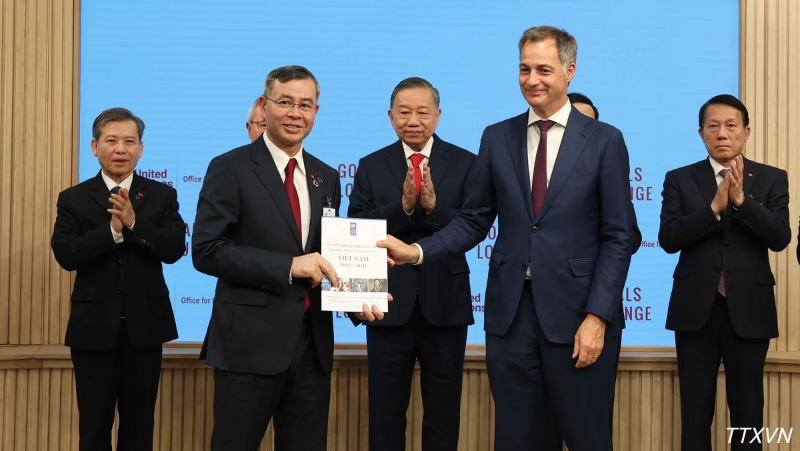
A formal ceremony took place in New York on September 22 (local time) during the UN General Assembly High-level Week at the special event “Rising Together: Vietnam-UN Partnership for Sustainable Development,” hosted by Party General Secretary and State President To Lam, who has been on a trip to attend the High-Level General Debate of the 81st Session of the United Nations General Assembly (UNGA 81) and conduct bilateral activities in the US.
During the event, Vietnamese Minister of Finance Ngo Van Tuan handed over the new CPDs to UNDP Administrator Alexander De Croo, UNFPA Executive Director Diene Keita, and UNICEF Executive Director Catherine Russell.
Meanwhile, Vietnamese Deputy Minister of Foreign Affairs Dang Hoang Giang and UNDP Administrator Alexander De Croo exchanged an agreement amending and supplementing the 2012 agreement between the Vietnamese Government and the UNDP on the renovation, upgrade, and use of the Green One UN House in Hanoi.
The three strategic frameworks outline how these key UN agencies will collaborate with the Vietnamese government and local partners over the next five years. The initiatives directly support national development objectives as Vietnam pursues high-income developed country status by 2045 and targets net-zero emissions by 2050, while navigating digital transformation, climate change, and demographic shifts.
Under the individual strategic plans for 2027-2031:
UNDP will focus on four core pillars: climate action and environmental sustainability, economic and digital transformation, inclusive human development, and governance and the rule of law. The agency aims to scale policy solutions, strengthen institutions, and drive an inclusive, resilient economic transition.
UNFPA will address demographic transitions - specifically rapid population ageing - by promoting evidence-based policy making, expanding access to sexual and reproductive health services, and combating gender-based violence.
UNICEF will center its efforts on child protection, equitable access to quality education, health, and social protection services, alongside climate-resilient initiatives tailored to safeguard vulnerable children.
Speaking at the ceremony, General Secretary and President To Lam, as quoted by the Vietnam News Agency, appreciated the invaluable support and cooperation that UN organisations have extended to Vietnam over the years.
He emphasised that these contributions are significant not only in terms of resources but, more importantly, through the sharing of knowledge, experience, and innovative ideas and solutions, all of which have helped improve the people's quality of life and solidify the foundation for the country's sustainable development.
He affirmed that the signing and exchange of the Country Programme Documents for 2027–2031 mark the beginning of a new chapter in the partnership between Vietnam and the three UN organisations. This serves not only as a framework guiding programmes for the next five years but also as a strong commitment to translating strategic goals into concrete actions and tangible results that bring practical benefits to the people.
Stressing the 2027–2031 period as pivotal for Vietnam following 40 years of Doi Moi (Renewal), the Vietnamese leader stated that the country is striving for a breakthrough to achieve its 2030 development goals, thereby laying the groundwork to realise the aspiration of becoming a developed nation with modern industry and high income by 2045.
On this journey, Vietnam looks to the UNDP, UNICEF, and UNFPA to continue leveraging their respective strengths, expertise, and global networks in partnering with the country in development model innovation, digital and green transitions, resilience building, adaptation to population aging, and the empowerment of women and youth, he stated.
General Secretary and President Lam expected these three UN agencies to remain trustworthy partners, facilitating Vietnam's access to advanced knowledge, technology, and resources, while strengthening internal coordination within the UN system to generate comprehensive and long-lasting impacts.
Vietnam will remain an active, proactive, and responsible member of the international community, he said, adding that it will continue to provide headquarters facilities to UN organisations in the country free of charge, and also welcomes these bodies to establish national or regional representative offices and to host major global events in Vietnam.
The country stands ready to share its development experience with other nations through cooperation mechanisms, working together towards a peaceful, prosperous, inclusive, and people-centered world, the top leader remarked.
In their speeches, the heads of the UNDP, UNICEF, and UNFPA expressed admiration for Vietnam’s development journey and outstanding achievements, pledging to continue supporting the country in seizing epoch-defining opportunities in a timely manner.
They expressed their hope that Vietnam will actively share its development experience through South–South and trilateral cooperation mechanisms, and that it will make even greater contributions to the shared development goals of the international community.
 Google translate