


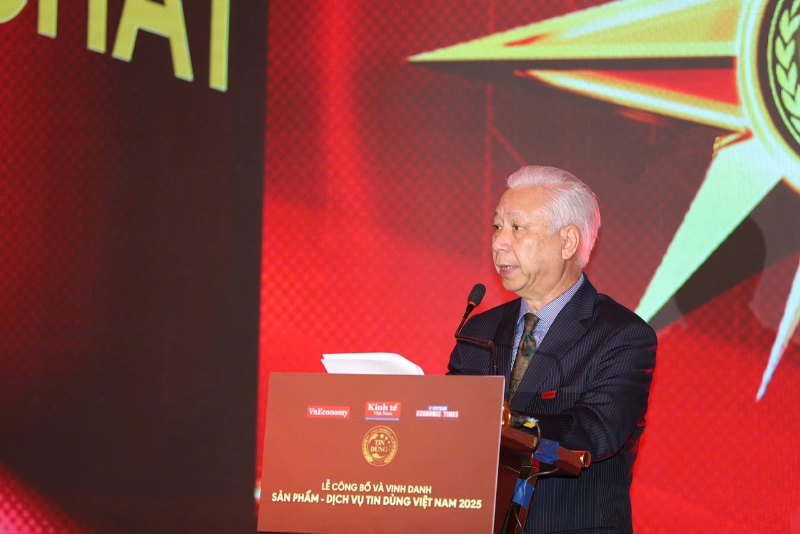
The Vietnam Consumer Program 2025, hosted by Tap chi Kinh te Viet Nam / Vietnam Economic Times/VnEconomy, was launched in Hanoi on December 18 afternoon, with the participation of representatives from state agencies, industry leaders, and a large number of businesses.
In the opening remarks of the event, Journalist Dao Quang Binh, Vice Chairman of the magazine's Editorial Board, and General Managing Editor, and Head of the Progam's Organizing Committee, stated that in the context of the digital economy that has become a new growth driver, transparency in information is playing an increasingly important role in market management, combating commercial fraud, and enhancing the competitiveness of Vietnamese enterprises.
According to Mr. Binh, promoting sustainable consumption and environmental protection is one of the five key tasks of the retail sector in 2025. This, he said, includes developing a fast and sustainable retail system primarily aiming at promoting digital transformation and developing modern retail models, enhancing consumer experience, and optimizing supply chain management.
In this context, transparency in traceability is not only a condition to gain customer trust but also a mandatory legal requirement as new management frameworks are gradually forming.
The National Assembly on June 18, 2025, passed the amended Law on Product and Goods Quality, which includes the addition of the concept of a "digital passport" for products. According to the roadmap, from January 1, 2026, all products circulating in the market must comply with regulations on traceability and information transparency.
"This is both an opportunity and a challenge for businesses. Those who proactively invest in and take the lead will have a superior advantage in building trust, optimizing supply chains, and enhancing competitiveness in both domestic and international markets," Mr. Bính emphasized.
Furthermore, transparency should not stop at merely complying with regulations but should also be strategically communicated. Therefore, businesses need to proactively communicate about transparency, helping customers understand the quality control process, business philosophy, and efforts to protect consumer rights, thereby establishing a sustainable and two-way relationship with the market.
On the consumer side, according to a survey by Nielsen IQ Vietnam, conscious consumption will be the key in the coming period. Future consumers will choose products and brands based on values they resonate with, not only in terms of quality but also sustainability, health, and social responsibility. These will be the values shaping the market in 2026 and beyond.
The central theme of the Vietnam Consumer Program 2025 is "True Quality – Real Trust." Accordingly, the program particularly honors products and services of good quality, with unique characteristics, while actively and proactively digitizing, ensuring transparency of information, and ensuring sustainable and responsible business activities.
Mr. Dao Quang Binh stated that the current period is a "purification" phase, marking a turning point for the Vietnamese retail market. Only by saying "no" to low-quality goods right from the supply source can we build a healthy market, protect consumer rights, and promote sustainable economic development.
Therefore, consumers need to be guided on how to check traceability codes. Retailers need to require fully certified sources of goods. Especially, businesses must consider product quality and information transparency as an indispensable part of their sustainable development strategy.
Throughout 19 years of implementing the program, Tap chi Kinh te Viet Nam/Vietnam Economic Times/VnEconomy has always strived to expand information channels connecting businesses with businesses, and businesses with consumers.
"With the year 2025 coming to an end and the new year 2026 approaching, we hope that businesses and brands will actively and proactively anticipate trends, leverage technology, and innovate to meet the increasingly high demands of consumers. This will contribute to increasing purchasing power, stabilizing the market, and boosting revenue growth," Mr. Bính emphasized.








 Google translate