


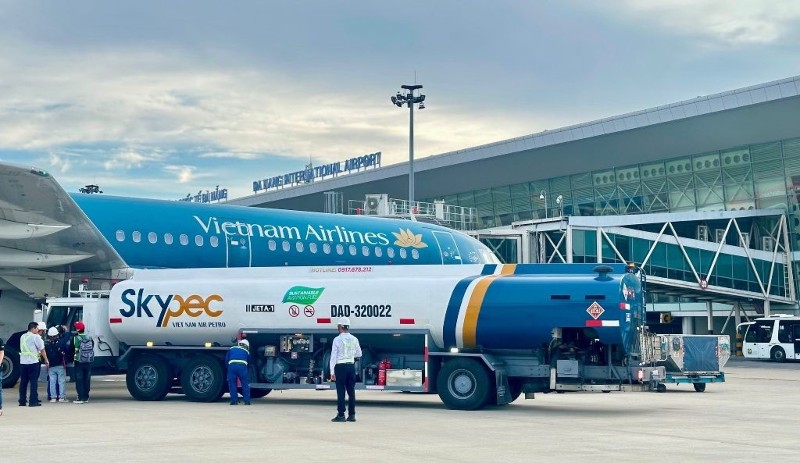
The Civil Aviation Authority of Vietnam (CAAV) is coordinating efforts to develop a roadmap for the adoption of Sustainable Aviation Fuel (SAF), while completing regulations on greenhouse gas emissions reduction in civil aviation, according to a report submitted to the Ministry of Construction.
The CAAV noted that the roadmap aims to prevent market and airline "shocks" during the transition to sustainable fuels.
On the regulatory front, the CAAV is drafting a circular outlining regulations on greenhouse gas emissions mitigation and environmental protection in civil aviation operations to seek feedback from relevant ministries and agencies. These regulations align with International Civil Aviation Organization (ICAO) standards and support Vietnam’s national commitment to achieving net-zero emissions by 2050.
In production, domestic enterprises have begun researching technologies and feedstocks for SAF processing. Petrovietnam has tasked BSR (Binh Son Refining and Petrochemical) and PVOIL with executing relevant initiatives. Specifically, BSR is exploring investment opportunities in SAF production using Hydroprocessed Esters and Fatty Acids (HEFA) technology, while PVOIL and the Vietnam Petroleum Institute (VPI) are researching used cooking oil (UCO) alongside alternative feedstocks.
PVOIL Trans has also engaged in collecting UCO and gained operational experience regarding ISCC EU certification. Meanwhile, BSR has successfully blended and sold a fuel consignment containing 5% SAF by combining imported SAF with its own domestically produced Jet A-1.
On the import and distribution side, Vietnam has achieved several milestones. According to the CAAV report, Petrolimex Aviation imported and supplied SAF for Vietjet flights departing from Tan Son Nhat International Airport in 2024 and engaged in SAF blending operations in 2025.
At Noi Bai International Airport, Noi Bai Aviation Fuel Service JSC (NAFSC) conducted an initial assessment indicating that existing infrastructure could potentially handle neat SAF or SAF-blended Jet A-1. However, the company highlighted the need for further evaluations concerning the compatibility of storage tanks, pipelines, equipment, and hydrant systems, as well as standards for quality, testing, certification, and traceability.
The CAAV noted that while Vietnam has established an initial foundation and gained early experience across parts of the SAF value chain, current activities do not yet constitute a fully integrated supply chain. Consequently, insufficient data exists to fully evaluate the feasibility of nationwide SAF deployment.
As the policy framework develops, the CAAV stated it is collaborating with energy firms, fuel distributors, and airlines on drafting committees for the relevant circulars. This ongoing collaboration enables industry stakeholders to provide direct input on the production, export, import, and consumption of SAF, as well as emissions reduction frameworks and carbon offsetting obligations under the Carbon Offsetting and Reduction Scheme for International Aviation (CORSIA).

 Google translate