


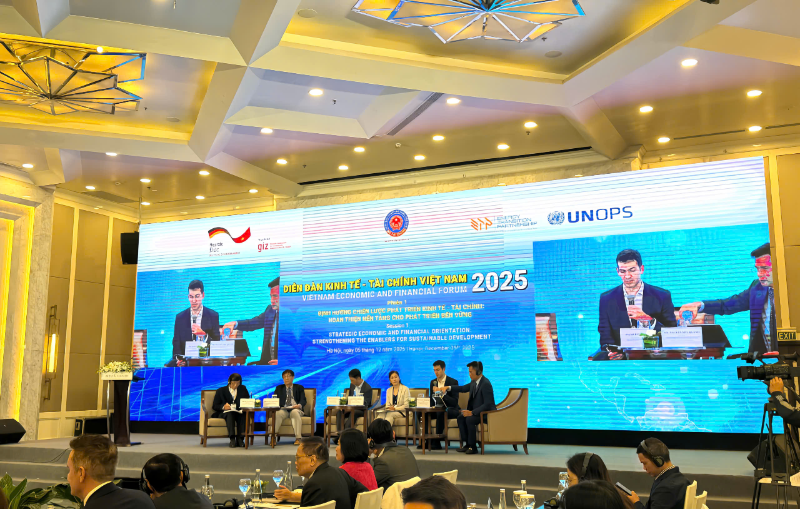
The Vietnam Economic–Financial Forum 2025 was held in Hanoi on December 5, featuring the theme “Positioning Vietnam in a new context and strategic economic–financial vision for 2026–2030.”
It was co-organized by the Ministry of Finance (MoF), the German Agency for International Cooperation (GIZ), and the United Nations Office for Project Services (UNOPS).
In his opening remark, Mr. Do Thanh Trung, Deputy Minister of Finance emphasized that Vietnam is entering a new development phase with more demanding strategic requirements, shaped by a fundamentally different environment. “This requires Vietnam to reposition itself, create breakthroughs in resource mobilization, renew its growth model, and expand development space in a sustainable manner,” he stressed.
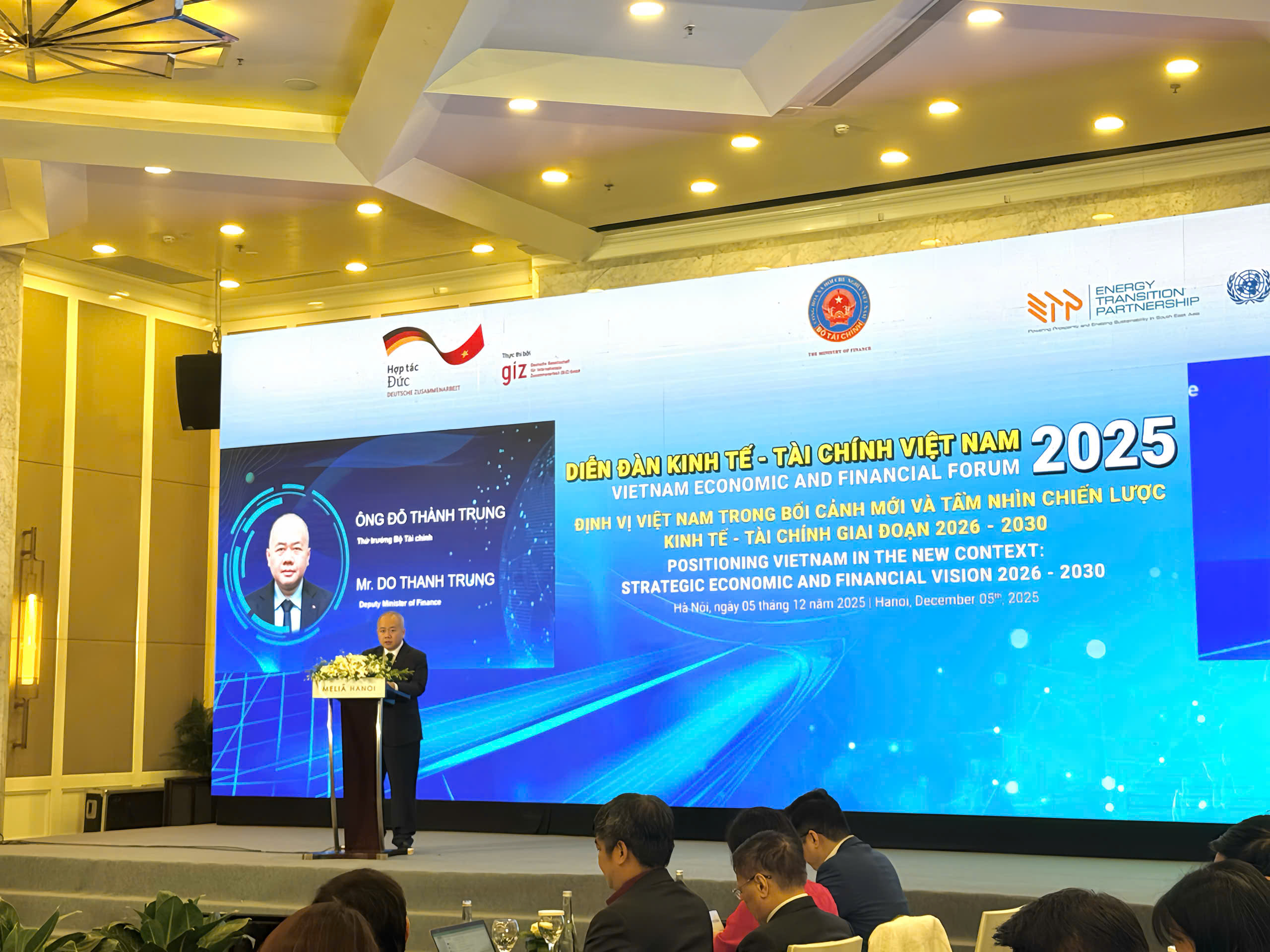
In order to achieve this, Deputy Minister Trung noted that Vietnam must establish a new growth model in which total factor productivity, investment efficiency, science–technology, and innovation form the core foundation. This model must harmoniously combine traditional drivers (investment, exports, labor) with new ones, such as the digital economy, green economy, knowledge economy, and circular economy.
Besides, a cohesive link among all economic sectors is essential. In which, the Gorvernment must play a enabling role in concentrating on strategic infrastructure and ensuring a transparent legal framework, while the private sector becomes a key engine of creativity and innovation, leading in digital industries, manufacturing, and high-quality services.
According to the Ministry of Finance, Vietnam’s GDP is projected to reach around $510 billion in 2025, up five places from the previous year, ranking 32nd globally and 4th in ASEAN.
At the same time, Deputy Minister Trung said that foreign direct investment (FDI) should be regarded as a selective, complementary source of capital, aligned with next-generation technology transfer and international ESG standards. Vietnam must also maximize new growth spaces by leveraging regional strengths and strengthening the role of priority economic zones as development hubs.
Similarly, Mr. Nicholas George, Deputy Regional Director for Asia–Pacific at UNOPS, noted that climate pressures, shifts in global supply chains, and rapid technological advancements are reshaping growth models worldwide.
He highlighted that the 2026–2030 period will be pivotal for Vietnam as it targets higher value-added growth, develops greener and more sustainable cities, and pursues its long-term vision of net-zero emissions.
Given these global shifts, Mr. George proposed an approach that places resilience and sustainability at the center of Vietnam’s next development phase. This would not only help the country proactively address emerging disruptions but also capture new opportunities arising from the global transition toward low-carbon development.
This transformation requires new growth models, including clean industrial development, efficient energy systems, digitized public services, and financial frameworks capable of mobilizing both public and private capital, according to Mr. George.
Morover, Mr. Sascha Hocke, Deputy Country Director of GIZ Vietnam, suggested that Vietnam should further strengthen key growth drivers—unlocking the full potential of the private sector, accelerating ESG adoption, and expanding green finance and investment.
These elements, according to him, will serve as a vital foundation for the next stage of development, helping advance national priorities in science and technology, energy security, legal reforms, and human resource development.



 Google translate