


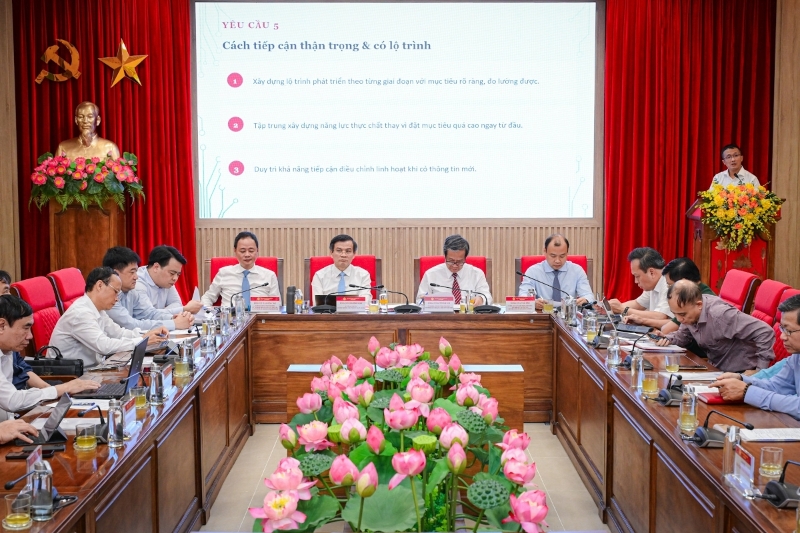
Quantum technology is a new developmental frontier with the potential to create major breakthroughs in science and technology, profoundly transforming perceptions, production methods, social governance, and the way we reshape the world.
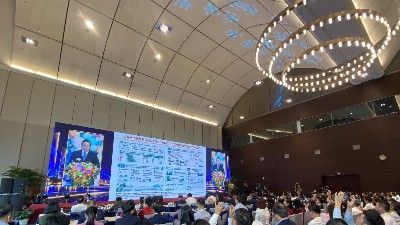
President of the Ho Chi Minh National Academy of Politics, Mr. Doan Minh Huan, made the remark at a scientific seminar titled "Quantum Technology in the New Era: International Trends, Opportunities, and Requirements for Vietnam," held in Hanoi on June 23.
As a strategic technology identified under the Politburo's Resolution No. 57-NQ/TW, quantum technology offers significant room for both basic and applied research. Recognizing development trends early is vital for strengthening strategic autonomy and ensuring national interests. Furthermore, it bridges the gap between theoretical thinking, strategic personnel training, and modern scientific knowledge, according to Mr. Huan.
While quantum technology is a challenging field requiring comprehensive preparation—ranging from scientific foundations and research infrastructure to human resources and organizational models, Vietnam cannot remain an outsider, said President of the Vietnam Academy of Science and Technology, Prof. Tran Hong Thai. He described it as a strategic technology capable of reshaping the future development of nations.
Regarding the approach, Prof. Thai noted that Vietnam must be proactive without being hasty, avoiding a comprehensive "all-out" race while refusing to remain a mere observer.
In his report, "Current Status, Bottlenecks, and Requirements for Vietnam in Quantum Technology Development," Dr. Nguyen Quoc Hung, Director of the Quantum Technology Institute (Vietnam National University, Hanoi), stated that Vietnam is currently in the early stages of development. While some specialized research facilities are beginning to take shape, actual capacity and operational mechanisms are not yet fully ready.
The report identified key bottlenecks, including the lack of a national-level policy, the absence of an interdisciplinary coordination architecture, limited specialized infrastructure, and a shortage of highly specialized human resources. Furthermore, corporate participation remains low, and existing financial, procurement, and evaluation mechanisms are ill-suited for high-risk, long-cycle technologies.
Based on these findings, Dr. Hung proposed that Vietnam adopt a focused strategy, prioritizing information security, post-quantum cryptography, sensors, and human resource training.
During the seminar, delegates argued that quantum technology should be viewed not only as a technical field but also through the lenses of philosophy, epistemology, political economy, and developmental methodology. Quantum technology is essentially the "technologization" of the principles of quantum reality, making tangible what were once abstract elements such as wave-particle duality, fields, information, and the microscopic states of matter.
Moreover, this field is directly linked to strategic competition, the new international division of labor, the ability to master high-tech value chains, data security, and national digital sovereignty.
Consequently, Vietnam needs to adopt a "quantum ecosystem" mindset. This encompasses multidisciplinary quantum science, quantum philosophy, quantum thinking, human resources, research infrastructure, governance capacity, market mechanisms, and international cooperation. Such an approach will ensure autonomy not only in technology but also in thinking, theoretical foundations, developmental resources, and basic scientific methodologies.

 Google translate