


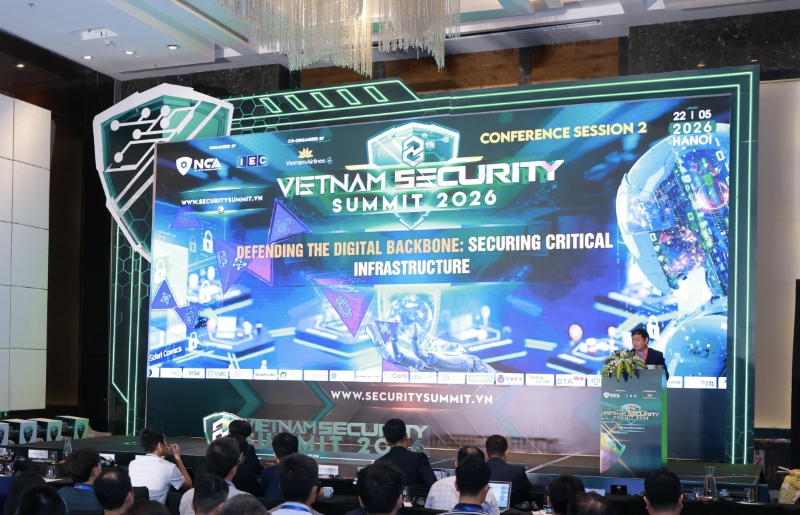
The Vietnam Security Summit 2026, held under the theme “Securing digital future: Preparing for the Post-quantum & AI world,” was organised on May 22 in Hanoi by the National Cybersecurity Association, IEC Group, and Vietnam Airlines.
The summit focused on cybersecurity challenges arising from the rapid expansion of AI, cloud computing, and next generation digital technologies, while also highlighting the need for stronger collaboration among government agencies, businesses, and technology experts.
At the event, policymakers, technology leaders, and businesses discussed solutions for strengthening cyber resilience and protecting critical digital infrastructure.
Cyber threats becoming more sophisticated in the AI era
Meanwhile, experts described AI as creating a “dual impact” on cybersecurity. On one hand, AI is enabling organisations to detect threats more quickly, automate security operations and improve large-scale data analysis. On the other, cybercriminals are increasingly exploiting the same technology to develop more sophisticated attacks.
AI-powered phishing campaigns, ransomware, identity fraud and fake content generation are becoming increasingly difficult to detect. Technologies such as voice cloning and Deepfake tools are allowing attackers to mimic identities with a level of realism that was previously difficult to achieve.
Alongside AI-related risks, the rise of quantum computing is emerging as another major concern for future cybersecurity systems.
Speaking during the plenary session, Colonel Nguyen Hong Quan, Deputy Director General, Department of Cyber Security and High-tech Crime Prevention under the Ministry of Public Security, said digital transformation is rapidly changing the way societies and economies operate. However, he noted that cyberattacks are increasing in scale, complexity and cross-border nature.
According to Colonel Quan, cybercriminal groups have begun using AI technologies to conduct online fraud, identity impersonation, malware distribution and targeted attacks against organisations, businesses and individuals.
New forms of cybercrime, including Deepfake manipulation, voice impersonation, account takeover and online financial fraud, are creating increasingly severe consequences for businesses and society. "Current requirements are not only about responding to immediate threats but also proactively preparing cybersecurity capabilities for future stages," Mr. Quan said.
He stressed that organisations and businesses need to strengthen awareness regarding cybersecurity, increase investment in technology and human resources, and enhance risk management capabilities.
He also emphasised the importance of developing a coordinated and sustainable national cybersecurity ecosystem involving government agencies, technology companies, research organisations and cybersecurity communities.
Meanwhile, Major General Nguyen Tung Hung, Deputy Commander of the Cyber Warfare Command under the Ministry of National Defence, said the nature of cyberattacks has changed significantly in recent years.
"If attacks previously focused mainly on isolated sabotage or small-scale financial gain, many cyberattack groups today are using artificial intelligence, exploiting zero day vulnerabilities, targeting supply chains and quietly embedding malware for extended periods before activation," he said.
According to Major General Hung, the objectives of cyberattacks are no longer limited to data theft. Increasingly, attackers are seeking to disrupt essential services, seize control of systems, damage operational infrastructure and undermine public trust.
He also highlighted concerns surrounding the "harvest now, decrypt later" strategy associated with quantum computing, where data collected today could potentially be decrypted in the future when quantum processing capabilities become sufficiently powerful.
Mr. Hung said organisations need to move away from a reactive mindset and adopt a proactive approach to cybersecurity. He stressed that prevention remains more effective than dealing with consequences after incidents occur.
Cybersecurity, he said, should be integrated into systems from the design stage rather than treated as an additional layer introduced after problems emerge. He also highlighted the importance of human factors in cybersecurity strategies. Many successful cyberattacks, he noted, originate from information leaks and weak internal control processes. Cybersecurity therefore should not be viewed solely as the responsibility of technical departments, but as a shared responsibility across leadership teams, management and employees.
Building stronger digital resilience
Panelists at the summit, under the theme “Defending the Digital Backbone: Securing Critical Infrastructure," highlighted the need to strengthen critical digital infrastructure and enhance resilience against increasingly complex cyber threats.
According to Synology's Digital Transformation in Southeast Asia 2025 survey, more than 55 per cent of businesses in the region have experienced ransomware incidents or attempted cyberattacks in recent years.
Meanwhile, Vietnam's Cybersecurity Report 2025 by Foresiet recorded approximately 552,000 cyberattacks during 2025, with 52.3 per cent of organisations and businesses reporting damages resulting from these incidents. The figures highlighted the increasingly persistent and widespread nature of cybersecurity risks facing enterprises.
Mr. Henry Nguyen, Synology Vietnam Country Manager, said data protection can no longer be viewed simply as a backup process. Instead, he argued, recovery capability has become equally critical. Businesses need not only to maintain copies of their data but also ensure that these copies remain recoverable, appropriately isolated and capable of maintaining integrity during incidents.
According to him, many organisations still face "blind spots" in their protection strategies, including untested backup systems, insufficient storage isolation and recovery plans disconnected from actual business objectives. Such weaknesses can prolong system recovery times and lead to greater operational disruption.
Alongside conference discussions, a cybersecurity technology exhibition featured more than 40 domestic and international cybersecurity solution providers. The exhibition showcased technologies including AI-powered security systems, SOC/SIEM platforms, identity and access management solutions, cloud security, Zero Trust architecture, post-quantum cryptography, Deepfake detection, DDoS mitigation and data protection systems.
As AI and quantum technologies continue advancing, experts at the summit suggested that cybersecurity is increasingly becoming not only a technological issue but also a broader challenge involving governance, preparedness and long-term resilience.
With digital infrastructure now serving as a foundation for economic activity, building a proactive and sustainable cybersecurity ecosystem may become one of the key requirements for protecting the future digital economy.






 Google translate