


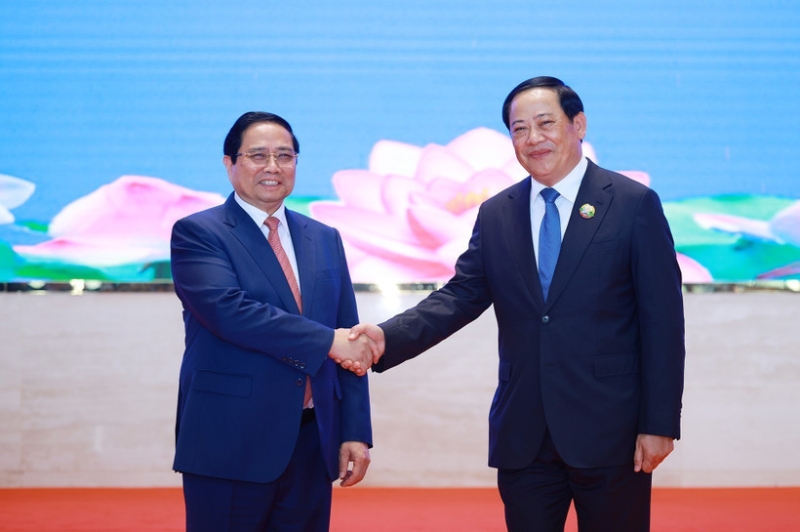
Vietnamese Prime Minister Pham Minh Chinh and his Lao counterpart Sonexay Siphandone co-chaired the 48th meeting of the Vietnam–Laos Intergovernmental Committee on Bilateral Cooperation in Vientiane on December 3, according to a report from the Vietnam News Agency.
The meeting aimed to review and assess the implementation of agreements under the Vietnam–Laos Cooperation Plans for the 2021–2025 period and for 2025; and discuss and agree on cooperation orientations and tasks for the 2026–2030 period and for 2026, particularly the realization of the outcomes of the recent high-level meeting between the Communist Party of Vietnam and the Lao People's Revolutionary Party.
Warmly welcoming PM Chinh and the high-level Vietnamese delegation, PM Sonexay emphasized that this working trip, taking place on the occasion of the 50th anniversary of the National Day of Laos, is of great significance, as it immediately advances the high-level agreements between the two Parties and brings to life the “strategic cohesion” between the two countries.
At the meeting, after listening to reports reviewing fields of collaboration in the 2021–2025 period and the orientations and tasks for 2026–2030, the two PMs and leaders of ministries, sectors, and agencies from both sides provided information and discussed specific measures to implement upcoming cooperation agreements, including concrete programs and projects.
PM Chinh identified 10 notable achievements in bilateral cooperation: political relations at the highest level; defense–security cooperation serving as a pillar; impressive growth in economic and trade ties; major breakthroughs in financial collaboration; progress in energy cooperation; effective implementation of aid programs; efficient operations of the Laos–Vietnam expert team; strong growth in cooperation in education–training, culture, and tourism; and the removal of obstacles in various projects.
The two leaders noted that, based on the exceptionally strong and trusted political and diplomatic relations, which serve as the core and overarching orientation of the bilateral relations, cooperation in defense and security has continued to be close and effective, and contributed to successfully maintaining political stability and social order in each country, building a shared borderline of peace, stability, friendship, and comprehensive cooperation, and effectively combating various types of crimes, especially transnational crime.
Economic, trade, and investment cooperation has made significant progress. As of April, Vietnam had invested in 267 projects in Laos, with total registered capital of $5.63 billion. In the first 10 months of this year, Vietnam’s investment reached $566.1 million, focusing on high-quality, sustainable projects in key sectors where Laos has strengths, such as clean energy, mining, and agriculture.
Many Vietnamese-invested projects in Laos are operating effectively, contributing positively to socio-economic development, creating jobs and increasing incomes for thousands of workers, and generating additional revenue for Laos’ state budget, especially in sectors such as telecommunications, banking, rubber planting and processing, food and agricultural production and processing, and dairy manufacturing.
In the January-October period, two-way trade hit $2.6 billion, up 50.4% compared to the same period in 2024, with Vietnam recording a trade deficit of $626.2 million.
Cooperation in education and training, science and technology, culture, tourism, people-to-people exchanges, and collaboration between ministries, agencies, and localities have been vibrant and continued to be strengthened. Vietnam and Laos have coordinated closely and supported each other at multilateral and regional forums, particularly in working with other member states of the Association of Southeast Asian Nations (ASEAN) to build the ASEAN Community and maintain ASEAN’s unity and consensus on strategic regional issues.
PM Chinh emphasized that in the current context, the two countries need new determination, new approaches, and new driving forces to create momentum and renewed spirit for joint development; and further promote and deepen the special Vietnam–Laos relationship, making it a model in international relations.
To advance the bilateral ties, especially following the recent high-level meeting between the two Parties, the two leaders agreed to immediately work together to deepen the substance of Vietnam–Laos relations to a new height of “Great friendship, special solidarity, comprehensive cooperation, and strategic cohesion,” in which political relations are vital; defense–security and economic cooperation are key pillars; collaboration in science, technology, and education–training is a breakthrough; partnerships between businesses and the people are a foundation; and collaboration between localities is a driving force.
Agreeing with PM Chinh’s remarks, the Lao PM said he will direct the Lao–Vietnam Intergovernmental Sub-committee to create breakthroughs and ensure in-depth implementation of high-level agreements and directions across all fields.
Recognizing that Vietnamese investors in Laos have contributed to economic development and job creation, PM Sonexay encouraged Vietnamese businesses to invest in large-scale projects in Laos; promote connectivity in transport and energy infrastructure; implement the Vientiane–Hanoi expressway project; and improve the effectiveness of the potash mining project.
Affirming his commitment to continue creating favorable conditions for enterprises to invest and operate effectively in accordance with Laos’ requirements, especially in high-value clean agriculture, science and technology, he proposed both sides further improve the quality of human resources training, while agreeing on building Laos–Vietnam University and emphasizing the need to develop vocational schools and educational institutions in border areas.
The two PMs agreed to continue raising strategic trust to a higher level; further strengthen cooperation in defense and security; and create strong, groundbreaking, strategic progress in economic, trade, investment, and infrastructure cooperation. This includes promoting connectivity between the two economies, enhancing infrastructure links, ensuring economic and energy security for each country, removing obstacles and barriers, and ensuring that bilateral cooperation programs and projects achieve high effectiveness.
In the immediate term, beginning in 2026, both sides will focus on effectively implementing the Vietnam–Laos Joint Statements and the agreement signed at the 48th meeting of the Vietnam–Laos Intergovernmental Committee on Bilateral Cooperation; and will introduce strong and practical measures to further deepen political and diplomatic relations, strengthen the defence–security cooperation pillar, and continue giving special priority to cooperation in education and training.
Accordingly, the two sides will continue to deepen political and diplomatic ties to achieve even higher effectiveness so as to guide the overall direction of bilateral cooperation; maintain and enhance the effectiveness of existing cooperation mechanisms; and efficiently organize high-level visits, meetings, and exchanges in flexible formats.
The two PMs agreed to step up economic connectivity and promote bilateral investment and trade cooperation. Accordingly, the Lao Government will continue providing preferential and favorable conditions for large and key projects of Vietnamese enterprises; consider adjusting regulations related to timelines for hydropower and mining investment to align with new conditions; and promote strong growth in trade turnover, striving to increase bilateral trade in 2026 by 10–15% compared to 2025, with the goal of soon raising the turnover to $5 billion and moving toward $10 billion per year. Both sides will focus on addressing obstacles, advancing transport infrastructure connectivity, and identifying agriculture and rural development as one of the pillars of their economic cooperation.
Both sides will continue to promote cooperation between ministries, sectors, agencies, and localities; and priorities and enhance the quality of cooperation in education, training, and human resources development. In this regard, the Vietnamese Government will continue to provide 1,300 scholarships for Lao officials and students to study in Vietnam and will continue sending teachers to teach Vietnamese language in Laos.
At the meeting, the two sides signed the Cooperation Agreement between the two Governments for the 2026–2030 period; the Agreement on the 2026 Cooperation Plan between the two Governments; the minutes of the 48th meeting; and the Cooperation Plan for 2026 between the Ministries of Education and Training of Vietnam and Laos.


 Google translate