


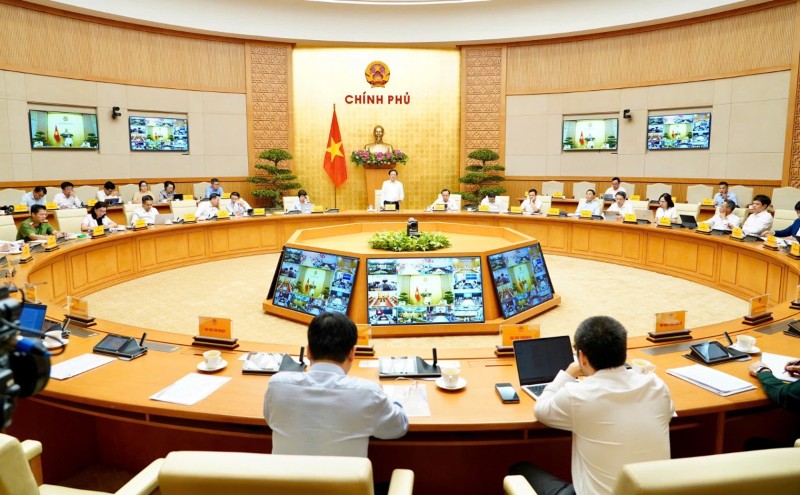
Speaking at the conference on connecting research institutes, universities, and the business community on October 23, Deputy Prime Minister Ho Quoc Dung noted that policy mechanisms have shifted from managing input processes to managing output results and accepting risks. However, bringing these policies into practice remains slow.
“A major bottleneck is that the link between the State, research institutions, the business community, and the market remains weak and lacks substance,” the Deputy Prime Minister stated.
Data for the 2021-2025 period underscores this disconnect. Only 12 percent of national-level science and technology tasks and 11 percent of local-level tasks involved enterprise participation. In 2023, only 6 percent of businesses participated in setting up science and technology funds to finance research.
Furthermore, corporate research and development (R&D) expenditure in Vietnam stands at 0.3 percent of GDP, far below China’s 2.1 percent and South Korea’s 4.2 percent. Out of roughly 21,300 doctorate-holding researchers nationwide, only 333 work directly within enterprises, while 21,000 are employed at universities and research institutes.
Intellectual property outputs further highlight the gap. Between 2021 and 2025, Vietnamese enterprises were granted over 700 patents, compared to roughly 24,000 granted to foreign firms - a 35-fold difference. On more than 20 tech trading platforms offering 62,000 technologies, only 750 investors and businesses sought information, resulting in just 72 transactions.
Additionally, out of 4,800 research tasks funded with VND17 trillion ($670 million) since 2021, few results reached commercialization because projects failed to address real market demand.
Minister of Science and Technology Vu Hai Quan highlighted existing support incentives, including 100 percent state funding for commissioned research tasks and initial product testing for strategic tech firms, 70 percent testing support for high-tech firms, land rent exemptions for recognized technology centers, and three years of free access to state-funded testing facilities for eligible startups.
To resolve these bottlenecks, the Government ordered a shift from issuing isolated research tasks to commissioned projects tied to specific market outputs.
For 2026-2027, Vietnam aims to have at least 30 to 50 percent of research topics originate directly from corporate orders.
The Ministry of Science and Technology will also map national research capabilities, upgrade shared laboratory infrastructure, and restructure national research programs.








 Google translate