


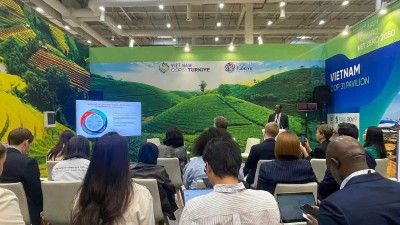
Vietnam's Ministry of Agriculture and Environment, in collaboration with the United Nations Development Programme (UNDP) in Vietnam, hosted a dialogue titled "From Climate Commitments to Blue Carbon Solutions: Strengthening National Partnerships for Implementation," on November 16, on the sidelines of COP31 that is taking place from November 9-20, in Antalya, Türkiye.
The event brought together representatives from Vietnam, Indonesia, and the Philippines, three countries implementing the National Blue Carbon Action Partnership (NBCAP), to share experiences, foster regional cooperation, and mobilize resources for conserving and restoring marine and coastal ecosystems.
Toward implementing the National Blue Carbon Action Plan
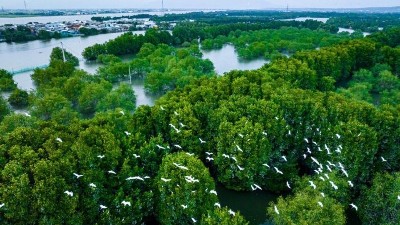
According to the Intergovernmental Panel on Climate Change (IPCC), blue carbon refers to carbon absorbed and stored in marine and coastal ecosystems such as mangroves, seagrasses, and tidal marshes. Scientific research shows these ecosystems can sequester carbon at rates two to four times higher and hold up to 10 times more carbon overall than terrestrial forests, helping mitigate climate change, protect coastlines, preserve biodiversity, and sustain coastal livelihoods.
With an extensive coastline and rich coastal ecosystems, Vietnam holds vast potential to leverage blue carbon for climate mitigation, adaptation, and sustainable development. However, pressure from economic growth and climate change has made ecosystem conservation and restoration increasingly urgent.
In 2026, Vietnam has continued refining policy frameworks to advance sustainable marine economic development and its domestic carbon market.
Key policies include Party Central Committee Resolution No. 20-NQ/TW dated July 28, 2026, on building Vietnam into a strong maritime nation; Government Resolution No. 218/NQ-CP on the action program to implement Resolution 20; and Decree No. 180/2026/ND-CP on forest carbon absorption and storage services. Vietnam's Nationally Determined Contributions (NDC 3.0) for the 2026-2035 period also underscore the role of marine and coastal ecosystems.
To support these efforts, the Ministry of Agriculture and Environment established NBCAP Vietnam, a multi-stakeholder platform that has connected over 500 organizations and experts across government agencies, research institutes, financial institutions, businesses, and development partners. A flagship outcome is the draft National Blue Carbon Action Plan, which aims by 2030 to finalize the legal framework, build a unified ecosystem data platform, integrate blue carbon into the national greenhouse gas inventory and NDC, and mobilize sustainable finance with equitable benefit-sharing for coastal communities.
Regional cooperation opens policy, science, and investment opportunities
Sharing policy experiences at the dialogue, an Indonesian representative noted that in February, Indonesia issued its National Action Planfor the Protection and Management of Blue Carbon Ecosystems (RENAKSI) for 2025-2030, linking conservation with food security, fisheries, aquaculture, seaweed farming, and coastal livelihoods.
Meanwhile, the Philippines has integrated blue carbon into NDC 3.0 as a mitigation solution, with its Department of Environment and Natural Resources (DENR) aligning the NDC with its National Adaptation Plan and Biodiversity Strategy and Action Plan.
Delegates focused on three cooperation pillars: strengthening national partnerships for inter-sectoral coordination, enhancing policy frameworks, benefit-sharing mechanisms, and investment readiness, and expanding regional knowledge and financial mobilization.
For Vietnam, the immediate priority is conserving and restoring existing ecosystems while linking them with sustainable forestry and aquaculture to generate livelihoods and economic incentives for local communities alongside future carbon finance mechanisms.
"Policy is the foundation, but ecosystem restoration in practice requires the collaboration of the government, scientists, communities, and businesses," said Dr. Nguyen Do Anh Tuan, Director General of the International Cooperation Department at the Vietnamese Ministry of Agriculture and Environment, emphasizing NBCAP's role in coordinating ministries, localities, and international partners.
Dr. Radhika Dave, Head of Adaptation and Resilience Society, Bureau for Programme and Policy Support (BPPS), UNDP, said: “With their extensive coastlines and globally significant mangrove ecosystems, Vietnam, Indonesia and the Philippines can become blue carbon champions in the Asia-Pacific region.”
She added that once national cooperation platforms are established, the next step is developing successful financial models that inspire other countries, which is key to driving investment in blue carbon solutions, building resilient ecosystems, and laying the foundation for socio-economic prosperity.
Following COP31, Vietnam will focus on finalizing its National Action Plan, developing a Blue Carbon Finance Roadmap, and deepening technical and financial cooperation with Indonesia, the Philippines, and regional partners.
Launched following a Letter of Intent signed between the Ministry of Agriculture and Environment and the World Economic Forum (WEF) in October 2025, NBCAP Vietnam makes Vietnam the third country globally, after Indonesia and the Philippines, to establish the platform. Led by the ministry with support from the UK Government via WEF, its secretariat is chaired by UNDP in coordination with the ministry's International Cooperation Department and WEF.
Established under Decision No. 1706/QD-BNNMT, the 25-member NBCAP Vietnam Working Group is chaired by a Deputy Minister of Agriculture and Environment and comprises:
- Seven ministries and sectors: Ministries of Agriculture and Environment, Science and Technology, Foreign Affairs, Industry and Trade, Culture, Sports and Tourism, Public Security, and Justice.
- Three commercial banks: BIDV, Vietcombank, and SeABank.
- Three international development partners: British Embassy in Vietnam, UNDP, and WEF.
- Two non-governmental organizations: WWF-Vietnam and Save the Children.
- Three research institutions: World Agroforestry Centre (ICRAF), Institute of Strategy and Policy on Agriculture and Environment, and Institute of Meteorology, Hydrology, Environment and Climate Change.
 Google translate