


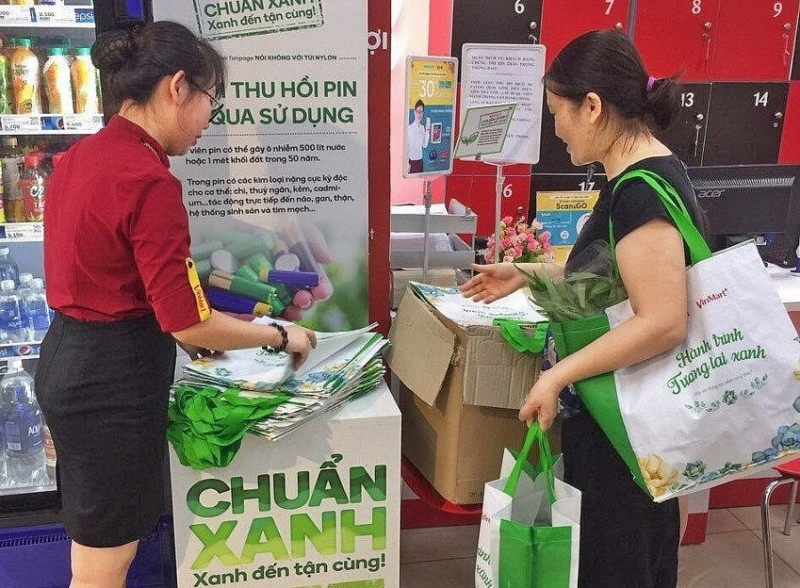
According to the survey report, the market is opening up significant growth opportunities across various sub-segments. Growth headroom is no longer coming solely from the expansion of total demand, but from structural shifts as the market increasingly prioritizes packaging solutions that meet higher criteria for materials, recyclability, and environmental friendliness.
Furthermore, 100 percent of respondents recognized increasing the use of recycled raw materials as the single most critical ESG trend over the next five years. This shift aligns directly with stricter requirements across major export destinations, particularly the European Union, where recyclable content standards dictate international market access.
Beyond raw materials, emissions reduction and product traceability are fast becoming essential links in ESG execution across the sector. Approximately 57.7 percent of enterprises prioritize reducing carbon emissions across their entire value chain, while 50.1 percent focus on tracing raw material origin, reflecting a broader shift toward Scope 3 emissions management under the Greenhouse Gas (GHG) Protocol.
With stringent requirements governing raw inputs and supply chains, carbon tracking and ESG compliance require precise operational data. Consequently, digital transformation is serving as the primary infrastructure enabling enterprises to quantify, track, and optimize sustainability targets.
The survey reveals that 68.4 percent of packaging enterprises have integrated digital technologies into specific production and management stages, while 25.9 percent have deployed digital systems enterprise-wide.
Market pressure is intensifying following the comprehensive application of the European Union’s Packaging and Packaging Waste Regulation, Regulation EU 2025/40, on August 12, 2026. The framework establishes mandatory lifetime standards spanning design, material use, reuse, recycling, and waste management.
In response, 96.5 percent of surveyed Vietnamese packaging firms have established and partially implemented ESG commitments, with 100 percent planning to increase ESG investments in 2026 to fulfill rising customer demands.
Consumer sentiment is actively reinforcing this market transition. Consumer survey results indicate that 33.9 percent of consumers are always willing to pay a premium for eco-friendly packaging, while 53.9 percent are willing to pay more if the price increase remains reasonable. Only 9 percent choose green packaging exclusively when no alternatives exist, and 3.3 percent are unwilling to pay any price premium.
While environmental awareness is altering purchasing behavior, commercial viability remains essential to bridging consumer interest and actual purchasing decisions. Packaging function has also evolved: clear, legible product information ranked highest among consumer priorities at 73.8 percent, outstripping storage convenience at 59.4 percent and attractive design at 54.2 percent, while 41.9 percent explicitly prioritized eco-friendliness and reusability.
As packaging evolves from a basic protective layer into a critical touchpoint for transparency, operational data, and trust, enterprises that proactively combine green materials, digital management, and supply chain transparency are best positioned to secure competitive advantages in 2026.





 Google translate