


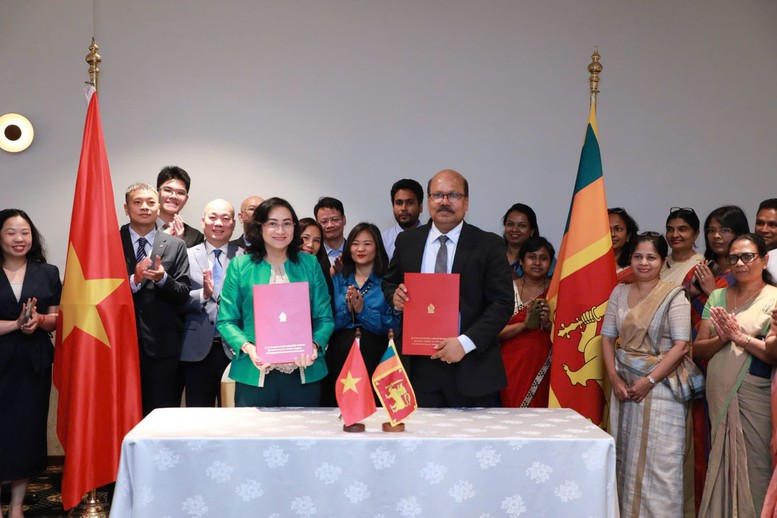
The third meeting of the Vietnam–Sri Lanka Joint Sub-Committee on Trade was held in Colombo (Sri Lanka) on December 9.
The meeting was co-chaired by Vietnam’s Deputy Minister of Industry and Trade Phan Thi Thang and Sri Lanka’s Deputy Minister of Trade, Food Security and Development Cooperation K.A. Vimalenthirarajah.
Speaking at the meeting, Deputy Minister Phan Thi Thang highlighted the positive progress in Vietnam–Sri Lanka trade relations in recent years.
The two sides reviewed and assessed the implementation of the commitments made at the second meeting, while noting the continuous improvement in bilateral trade turnover.
Both sides agreed that there remains substantial potential and demand for further cooperation, particularly as the trade structures of the two economies are highly complementary.
Within the framework of the meeting, the two sides held extensive discussions across a wide range of priority cooperation areas.
On trade facilitation, both sides agreed to strengthen technical dialogue on customs, standards and regulations, and non-tariff measures, helping businesses of both countries reduce compliance costs and improve market access.
On rice trade cooperation, Vietnam affirmed its stable supply capacity and diverse rice varieties, and proposed considering the development of a memorandum of understanding (MoU) on rice trade cooperation for food security.
In the textile–garment and footwear sector, Sri Lanka proposed cooperation under the EU’s Generalized System of Preferences (GSP) framework on rules-of-origin cumulation. Vietnam took note of the proposal and expressed willingness to enhance cooperation in training, design, product development, and supply chain connections.
In the fisheries sector, Sri Lanka expressed its interest in strengthening technical cooperation and importing raw materials for processing; Vietnam, in turn, proposed that Sri Lanka expand the list of approved products and simplify quarantine procedures.
Sri Lanka also expressed its desire to attract Vietnamese businesses to invest in infrastructure, energy, information and communication technology (ICT), electrical–electronic industries, agricultural processing, logistics, and supporting industries. The two sides further discussed cooperation in 3D printing technology, quality inspection, software and digital transformation, Ayurvedic medicine, and others.
The two sides also agreed to explore the possibility of opening a direct air route between Colombo and Hanoi/Ho Chi Minh City to promote trade, investment, and tourism in the coming period.
At the conclusion of the meeting, Deputy Minister Phan Thị Thang and Deputy Minister K.A. Vimalenthirarajah signed the Minutes, providing the basis for implementing cooperation activities in the time ahead. Both sides agreed to hold the fourth meeting in Hanoi, with the specific timing to be arranged through diplomatic channels.
Moreover, both sides will also work closely to effectively implement the agreed initiatives, support businesses in deepening their integration into regional and global supply chains, and move toward the goal of raising bilateral trade to $1 billion.
According to Ministry of Industry and Trade (MoIT), Vietnam ranks 48th among Sri Lanka’s export destinations and 17th among its import sources. In 2024, Sri Lanka’s exports to Vietnam reached $40.09 million, up 10 per cent year-on-year; while Sri Lanka’s imports from Vietnam amounted to $238.81 million, up 27 per cent year-on-year.
Vietnam’s imports from Sri Lanka include knitted fabrics, yarn, animal feed, rubber, textiles and garments, and tea packages.
Vietnam’s exports to Sri Lanka consist of yarn, knitted fabrics, basic metals, woven fabrics, phones, electronic equipment and components, and rubber.


 Google translate