


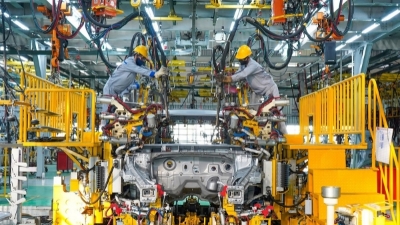
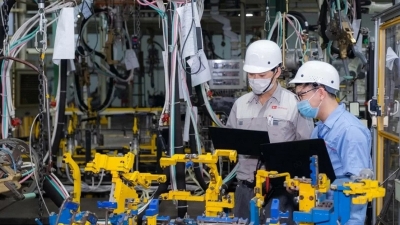
Vietnam's Purchasing Managers' Index (PMI) for January 2026 reached 52.5 points, indicating a solid start for its manufacturing sector, according to a report released by S&P Global on the morning of February 2, 2026.
The PMI for January 2026 was slightly down from 53.0 points in December 2025, but still above the 50-point threshold. This result indicates a clear monthly improvement in business conditions at the start of 2026, marking the seventh consecutive month of strengthening in the manufacturing sector's health.
The report highlighted three key points: increased production, a surge in new orders, and accelerated employment growth. Business confidence therefore reached its highest level in 22 months, while output prices rose at the fastest pace since April 2022.
The report noted that faster production growth, coupled with a steady increase in new orders, has made companies more optimistic about production prospects for the coming year. The rising demand for production has also driven employment and purchasing activities to continue growing. However, inflationary pressures remain relatively high, with selling prices increasing at the fastest rate since April 2022.
According to S&P Global's report, although the overall PMI showed some growth deceleration, despite the strong increase in production in January 2026, survey participants attributed this primarily to the faster rise in new orders compared to December 2025 amid improved customer demand. The total number of new orders was supported by a rebound in export orders. This marked the third decline in four months for export orders, but the overall decrease was not significant, with survey members reporting new orders from other Asian economies such as India.
The significant increase in production in January was also supported by stable employment levels. Employment rose for the fourth consecutive month, reaching the fastest job creation rate since June 2024, although some companies reported continued temporary contract worker recruitment. Businesses also ramped up purchasing activities to meet higher production demand, extending the current growth streak to seven months.
However, input inventory levels decreased for the first time since September of the previous year, as purchased items were immediately used to support production growth. Finished goods inventory also declined at the fastest pace in four months, with survey respondents indicating that products were quickly delivered to customers. The acceleration in delivery and production helped manufacturers maintain stable workloads in January 2026, resulting in a slight reduction in backlogs for the second consecutive month.
On the supply side, supplier delivery times continued to lengthen, although to the least significant extent in eight months. Survey group members attributed delivery delays to high input demand and material shortages. These factors also led to higher input costs, which continued to rise sharply at the beginning of 2026. The inflation rate only slightly decreased from the highest level in three and a half years recorded in December. Consequently, companies continued to rapidly increase selling prices, with the rate of price increases becoming the fastest since April 2022.
S&P Global's report noted that optimism about production prospects for the next 12 months continued to strengthen at the beginning of 2026, improving for the fourth consecutive month to the highest level since March 2024. Exactly 55% of survey respondents predicted that production would increase in the coming year, and companies expected new orders to continue rising amid improved market conditions.
"Vietnam's manufacturing sector has had a solid start to the year, as businesses ramp up production to meet rising new orders and as part of efforts to promptly meet customer demand. Building on the growth momentum accumulated until the end of 2025, the manufacturing sector has a positive outlook for a successful 2026," commented Mr. Andrew Harker, Economics Director for Economic Indicators & Surveys at S&P Global Market Intelligence.
However, a potential headwind for companies is the strengthening inflationary pressure. The ongoing material supply shortages continued to significantly drive up prices in January 2026, and companies responded by increasing selling prices more aggressively, according to Mr. Harker.




 Google translate