


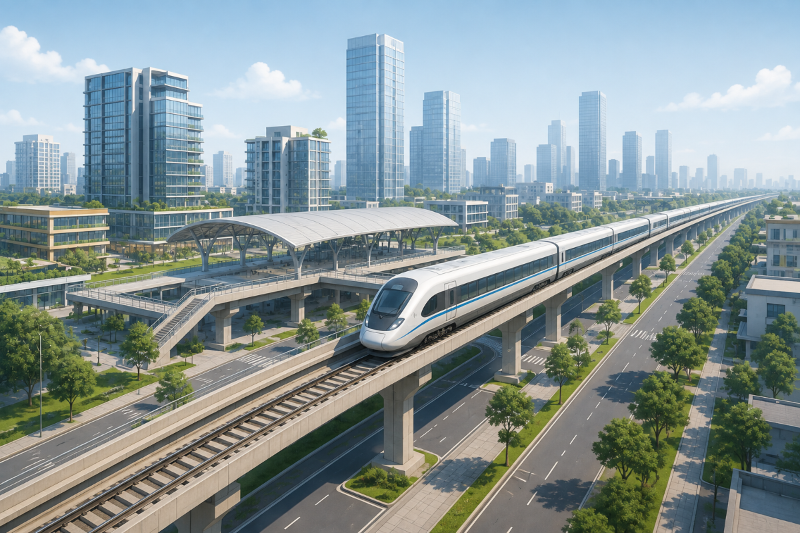
To optimize land utilization and enhance investment efficiency, some 28 compact urban areas have been proposed for development under the Transit-Oriented Development (TOD) around stations along the projected Ho Chi Minh City – Can Tho railway.
This information was released by the My Thuan Project Management Board (PMB) in its preliminary research report on potential areas for TOD development—a model that integrates urban housing and commercial spaces with public transport hubs—along the planned rail corridor.
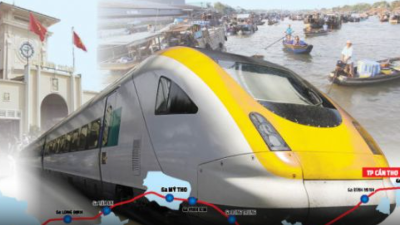
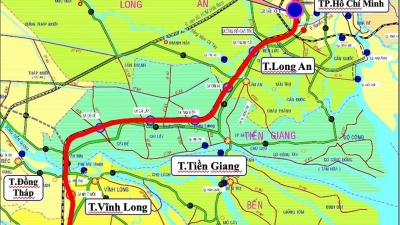
The proposed railway spans over 175 km, traversing Ho Chi Minh City and Tay Ninh, Dong Thap and Vinh Long provinces and Can Tho City in the Mekong Delta. The line is set to begin at An Binh Station (Di An, Binh Duong/HCMC border) and terminate at Can Tho Station (Can Tho City).
According to the My Thuan PMB, local authorities in the affected provinces have reached a consensus on researching TOD integration. However, several aspects require further clarification, including the specific scope of research, implementation mechanisms, infrastructure connectivity, and land exploitation strategies.
The pre-feasibility study for the HCMC – Can Tho railway is currently being finalized for submission to competent authorities for investment policy approval. In Phase 1, the project requires a total investment of over VND171 trillion (over $6.5 billion).
The plan involves constructing a 1,435 mm standard gauge line to serve both passenger and freight transport. The maximum design speed is set at 160 km/h for passenger trains and 120 km/h for freight trains.
Regarding the timeline, the National Assembly is expected to review the project's investment policy in August 2026. General technical designs and project approval are slated for completion by the first quarter of 2028, with construction beginning in the third quarter of 2028 and primary completion targeted for 2035.
To implement the project, approximately 801.5 ha of land will be reclaimed.
The My Thuan PMB has recommended utilizing public investment for the project. According to the project consultants, international experience indicates that the Public-Private Partnership (PPP) model for this type of infrastructure may not yield higher efficiency compared to direct public funding.



 Google translate