



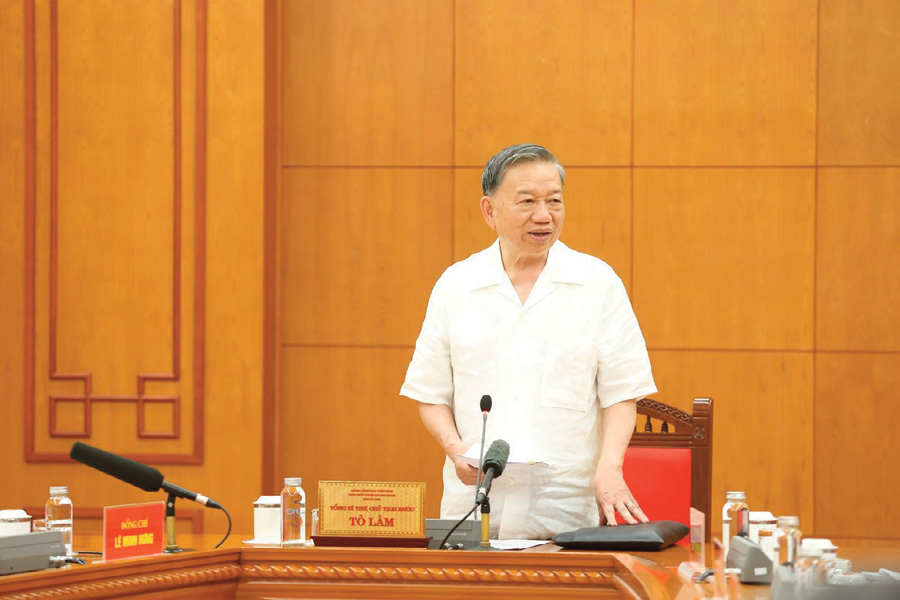
At a working session with the government Party Committee and relevant ministries and agencies on the implementation of Directive No. 34-CT/TW, issued by the Party Central Committee’s Secretariat on strengthening the Party’s leadership in social housing development under the new circumstances, Party General Secretary and State President To Lam stressed that housing policies in the new era must be designed with a new mindset and vision to ensure that everyone has access to housing. Housing, he added, should serve as a place to live rather than a vehicle for business or wealth accumulation.
“Vietnam’s housing development model in the new period is neither a subsidized housing model nor one that leaves everything to the market,” he continued. “The State will create land banks, develop planning frameworks, provide financial support, establish standards and regulations, and simplify administrative procedures. The market will participate in construction and operation while earning reasonable returns. Citizens will have access to stable, safe, and affordable housing suited to their needs. From now until 2030, housing for sale will remain necessary, but rental housing must be established as a strategic pillar, particularly in major cities, industrial parks, labor migration hubs, and areas where housing prices far exceed household incomes.”
Strategic pillar
Notice No. 64-TB/VPTW, issued by the Party Central Committee’s Office summarizing the conclusions of the Party General Secretary and State President, reaffirmed that future housing development, particularly social housing, should focus on several key priorities.
First, authorities must recognize that access to lawful housing is a fundamental right of citizens. Access to safe and affordable housing should be viewed as a measure of social progress, providing a foundation for stable and sustainable development while strengthening public confidence. Housing development should be integrated into urban and rural development strategies, contributing to social welfare, security, higher labor productivity, and the healthy development of the real estate market. The State should pursue housing policies aimed at ensuring that everyone has a place to live.
Second, housing development should follow a market-oriented model under effective State guidance and management. The State will not subsidize housing, but neither will it leave the market entirely to regulate itself. Instead, it will play a facilitating role through institutions, policies, and planning to promote a transparent and healthy market, allowing businesses to participate with reasonable profit expectations while ensuring citizens can access stable, safe, and affordable housing.
Third, alongside housing for sale, priority should be given to rental housing development, particularly apartment rental projects in major urban centers, industrial parks, economic zones, growth regions, and key economic corridors. Housing development should be aligned with urban planning, land-use planning, industrial park development, public transportation systems, labor markets, and population management.
The Notice also calls for a review of the current housing classification system and the development of a new framework consisting of four categories: commercial housing, rental housing, official residences, and policy-supported housing. This would allow the government to develop tailored policies for each segment, including State-supported pricing schemes and free housing provision for certain eligible groups.
Fourth, the government Party Committee has been tasked with developing appropriate land and credit policies to accelerate the affordable rental housing market and encourage greater private sector participation. Authorities are also required to establish standards for each housing category and streamline development procedures through a one-stop administrative mechanism.
Procedures related to investment, planning, land allocation, construction permits, and access to preferential financing should be shortened and made more transparent, with clearly-defined timelines and accountability.
Local authorities are instructed to review land resources and update planning frameworks. Housing development across all segments must be integrated with technical infrastructure, essential social services, cultural facilities, healthcare, and education, particularly in urban areas, economic zones, industrial parks, high-tech parks, and rapidly-urbanizing regions. They are also expected to proactively clear land and prepare serviced sites for rental housing projects while strengthening oversight to prevent abuse of housing support policies and speculative activity in the housing market. At the same time, greater use of digital technologies and data-driven management tools is encouraged in housing development and real estate operations.
Fifth, the government Party Committee has been assigned to develop a new housing policy framework aligned with the Constitution, Party policies, and public demand. It will also review the implementation of Directive No. 34 and propose a new directive from either the Secretariat or the Politburo, providing the basis for amendments to the Law on Housing and the Law on Real Estate Business, which are expected to be submitted to the National Assembly (NA) this year.
Turning plans into action
To accelerate the implementation of the Party General Secretary and State President’s directives, Prime Minister Le Minh Hung emphasized during meetings with local authorities that the development of affordable commercial housing and rental housing is a major policy priority of the Party and the State, reaffirmed through Directive No. 34 and Notice No. 64. “These are not issues that can be resolved overnight, but they require immediate and decisive action and cannot be delayed,” he said.
For Hanoi, the Prime Minister called for a pioneering approach, including assessments of housing demand, target groups, and investment mechanisms to develop large-scale rental housing projects for people living and working in the capital, including officials and civil servants from central government agencies.
Hanoi is expected to begin construction on several rental housing projects during June and make flexible use of social housing financial contributions, with the State investing and professional operators managing the projects.
The capital has also been tasked with preparing an investment, construction, and operational plan for rental housing projects and reporting the results to the Prime Minister in July. In addition, Hanoi should propose mechanisms to mobilize social resources and support investment in and the operation of rental housing projects through appropriate land allocation and land lease policies.
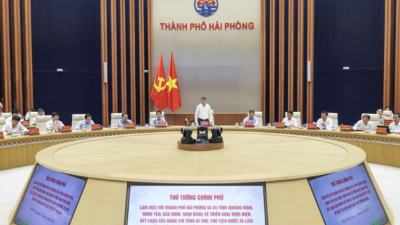
The Prime Minister issued similar instructions to the northern port city of Hai Phong and nearby Quang Ninh, Bac Ninh, Ninh Binh, and Hung Yen provinces, requiring that each begin construction of at least one rental housing project this month and accelerate larger developments in the third and fourth quarters.
“The policy direction is already clear,” he continued. “Local authorities must take the initiative and not wait passively for central guidance. Any obstacles should be clearly identified so that institutions, mechanisms, and policies can be updated and improved accordingly.”
He stressed that the issue is urgent and requires the State to take the lead, using public resources as leverage to attract private investment. National and local housing funds should be used effectively to stimulate the market, while diverse funding sources, particularly private capital and long-term investment, should be mobilized rather than relying solely on the State budget.
Regarding planning, the Prime Minister instructed local authorities to review and adjust planning frameworks based on approved master plans and provincial plans, identifying specific locations and scales for rental housing development linked to key industrial parks and strategic growth areas. This work must be completed by the end of June.
Local governments are also required to assess rental housing demand and prepare rental housing development plans through 2030, including annual targets, priority project lists, anticipated funding sources, and implementation roadmaps. These plans must also be submitted to the Ministry of Construction (MoC) by the end of June.
The Prime Minister also assigned specific responsibilities to ministries and agencies. The Ministry of Finance (MoF) and the State Bank of Vietnam have been tasked with proposing financial, tax, and credit incentives for long-term rental housing projects, to attract private investors and long-term investment funds.
Meanwhile, the MoC has been instructed to continue implementing tasks outlined in Notice No. 262/TB-VPCP, review the implementation of Directive No. 34, and propose a new directive to replace the current one. The Ministry is also responsible for finalizing draft legal amendments for submission to the NA, issuing national technical standards for small and medium-scale rental housing projects, including mini apartment buildings and family-operated rental housing, and ensuring compliance with safety and fire prevention requirements.
In addition, the Ministry will consolidate policy proposals from local authorities and coordinate with the MoF to review mechanisms allowing businesses and cooperatives to acquire commercial and social housing solely for rental purposes.
Moving into action
To implement the new housing development strategy, the MoC is now reviewing and amending relevant policies, with rental housing identified as a strategic segment of the housing market. The approach aims to develop housing under a market-based framework with effective State oversight, while mobilizing diverse investment sources, reducing reliance on the State budget, and unlocking private capital for housing development.
At its May review meeting and June task deployment conference, the Ministry said the new housing development orientations have been incorporated into policy dossiers for amendments to the Law on Housing and the Law on Real Estate Business. Draft legislation is expected to be submitted to the NA for approval this October.
Under the proposed framework, housing policies will be organized into four categories: commercial housing, rental housing, official residences, and policy-supported housing. Long-term rental housing with affordable rates will be prioritized through incentives related to land, finance, taxation, and credit.
The Ministry is also developing separate standards and regulations for different housing types, particularly rental housing, worker accommodation, student housing, and housing for the elderly. The standards aim to ensure quality of life and building safety while promoting the professional management and operation of long-term rental housing projects.
To ensure rental housing development aligns with actual demand, the MoC has conducted nationwide assessments covering different population groups, localities, and development stages. It is also reviewing land availability in urban areas, industrial parks, economic zones, high-tech parks, and rapidly-urbanizing regions to create a pipeline of serviced land for future rental housing projects.
In addition, the Ministry has requested local authorities to assess rental housing demand and propose targets for rental housing stock funded by local housing funds in 2026 and the 2027-2030 period.
“Alongside accelerating social housing development, local authorities are actively implementing rental housing programs and projects, while many businesses have registered to participate as investors,” Minister of Construction Tran Hong Minh told the 14th Congress of the Vietnam General Confederation of Labor for the 2026-2031 term. “Through State support policies, particularly in credit and interest rates, social housing and rental housing are expected to better meet the accommodation needs of low-income workers.”
Following directives from the Party and the government, local authorities have also moved quickly to implement the policy. Chairing a meeting on rental housing projects in Hanoi on May 27, Chairman of the Hanoi People’s Committee Vu Dai Thang said the capital would promptly study and implement new models in line with guidance from the central government. Hanoi aims to establish several pilot rental housing projects that can be rapidly developed and later replicated on a wider scale.
Authorities in the capital have instructed departments and agencies to develop attractive policies to encourage private sector participation and to urgently review urban planning, housing development plans, and land resources to allocate land for rental housing projects. Hanoi has also pledged to streamline administrative procedures and prioritize fast-track approvals.
In Ho Chi Minh City, meanwhile, the Department of Construction and the southern city’s Construction Science and Technology Association held a conference on June 9 to promote investment in rental housing development.
Officials said the city, with a population of around 14 million, faces significant housing demand from professionals, workers, students, and other residents. However, the rental housing market still lacks long-term mechanisms and incentives strong enough to attract investors.
The city aims to develop more than 181,000 social housing units between 2026 and 2030, including approximately 50,000 rental social housing units. It is also considering converting part of its unused resettlement housing stock and surplus State-owned housing into rental housing to improve the use of public assets.
At the conference, 13 companies - four State-owned enterprises and nine private companies - signed commitments to develop approximately 97,900 rental housing units.
“Ho Chi Minh City will provide maximum support and establish a green lane for social housing and rental housing projects,” Chairman of the Ho Chi Minh City People’s Committee Nguyen Van Duoc said. “We are reviewing rental housing demand and allocating land accordingly within the city’s housing master plan. With more than 97,000 rental housing units committed at this conference alone, I believe we have a solid foundation to successfully implement the city’s rental housing development strategy.”
In Quang Ninh, provincial leaders have also moved to accelerate implementation. At a meeting on June 11, Chairman of the Quang Ninh Provincial People’s Committee Bui Van Khang described rental housing development as an important political task that would contribute to social welfare, improve living standards, attract and retain talent, and support the province’s sustainable growth objectives.
He called on authorities at all levels to fully implement the conclusions of Party General Secretary and State President To Lam and Prime Minister Hung, treating rental housing development as a key priority requiring decisive action and measurable outcomes.
The province plans to establish a steering committee for rental housing development, led by the provincial Chairman, along with an implementation task force headed by the director of the Department of Construction. Local authorities will be required to submit weekly or bi-weekly progress reports and will be held accountable for delays or failure to deliver results.
Provincial agencies have also been tasked with studying the creation of a major projects management board to oversee housing projects and reviewing planning documents to incorporate rental housing developments into provincial and urban plans for 2026-2030.
Quang Ninh has been instructed to ensure rental housing projects are located in convenient areas with adequate infrastructure and aligned with the needs of target groups. At least one State-funded housing project is expected to break ground in June, while privately-funded developments are scheduled to accelerate in the third and fourth quarters.
According to Prime Minister Hung, the government has directed ministries, agencies, and local authorities to develop and refine policies supporting the housing market. By the end of the year, the legal framework for rental housing development must be completed.
“If we can meet this demand, it will improve living standards, strengthen social welfare and public order, and provide a solid foundation for maintaining the workforce, attracting investment, and supporting rapid and sustainable economic growth,” he said. “If local authorities actively engage, they can not only meet housing demand but also reduce pressure on home ownership and help address many broader economic challenges.”







 Google translate