



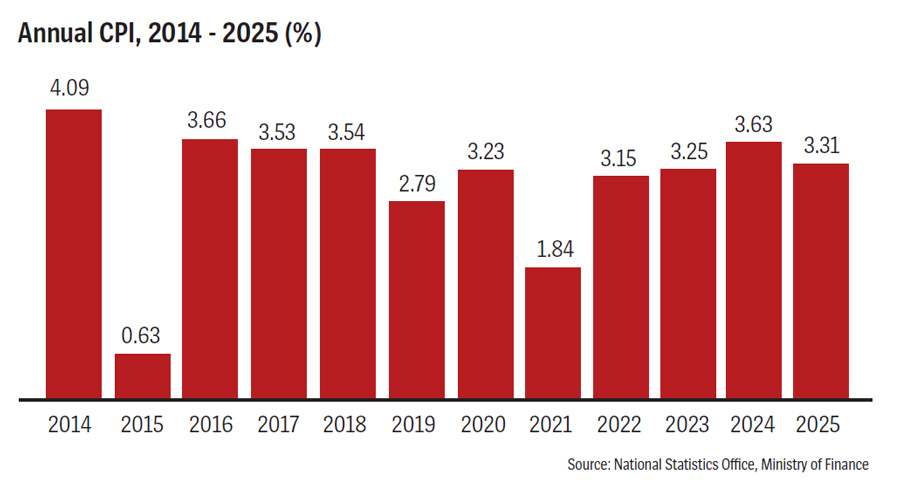
Vietnam’s annual CPI has consistently remained below the government’s target over the past 12 years, with inflation coming in at under 4 per cent during most years, with exceptionally low readings posted in 2015, 2019, and 2021.
Vietnam has achieved this performance while many advanced economies have been forced to maintain restrictive monetary policies with elevated benchmark interest rates as inflation remained well above their 2 per cent targets, in some cases reaching three to four-times that level.
Keeping inflation within target for more than a decade has helped stabilize the value of the VND, strengthen macro-economic stability, improve the balance of payments, and bolster foreign exchange reserves.
The CPI increased steadily in the first half of 2026 compared with the same period last year. Inflation accelerated from January through May before easing slightly in June. Even so, the CPI for the first half stood at its highest level in recent years and approached the government’s full-year target of 4.5 per cent.
Supply-demand dynamics
Among the eleven major categories of consumer goods and services, three recorded price increases above the average. Food and catering services, the largest component of the CPI basket, rose 4.79 per cent, including a 4.7 per cent increase in food prices and a 6.85 per cent rise in dining-out costs. Housing, electricity, water, fuel, and construction materials climbed 6.72 per cent, while transportation prices increased 5.23 per cent.
Inflation reflects multiple economic forces, beginning with the balance between domestic supply and demand. Vietnam’s GDP expanded 8.18 per cent in the first half; the strongest first-half growth in many years. Final consumption, which accounts for the largest share of domestic demand, rose 8.15 per cent, slightly below GDP growth, while gross capital formation surged 15.2 per cent, or nearly double the pace of economic expansion.
Though asset accumulation provides the foundation for investment, the investment-to-GDP ratio stood at only 27.3 per cent during the first half; well below the more than 34 per cent recorded in previous years.
Under normal circumstances, weaker domestic demand relative to supply would be expected to ease inflationary pressures. However, consumer prices rose more quickly than anticipated. One key reason was Vietnam’s shift from a decade of continuous trade surpluses to a trade deficit of $16.66 billion in the first half of 2026. If the more than $5 billion services deficit was to be included, the overall external deficit was even larger.
Ordinarily, a trade deficit would increase domestic supply relative to demand and help moderate inflation. However, because Vietnam continues to rely heavily on imported inputs for processing and assembly industries, rising imports instead boosted domestic demand beyond supply, adding to inflationary pressure. As a result, the transition from persistent trade surpluses to a sizeable trade deficit contributed to higher inflation. Conversely, the country’s decade-long period of trade surpluses had helped keep inflation under control.
Rising production costs
Another factor has been shifting capital flows within the economy. Funds previously concentrated in gold, real estate, and cryptocurrencies - markets that have experienced prolonged price gains - are increasingly moving into manufacturing, business investment, and consumer goods markets, adding demand-side pressure.
Producer prices have also risen sharply. Industrial producer prices, particularly in manufacturing, increased 5.4 per cent, while prices of raw materials and production inputs rose by the same amount. Warehousing and logistics support services also rose 4.6 per cent. These cost increases all exceeded average CPI growth during the first half, reinforcing inflationary pressure.
According to the National Statistics Office at the Ministry of Finance, industrial production expanded faster than value-added across the sector, suggesting that intermediate input costs increased more rapidly than output. Industrial production rose 10.8 per cent compared with value-added growth of 9.86 per cent. In manufacturing, production increased 11.4 per cent while value-added rose 10.23 per cent. Electricity, gas, and air conditioning output grew 9.6 per cent versus value-added growth of 9.34 per cent, while water supply and waste management output increased 8.9 per cent against value-added growth of 7.72 per cent.
When production grows faster than value-added, it indicates that intermediate costs are rising, reducing business efficiency and weighing on the quality of economic growth. Lower efficiency, in turn, can create additional inflationary pressure.
Fiscal and monetary factors
Fiscal and monetary policy remain among the most direct drivers of inflation because inflation fundamentally reflects a decline in the purchasing power of money. On the fiscal side, the first half of 2026 saw a notable improvement.
State budget revenue reached VND1,568.2 trillion ($60.3 billion), up 17.4 per cent year-on-year, while expenditure totaled VND1,149.1 trillion ($44.2 billion), up just 0.1 per cent. As a result, the budget posted a surplus of VND419.1 trillion ($16.1 billion), reversing the deficits recorded during the same period in previous years.
A budget surplus affects inflation in two ways. First, it reduces the amount of money circulating in the economy by transferring liquidity to the government, easing demand pressures in consumer markets. Second, it limits the flow of funds into speculative assets such as cryptocurrencies, gold, and real estate, helping curb inflation expectations and reducing the risk that asset price bubbles spill over into consumer prices.
Monetary and credit conditions also warrant close attention. As of June 26, credit growth stood at 7.41 per cent year-on-year. Though lower than the 8.3 per cent recorded during the same period last year, credit expanded faster than deposits, which grew 6.11 per cent. The widening gap between credit growth and deposit mobilization affects banking system liquidity and increases the money supply, adding to inflationary risks.
Exchange rate developments present another challenge. The average VND/USD exchange rate increased 1.75 per cent during the first half of 2026, below the 2.95 per cent rise recorded a year prior. This reflects effective exchange rate management, helping stabilize foreign exchange markets and contain inflation expectations.
However, policymakers should carefully evaluate any further depreciation of the VND, particularly given that Vietnam’s exchange rate already differs significantly from purchasing power parity estimates compared with many other economies. Combined with the country’s large trade deficit and rising import prices in USD terms, a weaker VND could further increase imported inflation.
Overall, inflation will require continued policy attention during the remainder of the year. Without sustained measures to contain price pressures, Vietnam risks exceeding its 4.5 per cent inflation target for the first time after 12 consecutive years of keeping it within official goals.
Such an outcome would erode the benefits of strong economic growth, undermine macro-economic stability, and reduce the real purchasing power of consumers, the largest and most directly affected group in the economy.







 Google translate