


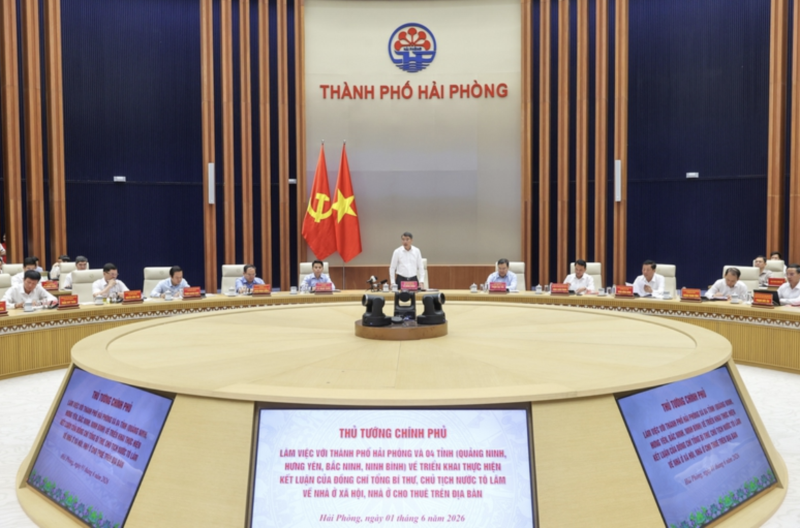
Prime Minister Le Minh Hung has demanded that northern Vietnam's Hai Phong, Quang Ninh, Bac Ninh, Ninh Binh, and Hung Yen each strive to break ground on at least one rental housing project within this month.
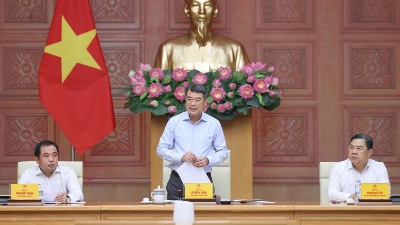
Chairing a meeting in Hai Phong with leaders from these five localities on rental housing development on the afternoon of June 1, the PM also called for the rapid implementation of large-scale rental housing projects in the third and fourth quarters of this year.
The Government leader noted that the localities are among the country's top economic performers, with hundreds of thousands of workers currently employed in industrial zones. He stressed that the pressure to provide rental housing is urgent and that successful implementation in these areas would serve as a pilot model to be replicated nationwide.
"The demand for rentals is massive, yet the supply is severely lacking, especially for long-term options at affordable prices—this is the primary bottleneck," said PM Hung.
He noted that most workers in these five localities currently live in informal, self-built boarding houses, which pose significant risks to safety, particularly regarding fire prevention, hygiene, and living conditions. Furthermore, some public housing assets are being used inefficiently, resulting in waste. Meanwhile, low profit margins and long payback periods remain major hurdles in attracting private investment, compounded by insufficient financial, tax, and credit incentives.
Consequently, the Prime Minister called for a strong shift in mindset: moving from a focus on housing primarily for sale to developing both commercial and rental housing simultaneously. The State will play an enabling role through institutions, policies, planning, and financial-credit tools, ensuring that those whose income levels do not yet allow for homeownership can access long-term, reasonably priced rentals. He emphasized that rental housing development must be closely integrated with industrial zone planning, economic zones, transport corridors, and population management.
“The policy is clear; localities must take the initiative and not wait passively for the central government. If there are obstacles, they must be identified specifically to propose amendments and perfect the institutional framework,” he said.
He emphasized that this is an urgent matter where the State must lead, using public resources as leverage to attract private capital. He urged the effective use of national and local housing funds to drive the market, mobilizing diverse resources rather than relying solely on the budget.
Regarding planning, localities are required to base their actions on general and provincial master plans approved by the Prime Minister. They must proactively review and adjust these plans to specifically define the locations and scales of rental housing zones, particularly those linked to key industrial zones and strategic development regions.
"This task must be completed within June 2026. Localities must carefully assess local demand to develop a rental housing development plan through 2030, including specific annual targets, priority projects, expected resources, and implementation roadmaps. These must be submitted to the Ministry of Construction to report to the Prime Minister by the end of June at the latest," he stated.
Finally, PM Hung requested that localities propose specific mechanisms to develop rental housing—including specialized policies on land, finance, credit, taxes, and investment procedures—based on their practical implementation. These proposals should be sent to the Ministry of Construction for a report to the Prime Minister and integrated into the revised Law on Housing and Law on Real Estate Business by July.




 Google translate