


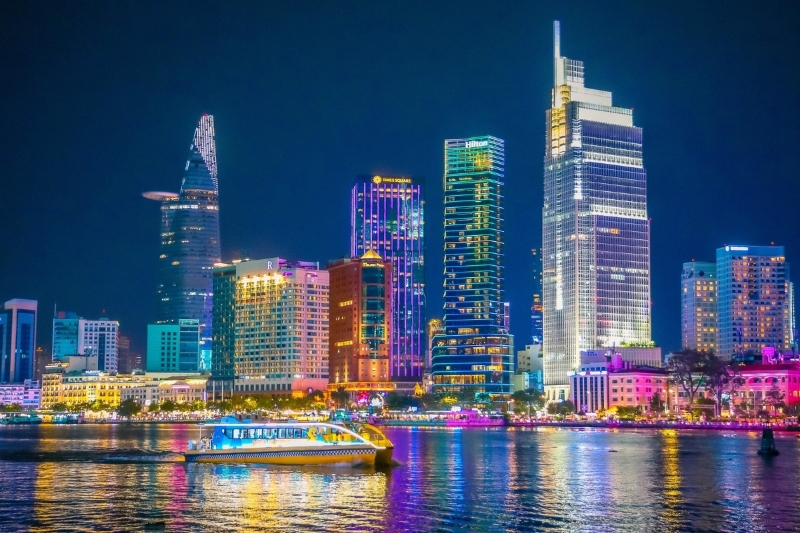
Analysts have noted that the goal of establishing an International Financial Center (IFC) in Vietnam is to attract major financial investors. Doing so, however, requires answering several fundamental questions, among them: Why should they come to Vietnam? What benefits will they gain?
In the context of increasingly fierce regional competition, the success of an IFC in Vietnam will depend heavily on the country’s ability to design and operate a flexible, efficient, and sophisticated institutional framework.
Competitive key
If Ho Chi Minh City wants to become an IFC, it must evolve into a regional capital-distribution hub, according to experts. To achieve that, Vietnam needs to meet at least one of two conditions. First, it must become a capital-surplus economy with the ability to export capital. Second, it must leverage shifts in the global financial order. As the world moves towards multi-polarity, financial centers can serve as intermediaries for global fundraising. This could be an opportunity, but the competitive equation remains unresolved.
Some observers argue that Vietnam could compete institutionally by using its late-mover advantage to design a framework suited to new asset classes and markets such as digital assets.
According to Mr. Phan Duc Hieu, Standing Member of the National Assembly’s Economic and Financial Committee, the National Assembly’s resolution establishing the IFC is an important starting point. “The resolution includes 14 groups of special policies spanning foreign exchange, banking, capital markets, taxation, imports and exports, residency and travel, and specialized rules for dispute resolution and jurisdiction,” he said.
He also highlighted key differences in policy design. Under the framework, English will be the official working language inside the IFC, while Vietnamese will serve only as a supplementary language. In addition, economic and commercial transactions conducted there may apply international law, depending on the needs of the parties involved.
The IFC’s judicial mechanism will operate as a separate system. Mr. Hieu believes that involving foreign judges should be considered: “Many have asked whether foreign judges can participate; in my view, that possibility cannot be ruled out,” he said. However, he also cautioned that the path from policy approval to effective implementation is long, especially in attracting investors.
Mr. Pham Tien Dung, Deputy Governor of the State Bank of Vietnam (SBV), said the central bank is working closely with Ho Chi Minh City to prepare for the IFC’s rollout and must draft around eight decrees to establish an appropriate regulatory framework.
One major breakthrough is the proposal to grant the IFC Executive Board in Ho Chi Minh City full autonomy in all licensing, supervisory, and management processes for institutions operating within the center. Additionally, the Executive Board will be authorized to issue guidelines on banking activities that extend beyond existing regulations, provided they align with the SBV.
On foreign exchange, Mr. Dung noted that transactions between the IFC and external entities will be almost fully liberalized. “Borrowing foreign currency is currently quite complex, but once the financial center becomes operational, the level of openness will increase significantly,” he said.
Experts emphasize that while a liberal regulatory corridor is necessary, it is not enough. Institutions must be stable, predictable, and equipped with exceptionally-strong risk-management capabilities to earn the trust of global investors.
In an environment of intensifying regional competition, the success of an IFC in Vietnam will hinge largely on institutional capacity, not only in designing laws but in operational flexibility and effective risk governance.
Notable models
At a recent workshop on attracting strategic investors to Ho Chi Minh City, organized by the Central Commission for Policy and Strategy, experts agreed that developing an IFC requires a globally-competitive policy framework, centered on identifying the right “strategic investors.” This is considered essential to building a deep financial ecosystem, rather than relying on widespread, ineffective incentives.
According to expert analysis, successful financial centers worldwide begin by defining and classifying groups of strategic investors. A common principle is that not every company with large capital qualifies for preferential treatment. Local authorities select only those operating in priority sectors, capable of innovation, committed to long-term investment, contributing to R&D, creating high-quality jobs, and generating technological spillovers. This is a selective approach based on capability and strategic impact, not merely capital size.
Professor Vu Minh Khuong from the Lee Kuan Yew School of Public Policy at the National University of Singapore, views Shanghai’s financial center model as a good example. The Chinese city developed an “Urban Strategic Partnership” mechanism allowing multinational corporations to invest under tailored arrangements. These include guarantees of property rights, free capital transfers, and access to international financial markets, designed specifically for companies classified as strategic investors.
Shanghai also created a “city-level strategic investment portfolio” comprising about 100 selected domestic and foreign enterprises chosen based on technological innovation and spillover potential. These companies benefit from land access, tax incentives, credit programs, talent development, and streamlined administrative processes. Administration also supports companies establishing regional headquarters or R&D centers, through policies on visas, residency, remittances, and specialist services, aimed at keeping the right strategic investors in place.
Tokyo adopted a different approach but has maintained a strong focus on strategic investors. Instead of publishing a fixed list like Shanghai, Tokyo targets clear priority groups. It offers strong incentives, including fast-track licensing, tax benefits, and workforce assistance, to companies with strong research capabilities. Though it does not explicitly use the term “strategic investor,” Tokyo’s policies clearly prioritize a core set of target enterprises.
Singapore, meanwhile, focuses on identifying “strategic projects” rather than specific companies. Its Refundable Investment Credit (RIC) allows cash refunds of 10-50 per cent of investment costs over four years, but only for large-scale projects in international finance, R&D, innovation centers, or regional headquarters. The mechanism is particularly effective under the Global Minimum Tax of 15 per cent, helping Singapore maintain its competitive edge in attracting major technology firms and international financial institutions.
Another notable model is Dubai, which has built 26 specialized free zones, each dedicated to sectors such as finance (DIFC and ADGM), commodities trading (DMCC), technology (Internet City and Silicon Oasis), and logistics (JAFZA). Each zone permits 100 per cent foreign ownership, provides tax exemptions, and ensures free capital flows, and has its own regulatory system. This allows Dubai to classify investors clearly according to sectoral strategy and functional needs.
Despite differences in design, successful IFC models share one principle: rigorous selectivity and focused policy support for strategic industries, rather than spreading resources thin. Incentives are tailored, from tax exemptions and direct financial support to talent, R&D, administrative procedures, and services for international professionals.
This offers an important lesson for Vietnam as it builds an IFC in Ho Chi Minh City. Defining strategic investor groups, identifying priority sectors, and designing suitable mechanisms will determine the center’s long-term competitiveness.


 Google translate