


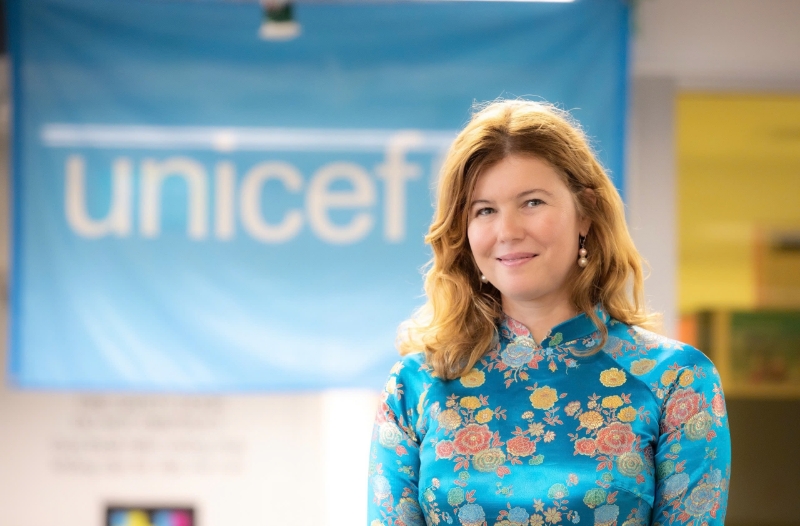
As a female leader in Vietnam’s current development landscape, what specific ways has UNICEF Vietnam and your leadership contributed to the country’s economic growth, including in job creation, innovation, and sustainable development?
My work is grounded in a simple conviction: investing in children - especially girls - is one of the most powerful drivers of sustainable economic growth. As the world’s leading child rights organization, UNICEF has partnered with the government and people of Vietnam for more than 50 years to strengthen national systems and programs in education, health, nutrition, water and sanitation, child protection, and social protection. These investments are not only essential for children’s well-being; they also form the foundation of a productive, resilient, and future-ready workforce.
UNICEF’s initiatives actively contribute to job creation and economic stability by strengthening public service systems that employ and serve millions - particularly women, young people, and marginalized communities. From expanding access to quality early childhood education and health services to reducing child poverty through robust social protection policies, UNICEF works to ensure that economic opportunity is inclusive and that human capital development keeps pace with Vietnam’s ambition to become a high-income country by 2045.
Under my leadership, UNICEF Vietnam has placed strong emphasis on digital transformation and innovation. We harness digital tools to improve service delivery, broaden outreach, and strengthen data-driven decision-making. At the same time, we equip adolescents - especially girls - with the digital and transferable skills needed for the future economy.
We also champion gender-transformative education by promoting girls’ participation in STEAM (Science, Technology, Engineering, Arts, and Mathematics), fostering women’s leadership, and addressing structural barriers that limit women’s economic potential. These efforts are essential for sustainable development, because when girls and women thrive, economies become stronger, more innovative, and more resilient.
In parallel, we integrate environmental sustainability across our programs and operations, promoting climate-resilient infrastructure and sustainable practices - because economic progress must never come at the cost of future generations. Together, these efforts contribute to building a more inclusive, innovative, and sustainable economy for Vietnam.
Vietnam is aiming for double-digit GDP growth in the coming years to transition towards high-income status. What key initiatives or strategies do you believe are essential for the economy to achieve this target?
Vietnam’s ambition to achieve sustained high GDP growth and transition to high-income status are bold - and achievable. But reaching these milestones will require a shift towards a growth model driven by productivity, innovation, and high-quality human capital. With a shrinking child population and a rapidly-aging society, maximizing the potential of every young person has become an urgent national priority. Long-term investment in children and youth is therefore not only a social responsibility; it is a central economic strategy.
Achieving this transformation demands coordinated action on several key fronts: an inclusive and future-oriented education system; a digitally skilled and adaptable workforce; strong social protection systems that reduce inequality; and climate resilience to safeguard development gains. International experience shows that countries that successfully made the leap to high-income status invested early and consistently in their people - starting from early childhood through adolescence - to ensure that growth is rapid, inclusive, and sustainable.
What specific action is your organization taking to support this goal?
UNICEF’s contribution in Vietnam is focused on supporting these national priorities at scale and with long-term impact. We work with government partners to strengthen education systems so that children and adolescents acquire not only foundational competencies but also digital and transferable skills essential for success in a modern, dynamic economy. We support digital transformation across education, health, and social services to improve efficiency, expand coverage, and enhance quality - while ensuring that vulnerable and remote communities are not left behind.
We also advocate for robust social protection systems that help families withstand economic and climate-related shocks, protecting children’s learning, health, and future productivity. At the same time, we promote climate-resilient social services - recognizing that climate risks, if unaddressed, can undermine growth potential and reverse hard-won development gains.
Across all our programs, UNICEF is committed to ensuring that investments in children translate into measurable improvements in human capital and productivity. By strengthening workforce readiness, reducing inequality, and building resilience, these efforts help lay the foundation for the sustained, high-quality growth Vietnam needs to achieve its long-term economic aspirations.
Women leaders like yourself have played an increasingly vital role in driving Vietnam’s inclusive and resilient economic progress. What challenges have you faced as a female leader in contributing to national development?
Women leaders are becoming increasingly visible in Vietnam’s development landscape, but the journey continues to present challenges. One of the most persistent obstacles I have encountered over more than 25 years working around the world - and witnessed among many women - is navigating unconscious bias and deeply rooted stereotypes. Women’s leadership styles and decisions are often judged through a different lens, requiring us to demonstrate competence and resilience in ways our male counterparts may not.
Unequal access to leadership development opportunities is another challenge. Early in my career, I noticed that high-quality training in strategic leadership, financial management, digital transformation, or executive decision-making was not always accessible or affordable for women, especially in social or mission-driven sectors. This can reinforce skill gaps and slow women’s progression into senior roles, even when they carry significant responsibilities. This is, however, changing, which is very encouraging.
Given my experiences as a women leader, I see values-driven and human-centered leadership, focused on empathy, care and inclusion, as a must to motivate teams and achieve impactful results. Workplaces where respect, inclusion, and psychological safety are non-negotiable are the best ones for women and men to thrive and contribute to the collective goals.
Balancing leadership responsibilities with family and caregiving duties is a reality for many women, like me, and workplaces that recognize this - through adaptable work arrangements and supportive parental leave - are the ones in which employees thrive. Equally important is fostering a culture where caregiving is respected and does not limit career advancement. When workplaces support caregivers, they unlock the full potential of women leaders, strengthen organizational performance, and contribute to more resilient and sustainable development for Vietnam’s future.
Throughout my career, strong support networks have been critical. Mentors, peers, and professional communities help women navigate challenges, share lessons, and maintain confidence. This is why I strongly advocate for investing in women and girls - through digital skills, financial literacy, leadership training, and supportive networks - so they can participate fully in Vietnam’s social and economic transformation.
Ultimately, addressing these challenges is not only about advancing women leaders; it is about unlocking Vietnam’s full talent potential. Inclusive leadership strengthens institutions, improves decision-making, and contributes to a more resilient and sustainable future for the country’s children.
What bold policies would you recommend to further empower women entrepreneurs and leaders to accelerate Vietnam’s path toward sustained double-digit growth in the new era?
Vietnam’s ambition to achieve sustained double-digit growth in the new era will not be realized unless women - who make up half of the population and a significant share of entrepreneurs, workers, and innovators - are fully empowered to lead and succeed in the economy. From my perspective, bold policies are needed not only to support today’s women entrepreneurs and leaders, but also to build a strong pipeline of girls and young women who will drive Vietnam’s future growth.
First, Vietnam should significantly increase investment in training, mentorship, and leadership development programs specifically designed for women entrepreneurs and aspiring leaders. This includes targeted support in strategic leadership, financial management, digital transformation, innovation, and green skills - particularly in high-growth sectors such as the digital economy, the green transition, and advanced manufacturing. When women have equal access to skills, networks, and leadership opportunities, the economic returns are substantial in terms of job creation and productivity.
Second, expanding women’s access to finance at scale is essential. Women-owned businesses still face structural barriers in accessing capital, despite strong performance and growth potential. Policies that incentivize financial institutions to lend to women entrepreneurs, alongside blended finance and guarantee mechanisms, could unlock significant domestic value creation and employment.
Third, strengthening social protection and care policies is a game-changer for women’s economic participation. Reducing the burden of unpaid care work - through affordable childcare, shared parental leave, and inclusive social protection - frees women’s time, increases their economic agency, and enables greater investment in entrepreneurship and leadership.
Fourth, long-term transformation must start early. Empowering adolescent girls and young women through education, skills development, and access to networks is critical to building the next generation of women leaders. This means expanding girls’ participation in STEM [Science, Technology, Engineering, Mathematics] from the early grades, embedding digital, financial, and entrepreneurial skills in education systems, providing equitable access to career guidance and vocational pathways, and actively challenging gender stereotypes that limit girls’ ambitions.
To ensure impact and accountability, Vietnam should also strengthen the availability and use of sex-disaggregated data. High-quality data and analysis are essential to inform policy decisions, track progress, and hold institutions accountable for results related to women’s economic empowerment - especially during periods of economic transition or crisis.
Finally, policies and financing must link humanitarian and development goals, ensuring that systems such as education, health, and social protection are resilient and inclusive. When shocks occur - whether economic, health-related, or climate-driven - women and girls are often the first to be left behind. Strong, shock-responsive systems are therefore not only a social safeguard, but a foundation for sustained growth.
UNICEF accompanies Vietnam stakeholders in advancing these priorities. We have been present in the country for over 50 years and will continue to partner with all to achieve women’s rights and children’s rights.





 Google translate