


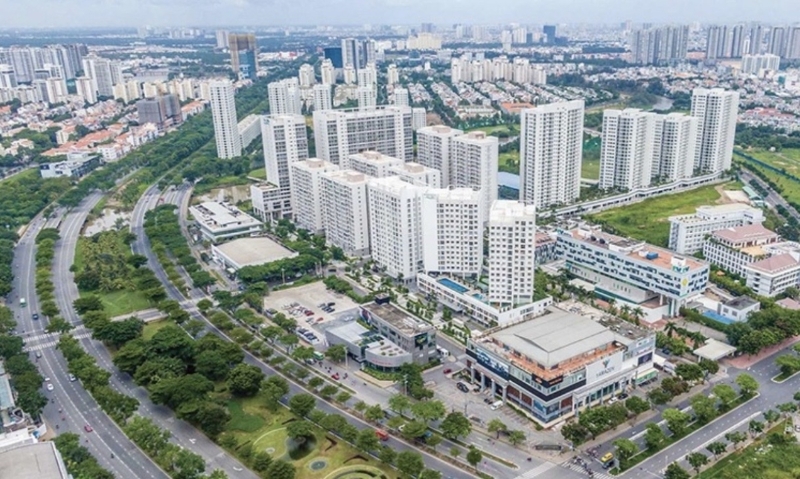
In a tightening financial environment, many businesses have pivoted towards mergers and acquisitions (M&As) as a key strategy to sustain growth momentum. In addition, a number of conglomerates, following restructuring efforts, have been actively expanding their real estate portfolios through M&A transactions.
According to the Foreign Investment Agency at the Ministry of Finance, total newly-registered, additional, and contributed foreign investment, including share purchases and capital contributions, exceeded $38.4 billion in 2025, up 0.5 per cent against 2024. Real estate ranked second among investment destinations, attracting more than $7.1 billion, or 18.51 per cent of the total and representing a 12.7 per cent increase.
Solution to sustain growth
Capital inflows continued to favor projects with strong legal transparency, particularly commercial land banks that have secured planning approval, hold clear land use rights, and offer well-defined construction completion timelines.
That said, the market is showing clear stratification between investor groups. While domestic investors lead in transaction frequency, primarily through small and mid-sized deals, foreign partners are focusing on large-scale transactions, especially in the high-end residential segment, integrated urban developments, and strategically significant industrial real estate.
Figures from global real estate consultants Jones Lang LaSalle (JLL) show that for disclosed M&A transactions during the first eleven months of 2025, cumulative deal value reached $2.4 billion and is significantly higher including undisclosed transactions observed by JLL.
Notably, the residential real estate sector dominated, accounting for more than 70 per cent of total M&A value. Commercial real estate and hospitality followed, with 17.7 per cent and 5.3 per cent, respectively. Data centers also emerged as a promising niche, representing 3.3 per cent of total M&A activity.
Ms. Le Thi Huyen Trang, Country Head & Head of Research and Consulting at JLL Vietnam, said the marked disparity reflects strong investor demand for “land banking.” This trend has become increasingly important as clean land supply tightens and legal procedures are enforced with greater transparency.
In particular, policies allowing negotiated land use rights for non-residential land to develop commercial housing from April 2025 have opened significant opportunities for land use conversion from industrial and agricultural purposes. This is expected to further spur M&A activity in the residential segment, which continues to face prolonged supply shortages alongside high absorption rates.
Meanwhile, the office segment shows clear divergence. Ho Chi Minh City is grappling with severe supply shortages, high occupancy rates, and sharply rising rents, while Hanoi is witnessing a strong wave of FDI from international investors. In the hospitality sector, expected investment yields are estimated at 8-9 per cent this year, with total M&A transaction value projected at $125 million.
Beyond these segments, JLL reported cumulative M&A transaction value in industrial real estate of $74 million during the first eleven months of the year. Rather than leasing land to develop from scratch, investors are increasingly favoring the acquisition of industrial parks with existing infrastructure, followed by phased expansions. This approach shortens development timelines, ensures infrastructure quality, and mitigates legal risks. “The emergence of investment products such as industrial land banks, ready-built factories, and specialized assets like cold storage facilities and data centers is creating a diverse range of M&A opportunities,” Ms. Trang emphasized.
Key drivers
Experts point to legal and policy reform as the primary driver, particularly the issuance of National Assembly Resolution No. 171/2024/QH15, which ushered in a new era for the market from April 2025 by allowing investors greater flexibility in converting non-agricultural land into commercial housing projects. At the same time, Politburo Resolution No. 68-NQ/TW has laid a solid foundation for private sector growth, while the government continues to refine the legal framework and innovate capital mobilization mechanisms.
Corporate restructuring needs represent the second critical factor. Many domestic companies are facing liquidity pressures and accumulated bad debts stemming from the 2020-2022 growth boom, prompting them to pursue M&A solutions to reorganize finances and complete project legalities.
Another factor is a stable monetary policy environment, with average lending rates at 7-9 per cent, lower than in recent years, creating favorable conditions for capital access. These preferential rates not only help level the playing field between domestic and international investors but also encourage long-term capital inflows into the market.
Nevertheless, experts note that international investors, particularly from South Korea, Singapore, Japan, and the US, are applying two clear priority criteria when evaluating M&A opportunities in Vietnam.
Legal transparency has become a non-negotiable factor in all investment decisions. These investors are especially focused on projects with complete legal documentation and immediate deployability, and are even willing to move faster on “clean” assets in exchange for legal certainty and shorter investment timelines.
At the same time, sustainability and environmental considerations are increasingly prioritized, particularly by European and North American funds that adhere strictly to environmental, social, and governance (ESG) standards. Against the backdrop of Vietnam’s strong commitment to net-zero emissions targets, these investors are seeking projects with climate resilience, energy efficiency, and compliance with international green standards.
Recommendations for enterprises
JLL recommends that Vietnamese companies focus on four key elements to effectively attract investors. First, ensure full legal compliance of assets, particularly land use rights and related permits, while preparing detailed legal due diligence reports. Second, conduct professional valuations aligned with international standards and update them regularly to accurately reflect market value; a critical factor in negotiations. Third, maintain flexibility in deal structures. Fourth, build a transparent financial system with internationally-audited reports and clear corporate governance. Enterprises should invest in standardizing financial reporting systems and establishing robust internal governance processes to ensure success in future M&A transactions.
From a personal perspective, Dr. Su Ngoc Khuong, Senior Director of Investment at Savills Vietnam, observed that foreign investors have been particularly active in M&A deals in Vietnam, attracted by competitive costs, a large workforce, a strategic position in global supply chains, and a markedly improved legal framework.
He noted that the biggest opportunity lies in access to international capital and advanced project development technologies, which can help local companies enhance their competitiveness. However, risks remain in areas such as asset valuation and post-merger management, as companies may lose operational control or face deeper-than-expected restructuring pressures without careful control. To maximize benefits, domestic enterprises must prepare thoroughly and select partners that share a long-term vision and development commitment.
According to Mr. Vo Huynh Tuan Kiet, Residential Project Marketing at CBRE Vietnam, today’s M&A landscape belongs to investors with long-term vision, clear strategy, and genuine operational capabilities. The market is shifting from opportunistic deals to strategic M&A transactions, where every square meter of land is optimally leveraged through layered models of joint ventures, partnerships, and multi-tiered cooperation.







 Google translate