


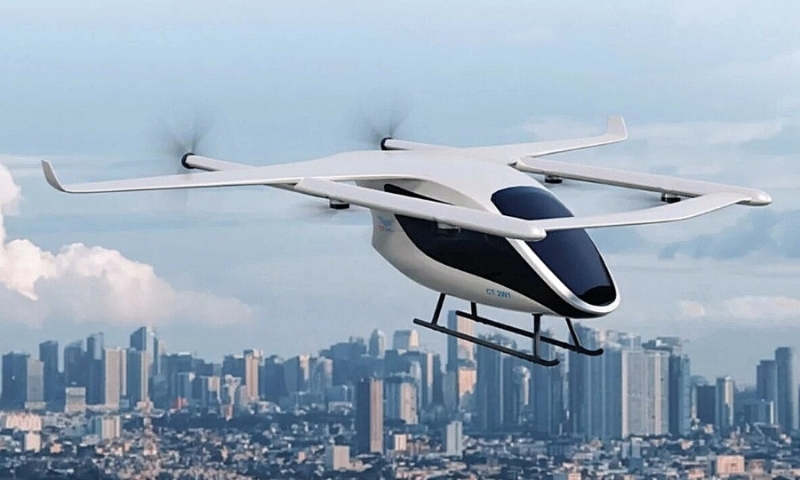
The concept of the low altitude economy (LAE) - also known as the marginal-space economy - first emerged in China in the 2010s. It refers to economic activity taking place in the airspace below 1,000 meters, and in some cases up to 3,000 meters, above ground level. The economy primarily relies on low-altitude manned and unmanned aircraft to deliver a wide range of aerial services, but development in these early years has been notably slow.
In Vietnam, the industry has begun expanding. “Vietnam stands before a ‘once-in-a-thousand-year’ opportunity to become the global hub of the LAE,” Mr. Truong Gia Binh, Head of the Private Sector Development Research Board (Board IV), told the recent Vietnam Private Sector Forum 2025, expressing confidence in Vietnam’s prospects in this emerging field.
Joining the game
In recent years, technology superpowers have been quietly racing to dominate a “new aerial frontier” - the space between ground level and traditional flight altitudes. A wave of legal frameworks, safety standards, and dedicated airspace management regimes for the LAE has been introduced across the US, Europe, and China, laying the groundwork for a field that could reshape the entire economic landscape in the future.
The US Federal Aviation Administration (FAA) and the European Union Aviation Safety Agency (EASA) have developed certification frameworks tailored to electric vertical takeoff and landing (eVTOL) aircraft - a key vehicle within the LAE. China, meanwhile, has gone even further, introducing a more comprehensive set of regulations than both of these economies and establishing the Low Altitude Economy Development Department in December last year.
According to a Morgan Stanley report, the market for urban air mobility (UAM) alone - a major segment of the LAE - could reach $1 trillion by 2040 and surge to $9 trillion by 2050. Such forecasts have made the LAE a veritable “gold mine” for countries looking to secure their position in the next generation of technology and industry.
Recognizing this opportunity, Vietnam has moved quickly. On August 25, the Vietnam Aviation-Aerospace-UAV Network was launched, bringing together nearly 100 experts, scientists, and engineers from inside and outside the country. Just over a month later, the Vietnam Low Altitude Economy Alliance was officially established, with participation from technology groups, financial institutions, and startups, aiming to build a cohesive development strategy for the LAE sector. The Alliance expects the new economy to help create thousands of support enterprises, generate 1 million high-quality jobs, and bring tens of billions of US dollars to Vietnam over the next 10 to 15 years.
Mr. Tran Kim Chung, Chairman of the CT Group, one of the pioneers in mastering unmanned aerial vehicle (UAV) technologies, emphasized the transformative potential of the LAE, which he described as essentially an expanded “aerial replica” of the entire ground economy. It spans all sectors: smart agriculture, logistics, transportation, construction, surveillance, rescue, and even national defense. “Once we master the LAE, we not only take control of a technological chain but also gain access to an entirely new development space,” he stressed.
He added that productivity gains from this sector “will not rise by a few dozen per cent, but by several times,” making it a critical driver of economic breakthrough. Moreover, because the LAE integrates multiple advanced technologies, mastering it would allow Vietnam not only to secure technological autonomy but also to claim a differentiated position on the global stage.
Altitude as an advantage
The CT Group drew significant attention in August when it signed a UAV export deal with South Korea, witnessed by Party General Secretary To Lam and South Korean Prime Minister Kim Min Seok.
Another Vietnamese player, Realtime Robotics Vietnam (RtR), has also taken Vietnamese UAVs to the global stage. In 2023, after nearly nine years in the field, RtR successfully exported its first HERA UAV to the US. Notably, the entire research, design, and manufacturing process for the HERA was carried out in Vietnam. The UAV model is now supplied to the US National Security Forces, US police departments, and law enforcement units in the Netherlands.
The Viettel Group is also developing multiple UAV product lines for both civilian and defense purposes. Its standout reconnaissance UAVs - the VU-R50 and VU-R70 - can fly continuously for 3-6 hours with an operational radius of some 70 km. The group has also deployed drones carrying mobile 4G/5G broadcasting equipment that operate at altitudes of 50-100 meters, provide coverage within a 6-km radius, and can stay in the air for up to 24 hours thanks to hybrid power cables tethered to the ground.
Other companies, including Phenikaa-X (part of the Phenikaa Group) and HTI Technology, are working to master vertical takeoff and landing (VTOL) technologies. Phenikaa-X’s VTOL-01 is designed to perform well in mountainous terrain for rescue missions, while HTI’s Horus P02, equipped with thermal sensors, is suited for surveillance and inspection with potential in rescue operations in the future.
In the draft amendments to the Law on Civil Aviation, the government proposed adding policies to develop low altitude air transportation, aiming to create a legal corridor for UAVs, commercial drones, and other unmanned aircraft. The amendments cover regulations on aircraft management, operations, imports and exports, airspace oversight, flight activities, and areas related to commercial and specialized aviation.
These policies aim to promote UAV applications in logistics, agriculture, rescue, surveying, and other fields, while enabling domestic enterprises to participate more deeply in high-tech value chains. The draft law also proposes regulations on the planning, investment, and expansion of airports to facilitate the mobilization of private capital for aviation infrastructure, particularly in the emerging low altitude transportation sector, giving businesses greater autonomy and strengthening operational capacity.
Horizons in the making
Within the LAE, UAVs, or drones, and eVTOLs - often dubbed the “air taxis” of the future - are only the surface of a much larger ecosystem. The LAE brings together multiple advanced technologies, from 5G telecommunications and AI to the Internet of Things (IoT) sensor networks, cloud computing, and smart ground infrastructure.
Its potential goes far beyond cargo transport or security monitoring. In smart agriculture, UAVs can spray crops, sow seeds, and measure soil conditions to boost yields and reduce environmental impact. In logistics and e-commerce, delivery drones can cut transport times from hours to minutes - a major advantage in mountainous areas, remote islands, or congested cities. In urban settings, autonomous aerial networks could strengthen traffic monitoring and infrastructure inspection.
These applications highlight the wide runway for the LAE’s expansion, especially as the global race is only beginning. With growing research capacity and a maturing tech ecosystem, Vietnam’s ambition to become a regional LAE hub is increasingly realistic.
The UAV segment, in particular, carries strong expectations. Deputy Prime Minister Nguyen Chi Dung has noted that UAVs are a field where Vietnam can leapfrog and take the lead.
Mr. Tran Anh Tuan, Executive Vice Chairman and CEO of the Vietnam UAV Network, is also confident that “Vietnam can become a leading UAV hub in ASEAN within the next ten years, with ‘Made in Vietnam’ products serving both domestic and global markets.”
The sky is emerging as a new frontier for innovation, and Vietnam aims not just to join the race but to help shape it. Achieving that vision, however, will require a steady and strategic roadmap: completing the regulatory framework for low-altitude airspace; creating incentives and sandbox mechanisms for innovation; and investing in R&D and high-quality talent in core fields.





 Google translate