


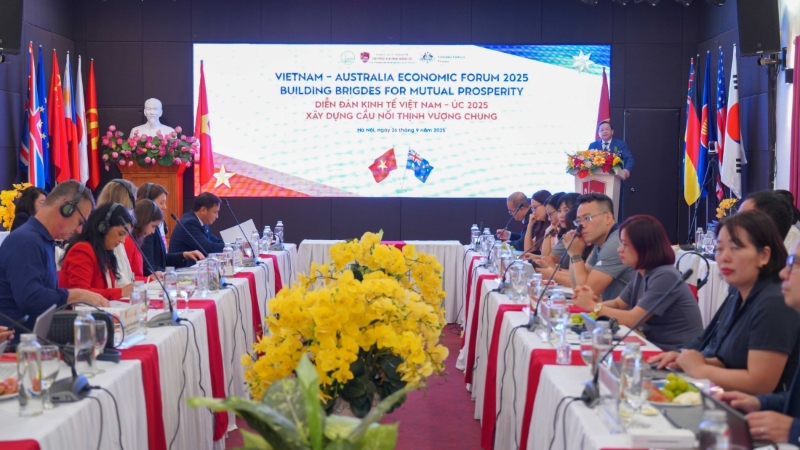
Vietnam has strengthened its position as the leading destination in Southeast Asia for Australian business expansion and investment, according to the Australian Business in Southeast Asia Survey 2025. This makes the 2025 edition the largest dataset in the survey’s nine-year history, providing a robust snapshot of Australian business sentiment, performance, and strategic intent across ASEAN.
One of the most significant findings is that 61 per cent of respondents identified Vietnam as a market they are considering for future growth; the highest share recorded by any Southeast Asian economy in the survey. This places it at the top of the regional rankings for future expansion consideration, well ahead of other ASEAN markets competing for Australian investment.
Strong position
The survey showed that 44 per cent of Australian businesses have plans to expand into Vietnam this year; again the highest proportion in Southeast Asia. These figures indicate that Vietnam is not only attracting attention as a market of potential but is also emerging as the primary destination for near-term investment decisions among Australian businesses.
Taken together, the data suggests that Vietnam has moved beyond being one of several attractive options in the region to become the most prominent focal point for Australian companies seeking growth in Southeast Asia, both for those already operating in the country and for those with a presence elsewhere in ASEAN.
The strong position Vietnam holds reflects broader optimism among Australian businesses about growth prospects in Southeast Asia, even as global economic uncertainty persists. Across the region, 33 per cent of respondents expect significant revenue growth of more than 10 per cent over the next five years, indicating that many continue to view ASEAN as a key driver of medium-term expansion.
Respondents also reported that trade activity across Southeast Asia has expanded over the past two years, suggesting that business momentum has been sustained despite challenges such as inflation, geopolitical tensions, and supply chain disruptions. Within this regional context, Vietnam stands out as the market most closely associated with future growth ambitions.
While the survey does not provide a full country-by-country breakdown of revenue performance, the high proportion of companies considering Vietnam for growth and planning expansion in the country suggests that Australian businesses associate it more strongly than other markets with their future revenue expectations. This positions it as a perceived growth leader within ASEAN.
The survey also highlighted the operational challenges Australian businesses face in Southeast Asia. Government bureaucracy was identified as having a high impact by 40 per cent of respondents, making it the most frequently cited challenge, followed by access to skilled labor (27 per cent) and corruption (24 per cent).
Despite these constraints, the survey data indicates that Australian businesses continue to pursue expansion, suggesting that perceived opportunities outweigh the risks. Vietnam’s leading position in both future growth consideration and planned expansion implies that Australian businesses view it as better positioned than other ASEAN markets to manage these challenges while still delivering growth.
Market scale is an important underlying factor in this assessment. Vietnam’s large population and rising domestic demand align closely with respondents’ growth expectations, particularly for companies operating in consumer-facing sectors alongside export-oriented activities. Though the survey did not quantify sector-specific outcomes by country, Vietnam’s dominance in future expansion intent suggests that Australian businesses see its market fundamentals as especially supportive of long-term growth.
From interest to action
According to the survey, Vietnam’s economy is among the fastest-growing in Southeast Asia, powered by surging exports, strong manufacturing, services, and robust inflows of FDI. For Australian businesses, the country is a key trade partner offering ripe opportunities in manufacturing, the digital economy, infrastructure, renewables, and education - all buoyed by expanded trade agreements, strategic reforms, and ambitious infrastructure investment programs.
Furthermore, in capitalizing on its gradual integration into the global trade and investment system, Vietnam’s economy is becoming more market-oriented. Ongoing reforms have strengthened trade openness, enhanced investment freedom, and improved regulatory efficiency, positioning the country as one of Southeast Asia’s most dynamic and competitive emerging markets.
Vietnam’s 44 per cent expansion-by-2026 figure indicates a comparatively strong conversion from strategic intent to operational planning. This is particularly notable in a regional environment characterized by elevated uncertainty.
The survey showed that Australian businesses are making selective decisions about where to allocate capital and resources, prioritizing markets that combine growth potential with a degree of predictability. Vietnam’s top ranking on both future growth consideration and planned expansion suggests that it meets these criteria more convincingly than other Southeast Asian destinations.
Survey data also points to the importance of regional integration in shaping business decisions. A substantial majority of respondents agreed that ASEAN’s economic integration supports business activity in the region. Vietnam’s participation in regional trade frameworks such as the ASEAN-Australia-New Zealand Free Trade Area and the Regional Comprehensive Economic Partnership (RCEP) enhances its appeal as a base for serving both domestic and wider ASEAN markets, reinforcing its position in Australian businesses’ regional strategies.
At the same time, the data also points to a clear set of risks and operational challenges facing Australian businesses in Vietnam. The most significant identified by respondents were political instability globally (39 per cent), followed by disruptions to international cooperation (27 per cent), impediments to trade such as tariffs and quotas (26 per cent), and changes in the regulatory environment (26 per cent).
The Australian Business in Southeast Asia Survey 2025, conducted by AusCham ASEAN in partnership with RMIT University, received responses from more than 300 Australian businesses operating in, or considering entry into, Southeast Asian markets.
At the operational level, corruption and poor governance emerged as the leading challenge, as cited by 38 per cent of respondents in Vietnam, ahead of barriers to ownership and investment (24 per cent) and the quality and ease of banking services (23 per cent). Infrastructure gaps (21 per cent) and the time and cost of import-export procedures (20 per cent) were also notable concerns.
Overall, the quantitative evidence from the Australian Business in Southeast Asia Survey 2025 presents a clear conclusion: Vietnam has emerged as the leading destination in Southeast Asia for Australian business expansion. In a region offering both opportunity and complexity, the survey data shows that Vietnam is the market where Australian businesses are most prepared to commit capital, resources, and long-term strategic focus.



 Google translate