


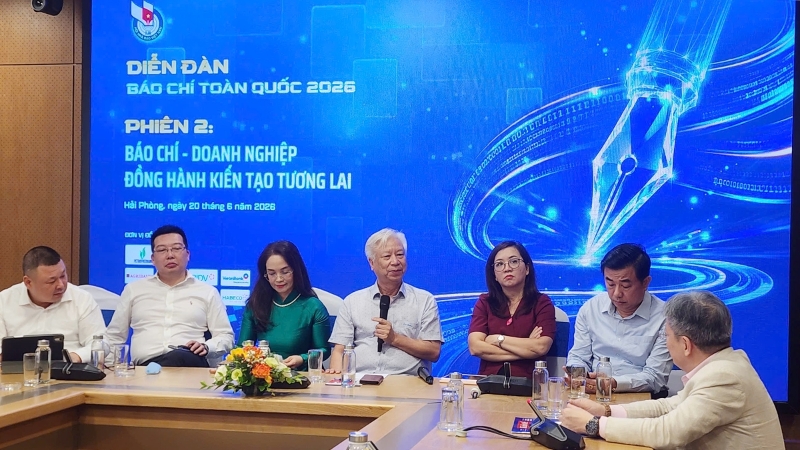
At the forum "Press - Businesses Accompanying to Create the Future" held on June 20 on the sidelines of the National Press Festival 2026 in Hai Phong city, speakers, including journalists and business representatives, discussed and dissected issues to ensure that the press and businesses work closely together, allowing the press to continue playing a leading role amidst the information explosion, social media, and the rising influence of artificial intelligence (AI).
Trust is built from correct information
From a business perspective, Ms. Le Thi Hong Nhi, Deputy General Director of Communications, External Relations, and Sustainable Development at Unilever Vietnam, highly appreciated the important role of the press in connecting information with social context, helping the public understand issues correctly and promoting constructive dialogues. When information is understood correctly, trust will be strengthened; when trust is strengthened, society will have more motivation to act.
"However, trust is not something that exists automatically. Trust must be built from correct information, responsible dialogue, and substantial actions that can be verified," Ms. Nhi said.
Addressing the current state of information, Ms. Nhi stated that social media can rapidly impact readers' emotions. Many unverified pieces of information can spread easily and have a wide influence. In this context, businesses need to proactively engage in dialogue, ensure transparency of information to protect their reputation, while the press needs to maintain a two-way information mechanism to help the public access the full essence of events.
From the perspective of the financial sector, Mr. Chu Hai Cong, Public Relations Director at the MB Bank, noted that Vietnam currently has 137 million mobile connections, 85.6 million internet users, and 78 million social media accounts. According to Mr. Cong, society today is not lacking information, but is facing challenges regarding trust in information. In the era of AI and the explosion of social media, the biggest challenge is no longer accessing information but identifying what is trustworthy information.
To illustrate the impact of the trust crisis, the representative from the MB Bank cited the collapse of Lehman Brothers in 2008 and the crisis at Silicon Valley Bank in 2023. When public trust is damaged, waves of withdrawals and stock sell-offs occur, causing financial institutions to quickly lose liquidity. "Trust is an intangible asset, but when lost, the damage is entirely tangible," Mr. Cong remarked.
In the digital economy, technology helps connect, data helps operate, but trust is the factor that enables society to accept and accompany. Trust is not created by calls for it but is formed through actions and reinforced by the truth. The MB representative also stated that customers may come to the bank for products but will stay because of trust.
Therefore, businesses must be responsible for maintaining transparency, ensuring asset safety, protecting data, and creating real value for customers. At the same time, the press and businesses need to enhance mechanisms for sharing, verifying, and interacting to build a healthy information environment together.
The press must be authentic, aiming for positive effectiveness
Leading the discussion on trust in the current context, Mr. Le Quoc Vinh, Chairman of Le Bros Media Group, raised the question of whether public trust is being shaken by the explosion of fake news and unverified content in cyberspace.
Mr. Nguyen Minh Duc, Deputy Director of Hanoi Press, Radio and Television, believes that trust is an eternal value. The press has legitimacy and must protect the truth. In an era where fake news is rampant, all information needs to be verified and confirmed from multiple sources before publication.
Ms. Vu Thi Anh Hong, Deputy Editor-in-Chief of the Economic - Finance Magazine, stated that public trust is only formed when the press effectively fulfills its role of conveying the truth and disseminating accurate information. Referring to the story of importing scrap materials during 2018-2019, when concerns arose about Vietnam becoming the "world's trash dump," Ms. Hong noted that the press stepped in to clarify information and urged regulatory agencies to implement appropriate solutions.
For the press and businesses to accompany each other, in addition to policy communication, the press needs to spend more time listening to the thoughts and recommendations of businesses, thereby proposing solutions to improve mechanisms and policies that align with reality. Businesses must also be bold in providing information to the press, as there has been a tendency for businesses to hesitate or not truly engage in responding to the press.
Mr. Nguyen Anh Vu, Editor-in-Chief of Culture Newspaper, likened trust to the soft infrastructure of society. The press sometimes chases views, leading to unverified and inauthentic reporting, gradually losing readers. "We can be slow, but it must be true and clean, with reasoning, guiding, and orienting public opinion. Businesses must also build trust through correct business practices and environmental protection," Mr. Vu stated.
Speaking at the panel discussion, Mr. Dao Quang Binh, Vice Chairman of the Editorial Board, General Director, and General Managing Editor of Tap chi Kinh te Viet Nam / Vietnam Economic Times / VnEconomy, affirmed that trust is a particularly important spiritual foundation for the press, businesses, and society as a whole. According to Mr. Binh, the press operates in an environment where social media also reports news, and AI can also create content. Therefore, the distinguishing factor of mainstream journalism is the ability to verify, confirm, and ensure the authenticity of information. "To maintain trust, the press must prioritize authenticity and verification," Mr. Binh said.
However, press information not only needs to be correct but also useful, providing positive value to society, contributing to guiding and promoting development. Information provided by Tap chi Kinh te Viet Nam / Vietnam Economic Times / VnEconomy has always aimed for positivity. "The press must not only provide 'correct' but also 'worthy' information which must bring positive effects to society; if it causes harm, it should not be used. The ultimate criterion of the press is that information must be beneficial to society," said Mr. Binh.
In response to the question of how to create a bridge between the press and businesses, Mr. Binh stated that after 35 years of accompanying businesses, Tap chi Kinh te Viet Nam / Vietnam Economic Times / VnEconomy has now taken a further step to stand alongside businesses. Economic journalism has an advantage since businesses are already the subjects served by the press. However, the editorial office must have an organic connection with the business's communication department, understanding the business to create a bridge. "We have a division to communicate with the PR staff of businesses, with all information conveyed immediately," Mr. Binh said.
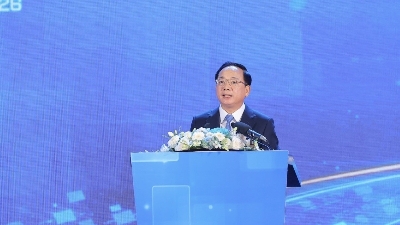
Speaking at the panel discussion, Mr. Le Quoc Minh, Chairman of the Vietnam Journalists Association, noted that the press's revenue mainly comes from businesses, making the role of businesses extremely important to the press. Therefore, mutual support is very much needed. However, in recent times, this relationship has evolved differently, leading to a context that businesses feeling apprehensive and complaining that the press is not operating healthily. "The press and businesses must accompany each other, not think that 'you need me, but I don't need you,” Mr. Minh said.
 Google translate