


At a discussion session titled “Infrastructure, industrial zones, logistics, and urban connectivity: From advantages to productivity” held on November 1 during 2026 DIGIFEST Dong Nai, speakers focused on infrastructure connectivity and logistics solutions for the province.
Discussions centered on integrating transport infrastructure with data infrastructure, structuring service chains around enterprise needs, and measuring efficiency through transport time and cost savings.
Structuring logistics chains around sector-specific demand
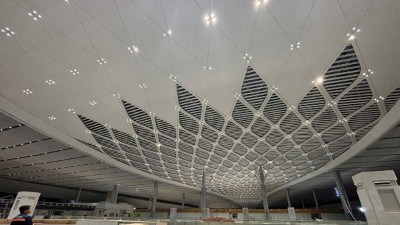
Dong Nai holds some of Vietnam's most critical infrastructure hubs, including Long Thanh International Airport, Phuoc An and Go Dau - Phuoc Thai seaport systems, industrial parks, and inter-regional road and rail networks. This foundation enables multimodal transport, high-quality logistics services, and international trade. However, the core challenge lies in connecting and operating these facilities as a unified network rather than isolated projects.
Mr. Duong Van Hieu, Deputy Director of the Dong Nai Department of Construction, noted that developing a smart logistics, airport, and seaport ecosystem is strategically vital for spatial organization, infrastructure investment, and regional competitiveness.
"The key question is how to ensure these infrastructure advantages do not merely exist side by side, but actively connect, coordinate, and function as a unified whole," Mr. Hieu said, emphasizing that Dong Nai must define an appropriate digital logistics ecosystem model, prioritize key issues, and translate plans into actionable strategies.
Addressing sector-specific logistics supply chains was another primary focus.
Mr. Le Quoc Anh, Member of the Board of Members of Vietnam Post, highlighted that each commodity group has distinct requirements for timing, quality, and logistics costs. For agricultural logistics, challenges stem from seasonality, preservation conditions, and shelf life. Improper handling during collection, storage, transport, and distribution leads to product loss and quality deterioration.
Vietnam Post proposed designing agricultural service chains from production hubs to end markets, combining collection, cold storage, transport, and distribution through direct capacity and strategic partners. Mr. Le Quoc Anh noted this solution aims to minimize losses, control logistics expenses, and boost net returns for farmers and enterprises.
Integrating data infrastructure from the planning phase
Beyond transport hubs and service chains, speakers underscored the need to build data infrastructure alongside transport networks.
In the digital economy, artificial intelligence (AI), the Internet of Things (IoT), and cloud computing enable tracking, forecasting, and operational optimization across transport and warehousing.
Mr. Nguyen Minh Quang, Deputy Director in charge of the Dong Nai Department of Science and Technology, stressed that data and transport infrastructure must be integrated during initial planning and construction stages, rather than adding digital layers after physical completion.
Mr. Quang requested municipal departments to collaborate with the Department of Science and Technology to advise the municipal People's Committee on building a digital logistics ecosystem scheme under the principle of "Real problems - Real solutions - Real efficiency."
Efficiency must be measured by time, costs, and end-user benefits. For enterprises, performance metrics include transit time, inventory storage costs, loss rates, and quality control. For regulatory authorities, success will be reflected in data integration, infrastructure coordination, and operational efficiency.






 Google translate