


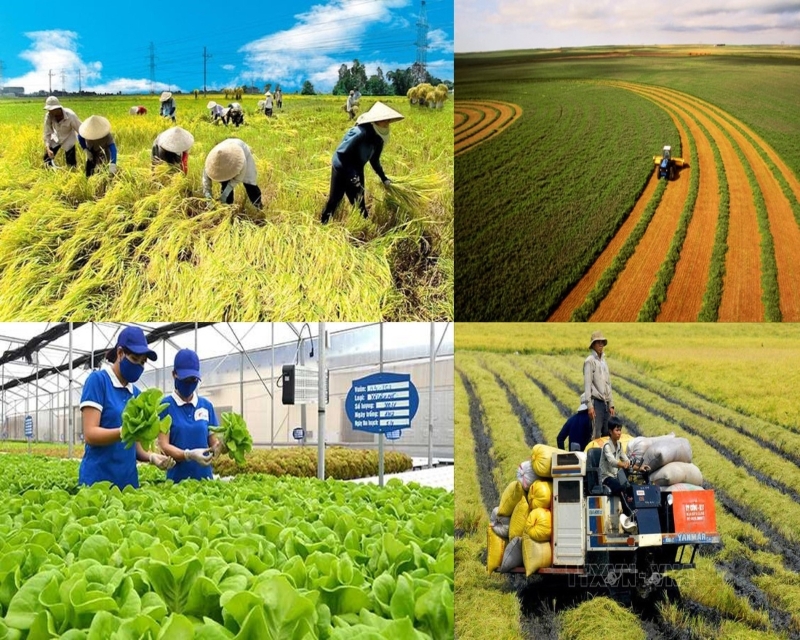
Vietnam’s agriculture and environment sector recorded a major breakthrough in 2025, posting growth of around 4 per cent - the highest result for a decade. Export turnover reached a record $70 billion, far exceeding the initial target of $65 billion. These figures reaffirm the sector’s role as a solid “pillar” of the economy amid mounting challenges, while laying an important foundation for green and sustainable development.
Deputy Minister of Agriculture and Environment Phung Duc Tien said 2025 was exceptionally difficult, marked by unprecedented challenges. The sector not only suffered heavy losses from natural disasters but also faced a volatile global environment, from rising trade tensions to increasingly stringent technical barriers related to traceability and food safety. However, in the midst of these pressures, the sector maintained its core targets and sustained stable growth.
Growth exceeds targets
According to the Ministry of Agriculture and Environment (MAE), output of many key agricultural products continued to rise or remained stable in 2025. Rice production was estimated at more than 43 million tons; livestock and poultry herds developed steadily; plantation forest timber output reached nearly 31 million cubic meters; and aquaculture and captured fisheries were estimated at around 9.8 million tons. In trade, exports of agriculture, forestry and fisheries products in 2025 were estimated at a record $70 billion, up 12.2 per cent year-on-year and well above the $65 billion target.
Mr. Tien said production restructuring continued towards greater efficiency, with a focus on products with strong growth potential and higher added value. Concentrated production zones based on regional advantages have taken shape, applying advanced technical processes, ensuring food safety, and meeting market demand, such as raw material forest areas for wood processing and fruit and vegetable zones meeting GlobalGAP and VietGAP standards. Organic agriculture, clean agriculture, and high-tech agriculture continued to be promoted, gradually shaping a green, clean and sustainable agricultural model.
On the institutional front, regulations related to decentralization and the delegation of authority were reviewed, updated, and submitted for approval. MAE completed a law amending 15 existing laws to remove major institutional bottlenecks, while significantly cutting administrative procedures to facilitate businesses and the public. “Institutional reform is a prerequisite, alongside decisive and substantive administrative reform,” Mr. Tien emphasized.
He added that the Ministry is implementing Politburo Resolution No. 57-NQ/TW on science, technology, and innovation as a strategic breakthrough for green growth, productivity gains, and higher agricultural value. At the same time, efforts to combat illegal, unreported, and unregulated (IUU) fishing remain a regular and determined task, aimed at removing the European Commission’s “yellow card.”
Pillar for green growth
2025 also marked a major turning point, as the 15th National Assembly approved the merger of the Ministry of Natural Resources and Environment with the Ministry of Agriculture and Rural Development, forming the Ministry of Agriculture and Environment from March 1, 2025. Minister of Agriculture and Environment Tran Duc Thang said this was a strategic decision by the Party and the State to improve the effectiveness of management, exploitation, and the sustainable use of national resources. Following the merger, the Ministry swiftly streamlined its organizational structure to ensure smooth and effective operations.
Amid accelerating globalization, Industry 4.0, and the global green transition, the Minister said the sector will focus on several key priorities, which include completing institutions and modern governance, and synchronizing the legal framework on land, water resources, forests, environment, climate, and agriculture. MAE will also promote ecological agriculture, the green economy, and the circular economy to enhance added value and the competitiveness of Vietnamese agricultural products.
The sustainable management and exploitation of national resources will go hand-in-hand with accelerated data digitization, the application of science and technology, and the digital transformation, which are seen as key drivers to improve productivity, efficiency, and climate resilience. “With a spirit of innovation and dedication, the agriculture and environment sector will continue to serve as a pillar of the economy, contributing to a fast-growing, sustainable, prosperous, and happy Vietnam,” Mr. Thang said.
On food safety, he noted that the legal framework is now relatively complete and clear. While previous management focused mainly on export-oriented production areas, from January 1, 2026, the Ministry will also strictly control products for domestic consumption. The goal is that, by the end of 2026, virtually all domestically produced and imported agricultural products circulating in the market will carry traceability information and meet safety standards, protecting public health and strengthening social trust.
Top priority
Chairing his dialogue with farmers on December 10, Prime Minister Pham Minh Chinh reaffirmed the consistent and enduring attention of the Party and the State to agriculture, farmers, and rural areas. Based on farmers’ opinions and recommendations, he highlighted key issues facing the agriculture, forestry, and fisheries sector. Science and technology, innovation, and digital transformation were identified as objective requirements, strategic choices, top priorities, and prerequisites for achieving the goal of raising agriculture, forestry and fisheries export turnover to $100 billion in the years to come.
However, the Prime Minister also pointed out that a significant gap remains between research and the application of science and technology in production. Digital transformation in rural areas faces difficulties due to inadequate electricity, telecommunications, and data infrastructure, particularly in remote, border, island, and ethnic minority areas. The incomes of most farmers remain low and they are vulnerable to natural disasters, epidemics, and market fluctuations.
Against this backdrop, the Prime Minister called on ministries, agencies, and localities to continue reviewing and developing more open mechanisms and policies on land, credit, science and technology and digital transformation in agriculture; rolling out credit programs to support agriculture and rural areas; and removing obstacles to develop agricultural insurance markets to help farmers manage risks from natural disasters, crop failures, and price volatility.
On domestic and international links, he urged the MAE and the Ministry of Finance to build close, legally-binding cooperative mechanisms between domestic enterprises and foreign investors. Many countries, particularly in the Middle East, Africa, and neighboring regions, have expressed interest in cooperating with Vietnam in agriculture, food security, and product development.
Regarding export markets, he stressed the need to diversify markets, products, and supply chains, and to make more effective use of Vietnam’s 17 FTAs with more than 60 economies. Relevant ministries should proactively negotiate market access, while businesses and associations step up trade promotion and product branding.
On infrastructure, the Prime Minister underscored the importance of climate resilient infrastructure, digital infrastructure, and transport infrastructure. The State will continue to prioritize resources for major projects to create new development space, reduce logistics costs, and enhance the competitiveness of Vietnamese agricultural products.
Regarding the removal of the IUU “yellow card,” he said the government has taken strong measures to end illegal fishing, while restructuring the fisheries sector towards legality and sustainability, expanding aquaculture and processing, and improving fishermen’s livelihoods.
In production, he called for promoting green production, the circular economy, and low-emissions development; ensuring food safety and traceability; protecting intellectual property; and combating trade fraud. On human resources, he emphasized strengthening links between the State, educational institutions, and enterprises to train high-quality human resources, improving knowledge and skills for farmers.
Finally, the Prime Minister emphasized the need to enhance value chain links and solidarity between domestic and international stakeholders, mobilizing diverse resources through public and private investment, public-private partnerships and other financial instruments, based on the principle of harmonizing interests between the State, businesses, and farmers.





 Google translate