


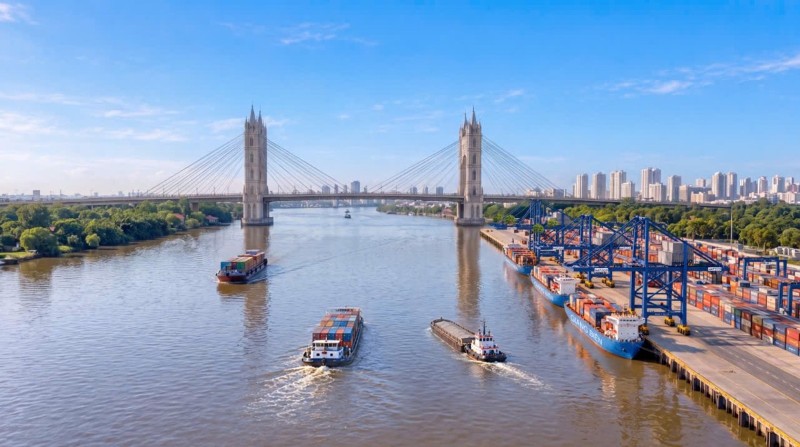
Hanoi has broken ground on the Giang Bien inland waterway port, a project intended to strengthen logistics along the capital’s eastern corridor and connect northern production centres with the Hai Phong–Lach Huyen seaport system.
The project covers more than 35 hectares, including 23.87 hectares of land and 11.23 hectares of port waters. With approximately 600 meters of berthing facilities, the port is designed to handle two million tonnes of cargo annually.
Total investment is estimated at VND2.55 trillion ($96.8 million).
The port will include cargo yards, internal roads, technical infrastructure and supporting facilities for cargo storage, loading, unloading and transshipment.
Its location on the Duong River is expected to facilitate connections with the Red River system and northern Vietnam’s inland waterways. Planned shipping corridors include the approximately 280-km Viet Tri–Hanoi–Pha Lai–Hai Phong–Quang Ninh route and the 145-km Giang Bien–Ba Lat–Tra Ly–Nam Trieu route.
Cargo arriving from Hai Phong’s seaports could be transported by river to Giang Bien before being distributed by road to Hanoi, Bac Ninh and nearby industrial parks. In the opposite direction, goods from manufacturing centres could be consolidated at the port before being shipped to export and import gateways.
Road access will also be important to the port’s operations. The site can connect with National Highways 5 and 1 and other regional routes. Planned links include the LK58 road connecting National Highway 5 to the port, as well as a proposed connection to the Giang Bien Bridge approach road, designed with a 25-metre-wide cross-section and six traffic lanes.





 Google translate