


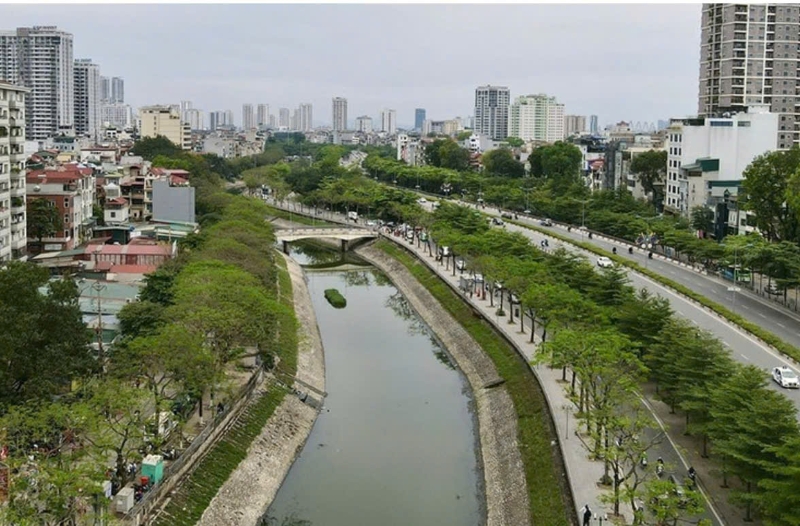
The Hanoi People's Council has passed a Resolution on policies for urban renovation, beautification, and Transit-Oriented Development (TOD) within the city.
The Resolution introduces several specific regulations regarding developer selection, compensation, support, and resettlement, aimed at resolving existing bottlenecks and accelerating the progress of urban renovation projects.
According to the Resolution, project boundaries for urban renovation and beautification are initially established by the City People's Committee upon the project's public announcement. However, during the detailed planning research phase, developers have the right to propose boundary adjustments. The boundaries defined in the detailed planning approved by the City People's Committee will serve as the official boundaries for the renovation project.
In addition to establishing project boundaries, the Resolution stipulates the process for selecting developers. Accordingly, homeowners and land users within the project area may propose to implement the project themselves in accordance with the approved planning. This case requires 100% consensus among all homeowners and land users. Alternatively, they may nominate a developer to implement the project for the City People's Committee's consideration and approval.
Beyond developer selection, the Resolution clearly outlines the plans for compensation, support, and resettlement. Notably, a compensation and resettlement plan will be approved if it receives consensus from at least 75% of the homeowners and land users. Regarding the renovation and reconstruction of apartment buildings or complexes, a 75% consensus from apartment owners and legal land users is required.
Furthermore, regarding compensation and resettlement support policies, homeowners and land users whose property is recovered within the scope of urban renovation, beautification, or reconstruction projects (for residential purposes) will be considered for on-site resettlement. An exception applies if the developer proposes an alternative plan—to balance and ensure the project's financial efficiency—which must be approved by the competent authorities.
Alongside incentive mechanisms and support to speed up implementation, the Resolution also specifies cases in which developer selection and investment policy approval will be revoked.
Specifically, the city will revoke the selection of a project developer if, after 12 months from the date of selection and after three rounds of formal consultation with homeowners and land users, a 75% consensus rate (representing at least 75% of the total land area in the renovation zone) cannot be reached.
Additionally, the city will revoke the investment policy and select a different developer if, within six months of completing all administrative procedures required to commence construction, the developer fails to break ground or implement the project according to the approved schedule.







 Google translate