


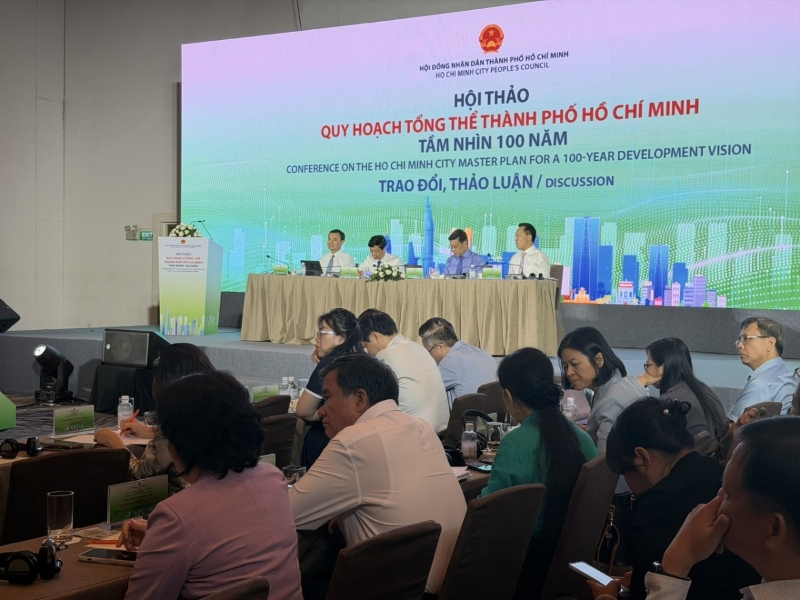
The Ho Chi Minh City People’s Council hosted a seminar titled "Ho Chi Minh City Master Plan: A 100-Year Vision" on June 2, during which the draft master plan—jointly developed by the National Institute for Urban and Rural Planning (VIUP) and Boston Consulting Group (BCG)—was presented for the first time.
Fundamental shift in planning mindset
The most widely supported consensus at the seminar was not centered on specific targets, but rather the urgent need for a fundamental transformation in planning philosophy.
Dr. Tran Du Lich, former Deputy Head of the HCMC National Assembly delegation, raised a pivotal question: "In the past, planning primarily focused on ‘what to do with this piece of land.’ However, the new mindset must address much larger questions: Which economic sectors will generate the highest value? How will people live and work? What infrastructure will trigger a breakthrough in productivity? And what factors will ensure sustainable development and climate resilience?"
"With a total area of over 6,700 sq.km and a population of approximately 14 million following administrative mergers, the city is no longer just a single urban entity; it is evolving into a megacity region. Our planning must reflect this reality. This shift in mindset carries profound practical significance," Mr. Lich said.
Echoing this view, Deputy Director of the National Institute for Urban and Rural Planning (VIUP) Sam Minh Tuan stated that HCMC’s greatest challenge is not a lack of development potential. Instead, it lies in the ability to reorganize resources and development space into a unified, multi-centric, and efficiently functioning structure.
The "5-5-10" model and six specialized zones
The draft master plan proposes that the city operate as a multi-centric megacity based on a "5-5-10" structure: 5 dynamic growth poles, 5 strategic axes, and 10 development management zones. This structure will be interconnected by a multi-layered urban infrastructure network—including metros, Transit-Oriented Development (TOD), and both underground and elevated spaces—serving as the city's "backbone."
To integrate deeply into global value chains, the plan establishes six specialized zones backed by breakthrough regulatory mechanisms: high-tech zone (Thu Duc and vicinity) specializing in semiconductor chips, electronics, and robotics; free trade zone (Cai Mep - Can Gio port cluster) integrating logistics with export-oriented manufacturing; International Financial Center operating under a legal framework aligned with international best practices; digital and data tech enter prioritizing computing infrastructure, Artificial Intelligence (AI), and cybersecurity; national energy hub developing LNG, hydrogen, and offshore wind power; and commercial and cultural hub focusing on large-scale cultural and trade development.
Contributing to the draft, Architect Ngo Viet Nam Son suggested that HCMC could achieve double-digit growth by aggressively pursuing regional connectivity. This includes strengthening links with Dong Nai City and Tay Ninh Province toward border gates and the Central Highlands, while simultaneously tapping into the East Sea corridor via the Cai Mep - Thi Vai port cluster.
"Many of the urban models proposed for HCMC, such as TODs and Free Trade Zones, are unprecedented in Vietnam’s current legal system. Therefore, a corresponding legal foundation is required to bring these plans to life," Mr. Son noted.
Productivity: critical bottleneck for growth
Mr. Vu Ngoc Dung, representing a research group that compared 40 competitiveness indices of the city with approximately 50 Southeast Asian metropolitan areas, presented several noteworthy findings. While HCMC's greatest historical advantages have been its large population and young workforce, data shows that population growth and the city's ability to attract new residents have slowed significantly since 2021.
"To maintain high growth rates in the future, the city must remain attractive to both residents and businesses by offering superior living and working conditions," Mr. Dung suggested.
The most critical point in Mr. Dung’s analysis was his warning regarding a "productivity trap." The productivity gap between HCMC and other localities is narrowing, while the costs associated with traffic congestion, logistics, and housing are increasingly becoming barriers to investment. Consequently, to accelerate growth, the city must lower operational costs for businesses and the cost of living for residents. These are the prerequisites for continuing to attract investment, securing high-quality labor, and maintaining development momentum.
Echoing this sentiment, Mr. Vu Doan Thai Long, Senior Project Manager at Roland Berger Vietnam, argued that HCMC does not lack potential, but rather the mechanisms to transform that potential into a sustainable growth model.
"The city needs to focus on high-value industries such as semiconductors, biotechnology, and specialized hubs for healthcare, education, logistics, and the digital economy," Mr. Long proposed. He further recommended the establishment of a powerful city-level coordination mechanism, "institutional sandboxes," and iconic projects with a strong "spillover" effect.
Resources and international cooperation
Regarding the financing of the master plan, Ms. Vu Hoang Uyen, a representative from the World Bank, proposed restructuring public investment to focus on key programs such as Transit-Oriented Development (TOD). With rational resource allocation, HCMC could potentially absorb three to five times the VND800 trillion ($30.4 billion) currently earmarked for public investment over a five-year period. She also suggested utilizing green bonds and carbon credits as supplementary financial tools.
Notably, diplomatic representatives from Singapore and France both affirmed their readiness to support HCMC in its planning process—ranging from multimodal connectivity models to transportation infrastructure and the development of high-quality urban living spaces.
 Google translate