


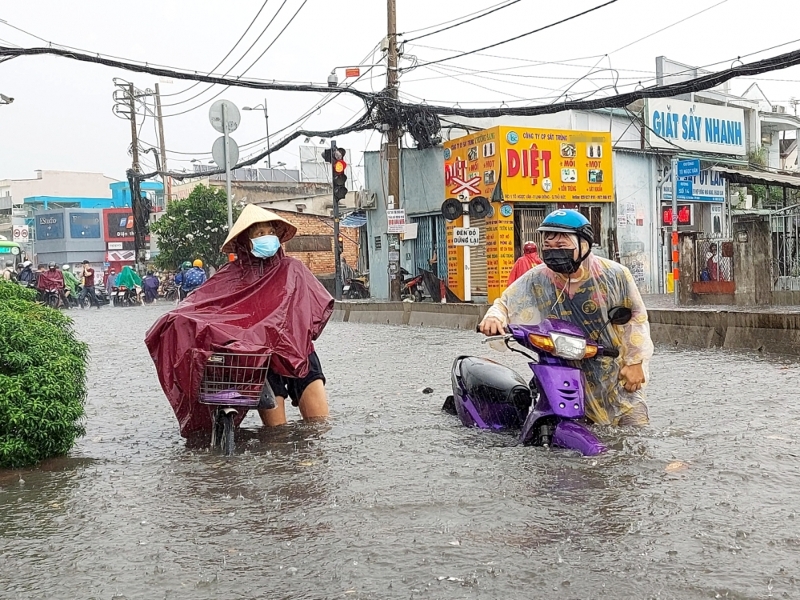
Ho Chi Minh City is drafting a comprehensive master plan for flood control and wastewater treatment for the 2026–2060 period, alongside a detailed implementation plan for 2026–2036. For the first time, urban water management will be studied based on river basins rather than restricted by administrative boundaries.
According to the city Department of Construction, this basin-based approach allows for a more accurate identification of water flows, the relationship between upstream, downstream, and estuaries, hydraulic bottlenecks, and areas affected by the ripple effects of flooding. Furthermore, the project sets out an integrated approach combining flood control, drainage, wastewater treatment, urban water management, environmental protection, and climate change adaptation.
As an initial step, the project will review the entire legal framework, existing urban planning, and previous programs related to drainage and wastewater. This includes evaluating the continuity of past initiatives, such as "Project 299," which has already been implemented in the city.
In parallel, the city will conduct a comprehensive assessment of the current state of flooding, drainage systems, tidal control, and wastewater collection across all districts post-merger. This effort will include the creation of a digital GIS (Geographic Information System) database mapping flood points, drainage works, tidal control structures, and wastewater treatment systems.
A notable highlight of the project is the development of growth scenarios that account for population increases, rapid urbanization, climate change, sea-level rise, and land subsidence. Based on these scenarios, technical analyses and flood-risk modeling will be conducted to identify priority basins for intervention and create a flood-risk zoning map for the entire city.
The draft outline also specifies that the city will establish a set of quantitative indicators for various sectors, including flood reduction, drainage capacity, wastewater collection and treatment rates, operational efficiency, resilience, and water reuse.
Beyond traditional "gray infrastructure"—such as sewers, dikes, pumping stations, tidal control gates, and treatment plants—the plan places heavy emphasis on integrating "green" and "blue" infrastructure alongside nature-based solutions.
Detention basins, water storage spaces, permeable surfaces, canal systems, ecological wetlands, and aquatic landscapes are viewed as vital components to enhance water regulation and reduce pressure on the city's technical infrastructure.




 Google translate