


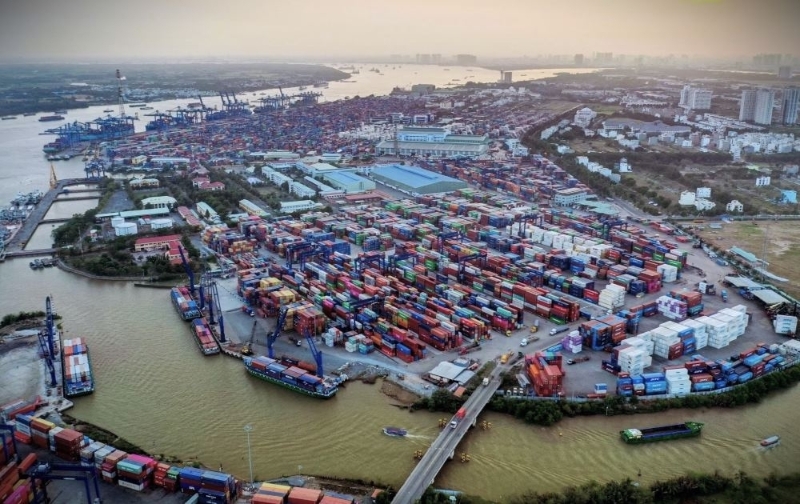
The Ho Chi Minh City People's Committee has issued a decision to establish a Steering Committee to implement the "Strategy for the Sustainable Development of Vietnam’s Marine Economy to 2030, with a vision to 2045."
According to the decision, the committee is tasked with strengthening the leadership, coordination, and implementation of maritime economic development. This comes as the city expands its development space toward a coastal urban model, aiming to become a logistics hub and a national maritime economic center.
Vice Chairman of the city People's Committee, Mr. Bui Minh Thanh, has been appointed as the Head of the Steering Committee. The two Deputy Heads include leaders from the Department of Agriculture and Environment, and the Department of Finance of the city.
The People's Committee noted that the development and implementation of the city’s Maritime Economic Scheme must be reviewed and adjusted based on new administrative boundaries and the strategic orientation of a coastal "megacity." The focus will be on developing port systems, logistics, high-tech industries, maritime services, sea tourism, the maritime economy, and the efficient, sustainable exploitation of marine resources.
The Department of Agriculture and Environment has been assigned to lead the review of relevant planning to build action plans and programs that synchronize various strategies. Key priorities include the National Marine Spatial Planning for 2021–2030 (with a vision to 2050) and the Master Plan for the Sustainable Exploitation and Use of Coastal Resources for 2021–2030 (with a vision to 2050), both of which have been approved by the Prime Minister.
Parallel to maritime development, the city is also implementing strategies for smart city development, green growth, and digital transformation to create a foundation for sustainable progress. The ultimate goal is to build a modern global city capable of adapting to climate change and fostering in-depth economic growth.
In its socio-economic development plan for the 2026–2030 period, the city identifies strategic infrastructure, the digital economy, high-tech industry, logistics, and the maritime economy as the key growth drivers for the city’s next phase of development.

 Google translate