


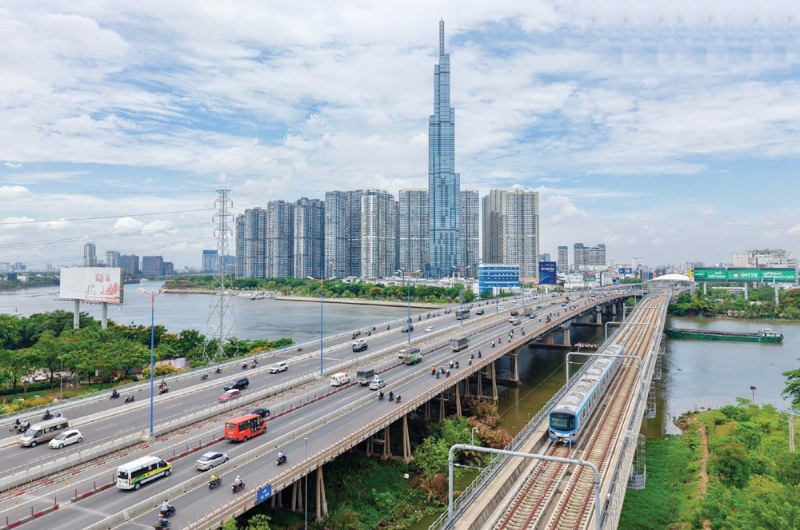
Vietnam has recorded historic progress after nearly four decades of “Doi Moi” (Economic Renewal), but the existing growth model now faces growing structural constraints. The economy remains heavily dependent on investment capital, resource extraction, low-cost labor, and FDI. Labor productivity continues to trail the country’s East Asian peers, domestic innovation remains limited, large private enterprises are still relatively few in number, and institutional and governance bottlenecks persist. At the same time, the rapid rise of AI and automation is heightening the risk of technological lag.
Amid profound global shifts, national development can no longer be defined solely by economic growth or traditional industrialization. A modern development model must be integrated and multidimensional, encompassing development goals, political and legal institutions, economic structure, social well-being as well as environmental sustainability, climate resilience, science and technology, innovation, digital transformation, culture, stakeholder engagement, and international integration. These elements must work together within a long-term framework that can adapt, self-correct, and withstand external shocks.
New dynamics
Digital transformation has become an unavoidable global trend. According to the World Economic Forum (2025), by 2030 around 22 per cent of jobs worldwide will be significantly reshaped by AI and automation, with roughly 170 million new jobs created while some 92 million existing roles may disappear.
Vietnam’s digital economy now accounts for approximately 14.2 per cent of GDP and is among the fastest-growing in Southeast Asia, supported by more than 78 million internet users and over 170 million mobile connections. The country has also taken notable early steps in semiconductors and AI, attracting major technology companies to invest and establish R&D centers.
The green transition is another defining trend, bringing both challenges and opportunities. Vietnam’s net-zero commitment by 2050, announced at COP26, along with the Just Energy Transition Partnership (JETP), requires a major shift in energy systems while creating opportunities to restructure the country’s energy mix toward renewable and clean sources. Green transformation is also becoming essential for maintaining access to major export markets such as the EU, which is introducing stricter carbon-related regulations, including Carbon Border Adjustment Mechanism (CBAM), the Ecodesign for Sustainable Products Regulation (ESPR), and the Corporate Sustainability Reporting Directive (CSRD).
At the same time, technology competition and disruptions caused by global crises are reshaping supply chains. Multinational corporations are increasingly adopting new strategies to diversify FDI flows. Vietnam is emerging as an increasingly attractive destination, with disbursed FDI surpassing $25 billion in 2025.
However, relying primarily on low-value assembly and processing will make it difficult for Vietnam to escape the middle-income trap. The challenge now is to move up the global value chain by strengthening science and technology, enhancing the competitiveness of Vietnamese enterprises, deepening links between FDI and domestic enterprises, and accelerating innovation-driven entrepreneurship.
The 14th National Party Congress set an ambitious target for Vietnam to become a high-income developed country by 2045. Based on the World Bank’s 2024 threshold, high-income status requires Gross National Income (GNI) per capita of around $14,005 annually, meaning Vietnam would need to roughly triple current income levels. This presents a formidable challenge, particularly as the country entered a population aging stage in 2011 and is projected to become an aged society by around 2036.
To adapt to this new reality, Vietnam’s development model must shift toward one driven by Total Factor Productivity (TFP), science and technology, innovation, AI, robotics, data, stronger domestic enterprises, and the digital and green economies, underpinned by modern institutions.
Theoretical framework
A national development model is more than a strategy or a collection of policies. It must answer fundamental questions: What are the country’s development goals? How should development be pursued? Who are the key actors? What values should guide progress? How should the State, market, and society interact? And how should the country integrate with the world? A theoretical framework for Vietnam’s development model in a new era can be built around several core ideas.
Development goals
Vietnam’s new development model should place people at its center, national self-reliance at its foundation, and innovation and knowledge as its main drivers, while making sustainable development and quality of life the ultimate goals. By 2045, the country aims to achieve high-income developed status, while longer-term goals beyond that milestone remain open for further discussion.
In this framework, economic growth is necessary but not sufficient. The ultimate objective is human development and well-being, in line with the thinking of Amartya Sen (1999) and the United Nations Development Programme (1990). Progress, therefore, should be measured not only by GDP but also by broader indicators such as the Human Development Index (HDI), happiness, sustainability, resilience, and adaptive capacity.
Values and development orientation
Vietnam’s new development model should be guided by a clear set of values: a resilient and prosperous nation with strong self-reliance; a democratic, rules-based, fair, and humane society; an innovative, digital, green, and sustainable economy; a harmonious relationship between people and nature; citizens who are compassionate, creative, responsible, and motivated to contribute; an advanced culture rooted in national identity; and a Vietnam that actively integrates into the global economy while contributing responsibly to the international community.
In this context, resilience means both self-reliance and the ability to withstand shocks, while prosperity implies not only modernization but also a higher quality of life. Democracy, the rule of law, and social discipline also depend on effective governance. A key feature of this model is its emphasis on creativity and contribution as drivers of faster growth and stronger competitiveness. This marks a shift from an earlier period, when individuals were expected mainly to follow rules and fulfill responsibilities. In an era shaped by rapid technological change and digital transformation, innovation has become essential for accelerating development.
At the same time, the model retains a defining feature of Vietnam’s development path: its socialist orientation under the leadership of the Communist Party of Vietnam, adapted to national conditions and the demands of a changing era.
Development institutions
Institutions serve as the central “operating system” of Vietnam’s development model, reflecting the arguments of Douglass North (1990) and Daron Acemoglu and James Robinson (2012). Institutional quality shapes a country’s ability to mobilize and allocate resources, sustain market confidence, build social trust, and foster innovation, while preventing governance bottlenecks.
This model calls for a modern socialist rule-of-law state with transparent and stable laws; Party leadership through policy direction and personnel management; data-driven governance built on digital platforms; stronger protection of property rights; accountability and checks on power; fair competition; and legal frameworks that encourage innovation while protecting those willing to take risks.
The State must also undergo three major transitions: from administrative control to development facilitation; from micro-level intervention to strategic coordination, infrastructure investment, and market shaping; and from traditional governance to data-driven digital governance. Politburo Resolution No. 66 identified the legal system as the “breakthrough of breakthroughs,” laying the legal foundation for this transformation.
New growth model and modern economic structure
The growth model is a core component of Vietnam’s broader development framework. Future growth can no longer depend on low-cost labor or extensive expansion. Instead, it must be driven by science and technology, innovation, AI, robotics, big data, high-value-added services, advanced manufacturing, and the digital, green, and circular economies.
These sectors will become Vietnam’s new growth engines, helping narrow productivity gaps with regional peers. Their success will depend on a fully-developed, high-quality market capable of allocating resources efficiently.
By 2045, Vietnam’s economy should evolve into a knowledge- and technology-intensive system. High-value services, including finance, logistics, premium tourism, healthcare, education, and information technology, could account for 65-75 per cent of GDP, in line with developed economies. High-tech and green industries, including semiconductors, smart electronics, renewable energy, electric vehicles, biopharmaceuticals, and advanced materials, should form the industrial backbone. Agriculture, meanwhile, will need to transition toward smarter, greener, circular, and higher-value production.
Emerging sectors such as the digital economy, the data economy, the low-altitude economy, and cultural industries will also play an important role in sustaining faster growth. Together, these shifts represent a strategic transition from an economy driven by resources and low-cost labor to one powered by knowledge, technology, and innovation.
Social policy and human development
In Vietnam’s development model, education, healthcare, social protection, and equal opportunity are not social costs attached to economic growth but essential foundations for long-term development. As argued by Amartya Sen (1999) and James Heckman (2006), human capital is critical both for absorbing new technologies and driving innovation.
Vietnam has a workforce of more than 52 million people and a strong culture of learning. Yet significant gaps remain in areas crucial to the new growth model, including Science, Technology, Engineering, and Mathematics (STEM) studies, AI, semiconductors, biotechnology, advanced materials, and technology management. The shortage of researchers and highly-skilled engineers continues to constrain next-generation industrialization. Closing this gap will require breakthrough policies in education, workforce training, and talent attraction.
The environment and the green economy
Vietnam’s development model treats sustainability and the green economy not as add-ons but as core requirements embedded across every pillar of development. Sustainability must be integrated into the model itself.
This includes more efficient use of land, water, and energy; reducing greenhouse gas emissions in line with Vietnam’s net-zero commitment by 2050; expanding renewable and clean energy sources such as solar, wind, biomass, hydrogen, and next-generation nuclear power; advancing the circular economy; protecting ecosystems; and strengthening energy and environmental security.
The green economy is also becoming a source of competitive advantage, particularly as the EU introduces stricter sustainability regulations such as CBAM, ESPR, and CSRD, while global green finance continues to grow.
Science, technology, and innovation
Science, technology, and innovation are central to Vietnam’s development model. They are not simply policy areas, but forces shaping the economy, social governance, and environmental management. More broadly, they are both the foundation of national development and a strategic breakthrough for faster, more sustainable growth.
Economic, social, environmental, and institutional progress increasingly depend on new technologies, AI, and digital transformation. In the economy, AI, robotics, big data, semiconductors, biotechnology, advanced materials, and digitalization are emerging as new productive forces that can accelerate sustainable growth. In society, technology can improve governance and strengthen inclusion and fairness. In environmental management, AI and digital tools can support ecosystem protection and sustainability.
Culture as the foundation
In Vietnam’s development model, culture is not merely one dimension of social life but a core pillar of development. It provides the values, social cohesion, and long-term strength that shape national progress.
Culture is also an increasingly important driver of growth and innovation. Long-term development depends not only on capital, technology, or natural resources, but also on the values embedded in people, businesses, and institutions. Building culture, therefore, is not only about preserving tradition, but also about shaping the norms and values of a modern society.
As Vietnam’s market economy and digital transformation accelerate, culture also serves as a guide for ensuring development remains humane and sustainable. Economic growth can only be truly sustainable when grounded in progressive values and centered on people.
Culture, therefore, is both the spiritual foundation of society and a source of national strength - a form of soft power that supports development. In Vietnam’s new development model, it should play a central role in human development, institutional quality, and sustainable growth with a distinct national identity.
Taken together, Vietnam’s development model rests on six interconnected pillars: the economy, society, the environment, institutions, science and technology and innovation, and culture. Science, technology, and innovation represent the key breakthrough for faster growth; culture provides continuity and identity; the economy and environment support sustainability and resilience; while institutions enable coordination and effective implementation.
Key actors
Vietnam’s development model is envisioned as a multi-actor development ecosystem, in which each stakeholder plays a distinct role while interacting and reinforcing one another within a layered system. This approach reflects the principles of national innovation system theory developed by Christopher Freeman (1987) and Bengt-Åke Lundvall (1992).
First, the State plays a development-enabling role, responsible for strategic coordination, ensuring the effectiveness of the rule of law, investing in both hard and soft infrastructure, including digital systems, data, education, and science, and sharing risks in strategic technology sectors. This reflects a “next-generation developmental State” that combines lessons from East Asia with Mariana Mazzucato’s mission-oriented approach (2013, 2021).
Second, the private sector is a key engine of growth and innovation. Politburo Resolution No. 68 marked an important shift by placing the private economy at the center of development. Private enterprises are expected to evolve in four directions: serving as the main force behind innovation; commercializing research and technology; leading value chains in sectors where Vietnam holds comparative advantages; and building a new generation of globally-competitive Vietnamese companies. Vietnam currently has nearly 1 million active businesses, yet the number of large, leading firms in high-tech sectors remains limited, underscoring the need for structural change.
Third, the State sector retains a leading role in strategic areas that private enterprises cannot easily undertake alone, including energy, transport and logistics infrastructure, national defense and security, foundational and strategic technologies, development finance, and sovereign investment funds. Politburo Resolution No. 79 calls for restructuring this sector to improve efficiency and transparency.
Fourth, FDI is no longer viewed simply as a source of capital but increasingly as a channel for technology transfer, managerial expertise, and participation in global value chains. The priority now is to strengthen links between FDI firms and domestic enterprises, raise the share of local value added in exports, and use foreign investment as a lever for technological upgrading. The experiences of South Korea and China, both of which used selective FDI policies to build domestic technological capabilities, offer valuable lessons for Vietnam.
Fifth, universities and research institutes are the knowledge engines of a modern economy. They serve four main functions: generating new knowledge, developing and transferring technology, training high-quality talent, especially in STEM and strategic technologies, and incubating technology startups. The “entrepreneurial university” model, exemplified by Stanford, MIT, KAIST, and Tsinghua University, demonstrates how higher education institutions can become direct drivers of economic growth.
Sixth, people are both the ultimate goal and the driving force of Vietnam’s development model. The global Vietnamese community, more than 5.3 million people across over 130 countries, represents a strategic source of knowledge, technology, finance, and international networks, with annual remittances estimated at around $14 billion to $16 billion.
Seventh, the Communist Party of Vietnam plays the central leadership role in the country’s development model by defining long-term priorities, setting strategic direction, issuing resolutions and policy guidance, and selecting and overseeing senior leadership. This role provides long-term strategic stability, an advantage that many developing countries struggle to achieve.
Operating mechanism
Vietnam’s development model functions as an integrated and dynamic system in which different components play distinct yet interconnected roles, reinforcing one another to drive development.
First, institutions sit at the center of the model, shaping the ability to mobilize resources, including capital, labor, land, technology, and knowledge, while influencing market performance, social trust, and incentives for innovation. This is why Douglass North (1990) and Daron Acemoglu and James Robinson (2012) viewed institutions as the key factor behind long-term prosperity.
Second, science and technology, AI, big data, robotics, and innovation are not only transforming production but also creating entirely new industries, from semiconductors and the data economy to AI services and the low-altitude economy. These technologies can raise labor productivity and TFP, becoming a new engine of growth to replace the traditional model based on capital accumulation and low-cost labor.
Third, private Vietnamese enterprises, State-owned enterprises (SOEs), and FDI enterprises are the direct creators of value. Through investment in R&D, the commercialization of research, job creation, and deeper participation in global value chains, businesses will play a critical role in upgrading Vietnam’s economic position.
Fourth, education and healthcare form the foundation of human capital, which underpins all long-term drivers of growth. A healthier, more skilled workforce will determine Vietnam’s capacity to innovate, absorb technology, and sustain productivity gains.
Fifth, culture provides the values and social trust that shape development, reinforcing a spirit of learning, creativity, and national cohesion while strengthening Vietnam’s soft power. Politburo Resolution No. 80 reaffirmed culture as both the spiritual foundation of society and a driver of national development.






 Google translate