


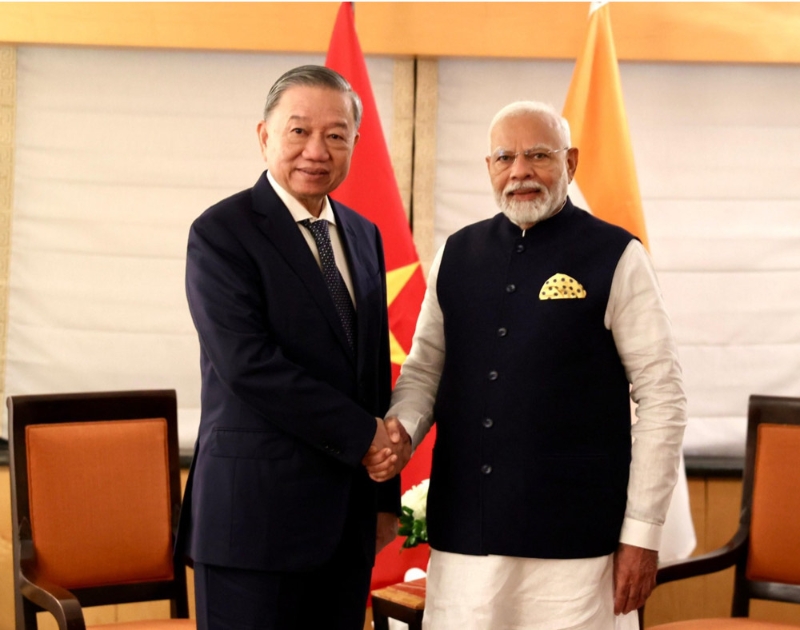
We celebrate ten years of our Comprehensive Strategic Partnership this year. This has been a journey that began together with our respective independence movements and the mutual expression of solidarity with each other. We have since never looked back. This is a friendship with a strong foundation of civilizational linkages, extensive people-to-people ties and mutual trust.
India in 2025: The ‘Year of Reforms’
Prime Minister Modi has called 2025 the “Year of Reforms,” which has witnessed the simplification of governance, modernized institutions and strengthened the foundations for long-term inclusive growth.
2025 has been an exceptional year for the Indian economy, with GDP growth reaching 8.2 per cent, making India the world’s fastest-growing major economy. Despite the global slowdown, foreign direct investment flows have remained resilient. India has moved from promise to laying firm foundations for Viksit Bharat 2047 (Developed India 2047). The impressive growth trajectory has positioned India as the world’s fourth-largest economy.
This transformation to a “New India” is not just about economic growth. It entails good governance, service delivery, people’s participation and empowerment—particularly through the use of technology—and an inclusive and sustainable development model that brings benefits for all, not just a few, while achieving harmony between growth and the environment.
The reforms undertaken by India have been revolutionary across domains. Some of the pathbreaking decisions across different sectors include:
• Boost to ease of doing business.
• Historic labor reforms.
• Diversified and expanded markets for Indian products through new trade deals.
• Maritime and blue economy reforms, with five landmark maritime legislations passed.
• Securities market reforms, with the Securities Market Code Bill introduced in Parliament.
• Boost to small and medium businesses with the expansion of the definition of “small companies” to include firms with turnovers of up to Rs. 100 crore (approximately $10.9 million).
• 100 per cent foreign direct investment permitted in Indian insurance companies.
• Goods and Services Tax reforms with a clean two-slab structure of 5 per cent and 18 per cent.
• Unparalleled relief for the middle class, with individuals earning up to Rs. 12 lakh (approximately $13,100) per annum facing no income tax.
• Landmark nuclear energy reforms with the SHANTI Act 2025.\
• Education reforms initiated with the introduction of a bill in Parliament.
Foreign policy
The global landscape is undergoing profound changes in these uncertain and volatile times. India has set its journey toward deeper engagement with like-minded countries with similar views and convergences. We have sought to maximize freedom of choice and striven to maintain autonomy in decision-making.
Our priorities start with the immediate neighborhood, expressed as “Neighbourhood First,” and are buttressed by a further set of policies that focus on the Gulf, Southeast Asia, Central Asia and the Indian Ocean. India is the voice of the Global South, built on historical solidarity with developing nations and amplifying their views on the global stage.
India remains committed to multilateralism. The need of the hour is a more enlightened and responsive multilateral system, and a new inclusive and non-transactional approach to multilateralism—in short, reformed multilateralism. Reform of multilateral systems, including the United Nations and global financial institutions, is not merely desirable but imperative.
2026 will be an active year for Indian diplomacy. India will host major events such as the AI Impact Summit, the BRICS Summit, the India-Africa Forum Summit and meetings of the International Big Cat Alliance, among others. This will be in addition to numerous bilateral, multilateral and plurilateral events hosted throughout the year.
India is conscious of its growing role on the global stage and understands that the choices it makes to meet its developmental aspirations carry significant implications for the region and the world. India is guided by the philosophy of Vasudhaiva Kutumbakam—“the whole world is one family”—and the doctrine of MAHASAGAR, or “Mutual and Holistic Advancement for Security and Growth Across Regions,” as it shoulders responsibilities for the global good.
India-Vietnam Journey
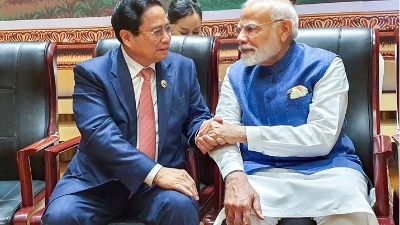
India was one of the first countries with which Vietnam entered into a Comprehensive Strategic Partnership in 2016. Our friendship and close relations predate 1972, when diplomatic relations were established. It is only natural that two civilizations with shared Buddhist and Cham linkages, historical people-to-people ties, contemporary aspirations and strategic convergence enjoy the highest level of friendship.
Vietnam is an important partner in India’s “Act East Policy” and within the Indo-Pacific, based on shared interests in promoting peace, stability and prosperity in the region. We both support evolution rather than expansionism.
Our bilateral partnership covers a vast canvas, including political engagement, development cooperation, defense collaboration, security cooperation, trade and investment ties and extensive people-to-people linkages. We believe that our journey together remains a work in progress.
Innovation, critical and emerging technologies, renewable energy and health care, digital public infrastructure, fintech, electric vehicles, automobiles, pharmaceuticals and electronics are among the areas with significant potential. Financial innovation and digital payments are also promising domains. Creating stronger linkages between the business communities on both sides remains a priority.
Trade and commerce is a sector in which our mutual ambitions have yet to realize their full potential. We are working with Vietnam and other ASEAN countries on updating and reviewing the ASEAN-India Trade in Goods Agreement, signed in 2009, to align with contemporary realities. The review will help enhance trade resilience, mitigate market volatility in an increasingly uncertain world and strengthen supply chains. We look forward to Vietnam’s support in the ongoing AITIGA review as we work to expand bilateral trade.
India and Vietnam have articulated their respective development visions—Developed India @ 2047 (Atmanirbhar Bharat @ 2047) and Vietnam 2045. These complementary goals necessitate deeper cooperation in selected priority areas.
Our shared commitment to international law, our common aspiration for reformed multilateralism and our inclusive vision for regional architecture make India-Vietnam cooperation a stabilizing factor in the region.
India and Vietnam are two rapidly growing economies with youthful demographics and aspirational societies. We share a belief in people-centric and inclusive development. India looks at Vietnam as a steadfast partner in our journey of togetherness, mutual trust and a forward-looking partnership.

 Google translate