


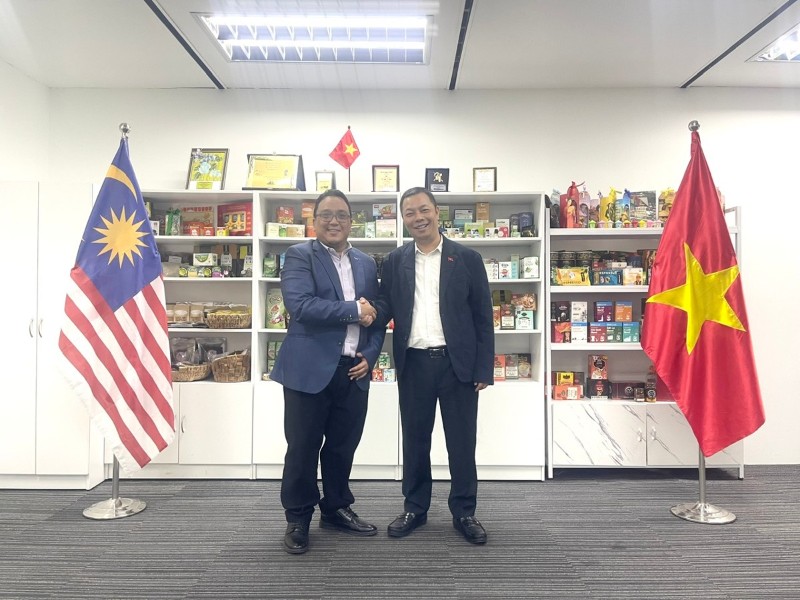
In an effort to promote trade promotion and business matching, the Vietnam Trade Office in Malaysia in early October held a working session with representatives from Aska Jitu Enterprise.
During the meeting, Mr. Ariff Khalid, Director of Business Development of Aska Jitu Enterprise, and Mr. Phung Van Thanh, Commercial Counselor at the Vietnamese Trade Office in Malaysia, discussed the potential for bilateral cooperation.
Leveraging Vietnam’s manufacturing strengths
Evaluating trade opportunities, Mr. Ariff Khalid noted that Vietnam possesses abundant resources, a developed industrial base, and a strong export-oriented manufacturing and processing sector. When combined with Malaysia's position as a leading ASEAN trade hub and a global Islamic commercial center, this collaboration will yield significant mutual benefits, creating a favorable pathway for Vietnamese products to access new markets and the global Muslim community.
Aska Jitu Enterprise plans to import directly from Vietnam and assist Vietnamese exporters with Halal certification procedures, enabling qualified Vietnamese products to enter not only Malaysia but also broader ASEAN, Asian, and African markets, particularly those with large Muslim populations requiring strict Halal standards.
Both Mr. Phung Van Thanh and Mr. Ariff Khalid agreed that Vietnam is emerging as a trusted manufacturing and processing hub with established brand reputations. The country's export catalog ranges from agricultural commodities such as rice, coffee, and pepper to industrial raw materials like rubber and minerals, alongside high-tech goods including smartphones, computers, and machinery.
Halal certification opportunities
Presenting an open letter to the Vietnam Trade Office, Aska Jitu Enterprise expressed its desire to find long-term partners in two primary sectors.
The first category includes pharmaceuticals, healthcare products, and medical supplies, with priority given to circumcision post-operative care, diabetic patient care, surgical consumables, as well as sleep and wellness products.
The second category encompasses consumer goods, personal care, convenience items, household products, food, and industrial goods, prioritizing personal care, convenience, and food products.
Cooperating with Malaysian businesses will help Vietnamese manufacturers adapt and tailor their products to the consumption habits of Muslim communities. Notably, Vietnamese firms will gain favorable conditions to obtain Halal certification under Malaysian standards, a widely globally recognized system.
Through Malaysia’s distribution channels and partner networks, Vietnamese goods can gain direct access to e-commerce hubs, wholesalers, and retailers, while expanding into major markets such as Indonesia, Brunei, Saudi Arabia, the UAE, Qatar, Turkey, Central Asia, and Africa.
To launch this cooperation chain, accepting an invitation from the Vietnam Trade Office in Malaysia, Aska Jitu Enterprise has decided to send representatives to attend the Vietnam Food Expo 2026.
Organized by the Vietnam Trade Promotion Agency under the Ministry of Industry and Trade, the event will take place on November 11-14, at the Saigon Exhibition and Convention Center in Ho Chi Minh City.
This is viewed as a prime opportunity for the Malaysian side to assess Vietnam's manufacturing capabilities and foster direct trade matching for firms interested in the global Halal market.



 Google translate