



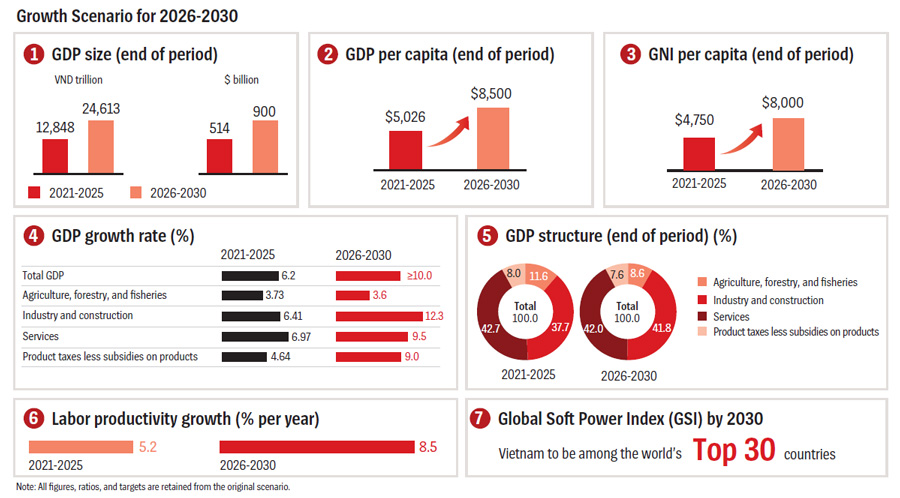
Vietnam is entering a new phase of development with more ambitious requirements as it targets annual GDP growth of 10 per cent or higher during the 2026-2030 period. The previous growth model made a major contribution to Vietnam’s development, but looking ahead, all of the traditional growth drivers have exhibited limitations.
The issue, however, is not to abandon these traditional drivers but to upgrade how they are used to generate greater value. In other words, Vietnam needs to shift from growth based on “more” to growth based on “better.” This is fundamentally a productivity challenge, and the starting point for reshaping the growth model.
Opportunity to reshape growth
External changes are simultaneously creating pressure and opportunities for Vietnam to upgrade its growth model. Three major trends are reshaping the competitive advantages of economies.
The first is AI and new technologies. Automation, data, and AI are transforming production, management, and labor markets. As a result, the advantages from low-cost labor will become increasingly less significant.
The second is the green transition. Carbon emissions, environmental, social, and governance (ESG) practices, and requirements such as the EU’s Carbon Border Adjustment Mechanism (CBAM) are increasingly becoming conditions for businesses seeking market access. Greening the economy is therefore no longer simply an environmental issue and has become an element of competitiveness.
And the third is economic and geopolitical restructuring. Supply chains are being reorganized, while economies are placing greater emphasis on energy and technology security and resilience.
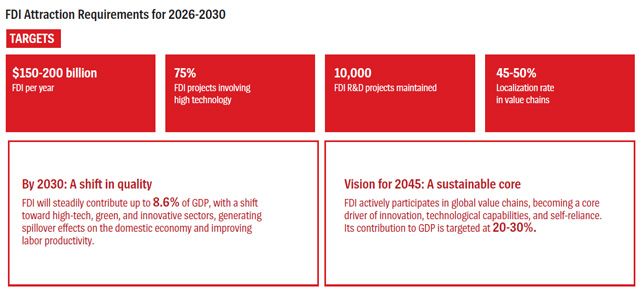
Vietnam benefits from a high degree of trade openness, but this openness also makes the economy more sensitive to external shocks. Therefore, Vietnam’s opportunity lies not only in attracting more factories but also in participating more deeply in value chains and strengthening the economy’s resilience.
Against this backdrop, Vietnam needs to reshape its growth model by shifting from expanding resources to upgrading capabilities, underpinned by five major transformations: from capital accumulation to capability accumulation; from low-cost labor to high-quality human resources; from processing and assembly to technology, design, and R&D, thereby retaining more value domestically; from resource extraction to efficient resource use and a circular economy; and from management and pre-approval controls to facilitation and post-inspection.
The key point is that these five transformations are not separate. They reinforce one another and collectively aim at one fundamental shift: from growth based on “more” to growth based on “better.”
Digital productivity
Digital productivity is not simply about introducing technology into businesses or moving conventional records and processes into a digital environment. The process can begin with data digitization, as physical records and information are converted into digital data. This is followed by process digitalization, in which functions such as procurement, production, sales, logistics, and accounting are connected through digital platforms. At a more advanced level, businesses can apply AI, automation, and data analytics to improve operational efficiency. Digital productivity emerges when technology fundamentally changes how production, management, and decision-making are organized.
According to research by the Institute for Policy and Strategic Studies (IPSS), the impact of digital transformation on Total Factor Productivity (TFP) - a key aspect in achieving high growth - takes time to materialize. In the early stages, businesses must bear investment and learning costs and may experience disruptions as processes are changed. However, as businesses gradually adjust processes, train workers, integrate data, and reorganize production, productivity gains begin to become more apparent.
This also shows why technology investment cannot be equated with higher productivity. A business may invest heavily in software, equipment, or digital platforms, but if its processes, management practices, and workforce skills do not change, productivity may not improve. Technology must therefore be embedded in the organization of production rather than remain confined to information technology (IT) systems. Policies should consequently support businesses throughout the transformation process, from technology investment to changes in processes, skills, and management.
Against this backdrop, AI is opening significant room to raise TFP and create an additional driver of high growth. Under the research scenario, the rate of AI adoption could rise from around 15 per cent in 2025 to 50 per cent in 2030 and 90 per cent by 2045. Accordingly, AI’s contribution to TFP growth could increase from 0.24 percentage points in 2025 to 0.95 percentage points in 2030 and 1.92 percentage points in 2045.
However, AI can generate productivity gains only when it is integrated into production, management, and decision-making, supported by high-quality data, appropriate human resources, digital infrastructure, and new management practices. Vietnam’s challenge, therefore, is not simply to expand AI adoption but, more importantly, to strengthen businesses’ capacity to absorb and leverage AI so that the technology can be translated into higher TFP and economic growth.
If AI and new technologies are adopted rapidly only by large businesses with advantages in capital, data, and human resources, the economy could develop “islands of high productivity” while the gap between different groups of businesses widens. According to estimates from the IPSS research team based on annual enterprise surveys, average TFP stands at around 19.99 for large businesses, 13.19 for medium-sized enterprises, and 8.09 for small businesses. These figures highlight the uneven capacity of different business groups to adopt and leverage technology.
The challenge, therefore, is not merely to create a number of technology leaders but to establish mechanisms for productivity gains to spread more broadly. Large businesses and the FDI sector can play a leading role in supply chains; infrastructure and data access need to be expanded; AI needs to become affordable for small and medium-sized enterprises (SMEs); and businesses’ management capabilities and workforce skills must also be strengthened. If technology is widely adopted and effectively leveraged, digital productivity will no longer be an advantage enjoyed by a limited group of businesses, but could become a new production capability for the economy as a whole.
Green productivity
Climate change is no longer simply an environmental issue; it has become a direct economic risk. Greening the economy can become a genuine growth driver only when it enables the economy to use resources more efficiently, generate greater value, and become more resilient. In this sense, the green transition is no longer an external requirement for growth, but a means of improving productivity and economic competitiveness.
According to the World Bank, Vietnam will need approximately $233 billion for climate adaptation through 2040, equivalent to around 0.75 per cent of GDP annually. This represents a significant investment need, but the cost of inaction would be even greater. Without stronger adaptation measures, Vietnam’s GDP could be around 9.1 per cent lower in 2030 and 12.5 per cent lower in 2050 than under the baseline scenario. This would also directly affect productivity and employment. Labor-intensive industries such as garments and electronics could face significant impacts from heat stress and production disruptions.
Against this backdrop, climate adaptation should be viewed as a development investment rather than simply an environmental cost. Investment in resilient infrastructure, energy, water, and worker protection is effectively an investment in maintaining productive capacity and reducing future productivity losses.
At the same time, the economy needs to change how it views resources: from inputs that can be extracted to expand output to resources that must be optimized to generate greater value. As resources become increasingly scarce, energy costs rise, and the pressure to reduce emissions intensifies, the key question is no longer simply how many resources the economy uses, but how much value each unit of resource generates. For example, how much value-added is generated by a unit of electricity; how much output is produced from a unit of raw material; how much value is generated from a cubic meter of water; and how much economic value corresponds to each ton of carbon emissions. This is the essence of a resource productivity approach.
At the enterprise level, the green transition is first and foremost a new productivity challenge focused on improving resource efficiency. If a business can use less energy, raw materials, water, and other resources to produce the same level of output, input costs will fall while the value generated per unit of resource will increase. Greening therefore not only helps reduce emissions but can also become a means of improving productivity and competitiveness.
Research by the IPSS on ESG practices at 1,180 Vietnamese and ASEAN businesses found that the average ESG score of Vietnamese businesses was 2.39; significantly below the ASEAN average of 3.77. However, Vietnamese businesses recorded an average ROA of 5.76 per cent, higher than ASEAN’s 5.23 per cent. This combination suggests that Vietnamese businesses continue to maintain relatively strong profitability despite their lower level of ESG practices. At the same time, it points to significant room for ESG to generate additional value if businesses move beyond formal compliance and integrate such practices into operations, risk management, and access to capital.
This potential is also evident in differences in energy and carbon efficiency across industries. Energy productivity varies significantly: leather and related products generate approximately VND6.7 billion ($257,692) per ton of oil equivalent (TOE), textiles and garments around VND5.5 billion ($211,538), and agriculture, forestry, and fisheries around VND4.1 billion ($157,692).
Carbon productivity has a similar gap. Leather and related products generate approximately VND2.25 billion ($86,538) per ton of CO2 emitted, compared with around VND1.76 billion ($67,692) by textiles and garments, while food production and processing generate approximately VND110 million ($4,231), construction around VND110 million ($4,231), and chemicals around VND70 million ($2,692).
The World Bank noted in 2025 that Vietnam remains a relatively carbon-intensive economy, with greenhouse gas emissions per unit of GDP 45.6 per cent higher than the average for middle-income countries. Therefore, if the green transition is viewed only as an emission reduction requirement, only half of the issue is being addressed. The other half is increasing the value generated per unit of energy, raw materials, and carbon. This is where businesses can simultaneously reduce input costs, cut emissions, raise productivity, and strengthen competitiveness.
Priorities for a productivity breakthrough
Institutions are not an external factor affecting productivity. They directly determine businesses’ costs, time requirements, risk levels, and access to resources. Effective institutions also help direct capital, talent, and technology toward areas capable of generating greater value. They therefore need to move one step ahead to create space for new technologies and business models while ensuring risk management and accountability.
This requires specific institutional changes. First, in data and AI, regulations need to clarify data rights, data-sharing mechanisms, security, and AI risk management. Second, in science and technology, the gap between research and the market needs to be shortened, links between research institutes, universities, and businesses strengthened, and commercialization accelerated. Third, financing for innovation needs more diversified funding sources and risk-sharing mechanisms. And fourth, sandboxes should be established to allow new models to be tested within controlled environments. All of this should be based on the principle of “test quickly - assess quickly - adjust quickly.”
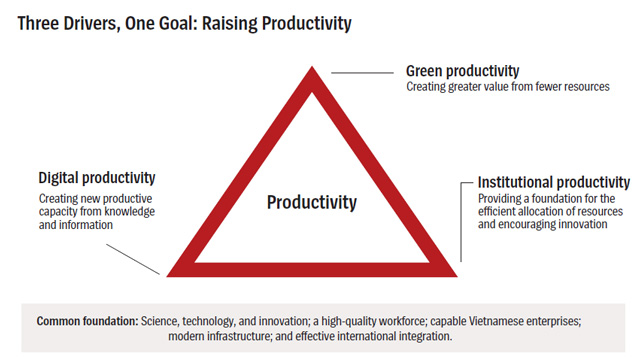
In the broader picture, digital, green, and institutional productivity should be viewed as an integrated system. Digital productivity creates new production capabilities based on data, AI, automation, and knowledge. Green productivity generates greater value with less energy, raw materials, water, and carbon. Institutional productivity creates the conditions for these two sources of capability to be absorbed, adopted widely, and scaled across the economy. Together, the three affect TFP, labor productivity, and resource efficiency. For all three to function effectively, however, a common foundation is required: science, technology, and innovation; high-quality human resources; capable Vietnamese businesses; modern infrastructure; and effective international integration.
Based on the above analysis, six priority areas should be addressed to create a productivity breakthrough: raising enterprise productivity by focusing on management, quality, automation, and technology absorption, particularly among SMEs; expanding access to AI and technology to ensure that these capabilities are not concentrated among leading businesses; building an innovation ecosystem by strengthening links between research institutes, universities, and businesses and promoting commercialization; boosting green productivity by combining energy efficiency, the circular economy, green finance, and substantive ESG practices; delivering an institutional breakthrough, particularly in data, sandboxes, technology markets, and competition; and rethinking how growth is measured, rather than looking only at GDP.
For SMEs in particular, policies should avoid creating additional administrative burdens and instead provide support that enables businesses to genuinely transform, rather than simply helping them purchase technology.
Overall, the 2026-2045 story is not simply about how to make GDP grow faster. More importantly, it is about changing how the economy creates value so that growth can become faster, more sustainable, and of higher quality at the same time. This is the core requirement of reshaping Vietnam’s growth model.
(*) The Research team consists of Dr. Nguyen Duc Hien, Vice Chairman of the Central Commission for Policy and Strategy, and Mr. Tran Binh Minh and Ms. Ha Thi Thu Thuy from the Institute for Policy and Strategic Studies at the Central Commission for Policy and Strategy.





 Google translate