



The first eight months of 2026 painted a brighter economic picture overall than the opening months of the year. But behind these positive figures lies a more important question: To what extent is growth creating new capacity for the economy?
Therefore, in assessing the economic picture for the first eight months, the key issue is not simply how much the economy has grown, but how that growth has been achieved, what new capacity it is creating, and how broadly its benefits are spreading across the domestic economy. These are the issues that should be placed at the center of economic policymaking in the closing months of the year and throughout the 2026-2030 period.
Industry accelerates
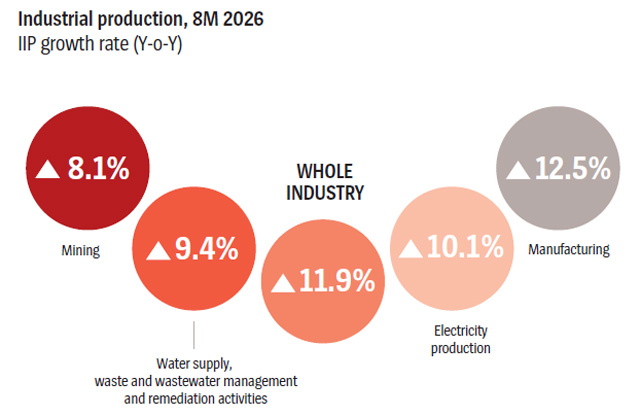
If one had to identify the most prominent positive signal from the first eight months of 2026 it would be the clear acceleration in industrial production capacity. The Index of Industrial Production (IIP) rose 1.5 per cent month-on-month in August and 14.4 per cent year-on-year. For the first eight months as a whole, the IIP for the manufacturing and processing sector increased 12.5 per cent, or 2.5 percentage points higher than in the same period last year, indicating a significant strengthening of production capacity.
The Purchasing Managers’ Index (PMI), meanwhile, reached 53.3 points in August; its highest level since March and 0.4 points higher than in July. New orders and output continued to rise, with output recording its fastest growth in more than two years. Raw material supplies became more favorable, while raw material prices and production costs showed signs of easing. These suggest that the manufacturing sector is entering the final months of the year from a relatively solid position.
However, a fuller reading of the PMI also shows that new export orders declined in August, employment continued to contract, and expectations for output over the next 12 months weakened amid global geopolitical uncertainty. This suggests that the current production momentum does not necessarily mean a firm new growth cycle has been established. In other words, supply capacity is improving faster than business confidence. This gap warrants close attention from policymakers.
The August PMI reading of 53.3 points is encouraging but it should not be viewed simply as a sign that the economy has moved comfortably beyond the 50-point threshold. More important is the composition of the Index. New orders and output increased, but new export orders declined. Businesses remained cautious about hiring, while the outlook for the year ahead showed no meaningful improvement.
The August PMI indicates that the economy’s production capacity is recovering, supported by stronger aggregate demand and market confidence. Nevertheless, economic managers and policymakers should remain cautious when assessing the outlook for the closing four months of the year. If external demand weakens while domestic demand is not sufficiently strong to compensate, manufacturing growth could quickly approach its limits.
Therefore, policy should not focus solely on keeping the PMI above 50 points. It should also pay attention to the quality of orders, the potential for job creation, the stability of input costs, and the recovery of business expectations.
Business resilience remains a bottleneck
Maintaining high and sustainable growth cannot rely solely on large-scale projects, because the vitality of an economy is reflected in the ability of its business community to survive, expand, and reinvest.
In the first eight months of the year, 138,100 new businesses were established, while 68,300 returned to operations. On average, 25,800 businesses entered the market each month. This is a positive signal.
At the same time, however, 157,400 businesses exited the market. More notably, in both July and August, the number of businesses leaving the market exceeded the number entering it.
This is not enough, though, to conclude that the business sector is weakening, as some dissolved businesses may have already ceased operations and were only completing the formal dissolution process. Nevertheless, it remains a warning sign about the resilience of the business sector, particularly as the recovery in domestic purchasing power remains slow.
Now is the time to shift the focus from how many new businesses are being established to how many can survive, grow, and improve productivity. A strong economy is not simply one with a high rate of business entry; it must also have a high business survival rate, with companies capable of accumulating capital, adopting new technologies, and participating more deeply in value chains.
Investment expands
Public investment remains the most important driver of growth. In the first eight months of 2026, investment from the State budget stood at approximately VND546.8 trillion ($21.11 billion), up 18.5 per cent against the same period last year and equivalent to 50.5 per cent of the annual plan. This represents a significant effort by the government to accelerate disbursement, remove bottlenecks related to administrative procedures and site clearance, and address delayed projects.
However, for high and sustainable growth, the issue goes beyond the pace of disbursement. Public investment can generate long-term growth only when it is converted into new economic capacity.
Such capacity can take the form of transport infrastructure that reduces logistics costs, energy infrastructure that strengthens supply capacity, industrial parks that create new production space, or digital infrastructure that helps businesses reduce transaction costs.
Therefore, in the final months of the year, the priority should not simply be to accelerate the disbursement of remaining funds, but to speed up projects with the greatest potential to raise productivity and generate spillover effects.
FDI surges
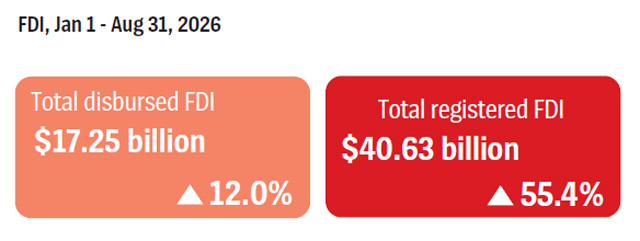
FDI remains one of the brightest spots in the economic picture. Total registered FDI reached $40.63 billion in the first eight months, up 55.4 per cent, while disbursed FDI stood at $17.25 billion, up 12 per cent and the highest level in the first eight months of any year for the past five years. This is an important source of capital for expanding production capacity and connecting Vietnam to global value chains.
However, policymakers and economic managers need to take a closer look at the composition of FDI flows. Of the $40.63 billion in registered FDI, $6.7 billion came from capital contributions and share purchases. Notably, $4.15 billion of this amount involved share-acquisition transactions that did not increase charter capital. These transactions do not directly create new production capacity; rather, they reflect changes in ownership of existing productive capacity and assets within the economy.
This does not mean share-acquisition FDI is inherently negative. Such transactions can bring new technologies, management expertise, markets, and distribution networks. From a policy perspective, however, it is important to distinguish between two different impacts: FDI that creates new capacity and FDI that changes ownership of existing capacity.
Notably, approximately 30 per cent of the value of share acquisitions was concentrated in wholesale, retail, and the repair of automobiles and motorcycles. The issue is therefore not simply one of investment capital but also concerns ownership structures and the ability to influence domestic distribution networks.
The policy objective, therefore, should not be to restrict these capital flows but to raise the standards used to assess FDI quality - from value creation and links with domestic businesses to technology transfer, competition, taxation, and sectors of strategic importance.
Consumption growth sluggish
While production and investment emerged as bright spots in the first eight months of 2026, domestic consumption remains a weak link.
The total retail sales of goods and consumer services revenue rose 7.6 per cent in the period, just 0.1 percentage point higher than in the same period last year. Average monthly retail sales have improved over time, but the pace remains insufficient to make domestic consumption a growth driver commensurate with the size of the economy.
International tourism is generating additional consumer demand. Vietnam welcomed approximately 15.9 million international visitors in the first eight months, up 14.4 per cent. While international tourists can supplement domestic purchasing power, they cannot substitute for a recovery in household incomes and consumer confidence among tens of millions of Vietnamese households.
For domestic consumer demand to become a genuine engine of growth, policy needs to simultaneously address employment, real incomes, living costs, consumer confidence, and access to quality services. Ultimately, sustainable growth must be reflected in consumers’ purchasing power and domestic businesses’ ability to expand their markets.
Foreign trade gains momentum
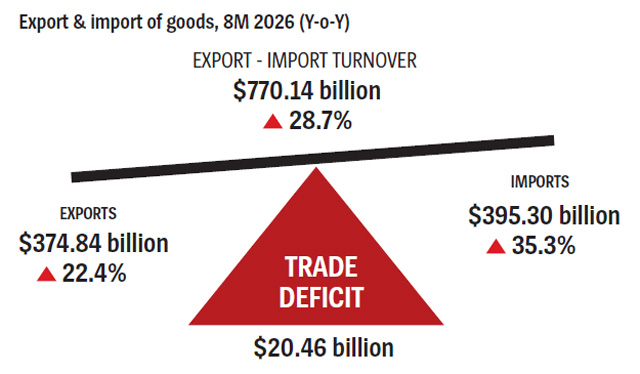
In the first eight months, total merchandise trade reached $770.14 billion, up 28.7 per cent. This substantial trade volume further underscores Vietnam’s important position in global merchandise trade. Imports reached $395.3 billion, up 35.3 per cent, while exports totaled $374.84 billion, up 22.4 per cent, resulting in a trade deficit of $20.46 billion for the period.
More notable is the high concentration of trade in a limited number of product groups and markets. Electronics, computers, and components alone accounted for 40.88 per cent of the economy’s total import value in the first eight months, generating a deficit of $60.57 billion.
The US accounted for 32.5 per cent, or nearly one-third, of total exports, while nearly 41 per cent of total imports came from China. These figures show that Vietnam’s merchandise trade is expanding rapidly, but its heavy reliance on a handful of markets remains a concern. The strength of domestic capabilities and the economy’s ability to retain value domestically remain major questions.
Not all imports, of course, are cause for concern. Imports of machinery, equipment, components, and raw materials can be essential inputs for growth. The issue arises when imported inputs grow faster than domestic supply capacity, leaving the economy heavily dependent on external supply chains.
Therefore, the challenge for the next phase is not simply to reduce imports, but to gradually reduce the import content embedded in each unit of value-added in exported products.
In other words, Vietnam needs to shift from a focus on increasing export turnover to increasing the value retained domestically from exports.
The clearest positive signal in merchandise trade came in August, when the trade deficit narrowed to just $120 million; the lowest level since the beginning of the year. Compared with the $3.59 billion deficit posted in July, the August figure was down by more than 96 per cent. This is a significant improvement, indicating that export growth and the balance between exports and imports became more favorable toward the end of August.
However, the August result needs to be viewed in the broader context of the first eight months of the year. With the trade deficit reaching approximately $20.46 billion, the economy remains in a position where imports are growing faster than exports. Therefore, the sharply narrower deficit in August is encouraging, but it is not yet enough to conclude that pressure from the trade deficit has been resolved.
Inflation headroom narrows
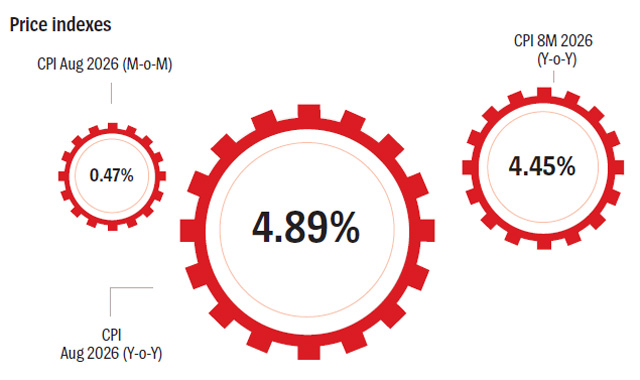
The CPI rose 3.57 per cent in August from December 2025 and 4.89 per cent year-on-year, while the first eight-month figure increased 4.45 per cent from the same period last year. This means the remaining room relative to the full-year inflation target of 4.5-5 per cent is becoming increasingly limited.
What is noteworthy is that inflationary pressure is not driven solely by consumer demand. Raw material prices, production costs, energy prices, exchange rates, and unpredictable developments in international markets could all affect the price level in the closing months of the year. This calls for increasingly close policy coordination. Growth needs to be supported, but not at any cost.
Public investment needs to accelerate, but capital concentration must not create excessive pressure on material prices. Credit needs to support production while being accompanied by risk controls. The exchange rate needs to remain sufficiently flexible to support exports without adding to imported inflationary pressure.
The objective, therefore, is not to choose between growth and stability, but to identify the highest sustainable rate of growth within the limits of macro-economic stability.
Growth constraints
Overall, the economic picture for the first eight months shows that the economy has strengthened its growth capacity, while also revealing several increasingly clear constraints.
First, production capacity is expanding faster than domestic demand. Second, the scale of international merchandise trade and FDI is growing faster than the economy’s ability to increase domestic value-added and strengthen its internal capabilities. Third, investment is increasing, but the need to convert capital into higher productivity and new capacity is becoming increasingly urgent. And fourth, the number of businesses entering the market remains substantial, but the resilience of the business sector remains fragile.
These constraints are not four separate groups of difficulties and challenges. Together, they convey a broader message: growth resources are increasing, but the domestic capacity to absorb, transform, and retain value from those resources has not grown at a commensurate pace. If these constraints are not addressed, they could undermine the quality of growth and reduce the economy’s resilience.
This is why the closing four months of the year should be viewed not simply as the final stretch toward meeting Vietnam’s 2026 growth target but as a critical period for strengthening the foundations of a higher new growth trajectory.
From driving growth to improving quality
The signals from the first eight months of 2026 suggest that economic management in the final four months should not focus on creating more growth drivers, but on converting existing drivers more effectively into domestic economic capacity.
First, public investment should be directed toward areas that create new capacity and generate the greatest spillover effects, rather than simply pursuing higher disbursement rates.
Second, strengthening domestic purchasing power should become part of the growth strategy through employment, incomes, and consumer confidence, rather than focusing solely on increases in total retail sales of goods and consumer services revenue.
Third, domestic businesses should be placed at the center of efforts to improve productivity, as they are the key force determining the economy’s ability to retain value domestically.
Fourth, FDI flows should be assessed not simply by the amount of capital registered but by the new production capacity created, the value-added generated and retained domestically, links with local businesses, technology transfer, and their contribution to long-term competitiveness.
Fifth, international merchandise trade policy should shift decisively from the goal of increasing export turnover toward raising domestic value-added, developing support industries, diversifying markets, and gradually reducing dependence on a limited number of supply chains.
Above all, macro-economic management requires close coordination between growth and stability. One percentage point of growth achieved at the cost of inflation, greater import dependence, or weaker economic resilience is not necessarily one percentage point of high-quality growth.
The economic picture for the first eight months is both encouraging and thought-provoking.
The economy has demonstrated its ability to expand production, attract capital, accelerate investment, and maintain rapid growth in merchandise trade despite considerable uncertainty in the global economy.
Yet the growth drivers and the capabilities needed to retain the benefits of that growth have not developed at the same pace. This is precisely where policymaking and implementation should focus in the period ahead.
In the closing months of this year and throughout the 2026-2030 period, the most important question is not simply how many percentage points Vietnam’s economy grows. More important is how much additional production capacity, productivity, domestic value-added, and resilience to external shocks the economy creates with every percentage point of growth.
If production increases but domestic businesses do not grow accordingly; if exports rise without a corresponding increase in the value retained domestically; if investment disbursement accelerates without generating new capacity; or if FDI expands while links with the domestic economy remain weak, growth may still be high but the foundations of that growth will not necessarily have strengthened to the same extent.
Conversely, if every flow of capital is converted into new capacity, every investment project into productive capacity, and every market opportunity into greater competitiveness, while domestic businesses gain the ability to participate more deeply in global value chains, growth will do more than expand GDP - it will strengthen the economy itself.
This, perhaps, is the most important measure of the quality of growth, and the deeper meaning of Vietnam’s development journey from 2026 to 2030: not simply meeting annual growth targets but turning this year’s growth into the capacity for tomorrow’s development.
(*) Dr. Nguyen Bich Lam is the former Director General of the General Statistics Office, now the National Statistics Office at the Ministry of Finance.


 Google translate