



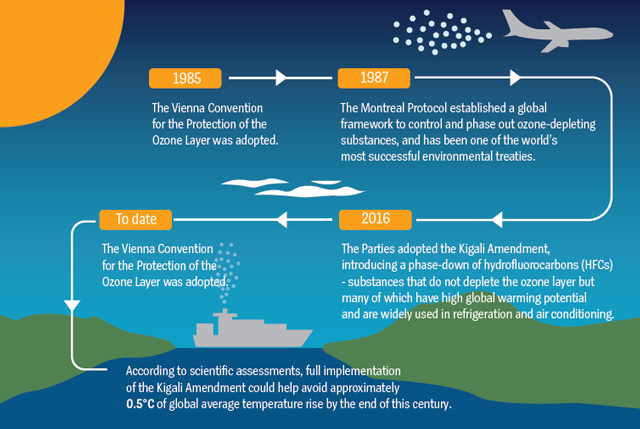
Nearly four decades after the Montreal Protocol on Substances that Deplete the Ozone Layer was adopted in 1987, the world has witnessed one of the most successful examples of international environmental cooperation in history. Approximately 99 per cent of controlled ozone-depleting substances have been phased out, and the ozone layer is on track to recover. The Montreal Protocol established a distinctive mechanism for achieving environmental goals through phased reductions in controlled substances; systems to manage their production, import, and consumption; financial support for technology transition; and direct business participation.
For Vietnam, implementing the Montreal Protocol for more than 30 years has been a continuous process of strengthening policy and advancing technological transformation.
Proactive action and responsibility
Vietnam joined the Vienna Convention and the Montreal Protocol in 1994. Over the three decades since, the country has met its control obligations under the Protocol’s schedules while gradually establishing management mechanisms, mobilizing resources, and supporting businesses in technology conversion.
In 1995, Vietnam issued its National Program for the Gradual Phase-out of Ozone-Depleting Substances and established the National Ozone Program Office in 1996 to coordinate implementation. Programs and projects have since been carried out in successive phases, aligned with control schedules and linking the phase out of controlled substances with technology conversion at businesses.
From 1994 to 2004, conversion programs helped businesses phase out chlorofluorocarbon (CFC)-11 and CFC-12, reducing emissions by more than 3.5 million metric tons of CO2 equivalent (CO2e) annually. By January 1, 2010, Vietnam had fulfilled its obligations to phase out the consumption of CFCs, halons, and carbon tetrachloride (CTC), while also phasing out methyl bromide for uses other than quarantine and pre-shipment applications.
Vietnam subsequently continued implementing the hydrochlorofluorocarbon (HCFC) phase-out schedule, freezing consumption at the baseline level from 2013 and reducing baseline consumption by 35 per cent from 2020, in line with the Montreal Protocol’s control milestones. HCFC consumption during 2025-2029 is capped at 32.5 per cent of the baseline level.
Following the approval of the Kigali Amendment, Vietnam established an HFC management framework and began allocating import quotas in 2024 to implement the phase-down schedule.
According to data from the Ozone Secretariat, Vietnam’s implementation of the Montreal Protocol has helped prevent approximately 260 million metric tons of CO₂e in emissions. More importantly, it has not only met its control milestones but also strengthened its management capacity, supported technology conversion across multiple manufacturing sectors, and laid the groundwork for a more proactive approach in the next phase.
From projects to strategic direction
In the early stages, Vietnam’s implementation of the Montreal Protocol relied primarily on programs and projects under successive phase-out plans, with a focus on helping businesses convert their technologies. Over more than three decades, Vietnam has gradually moved from a project-by-project approach toward proactive policy development and long-term planning.
The 2020 Law on Environmental Protection marked an important shift by establishing a more systematic framework for ozone-layer protection. This framework has since been further specified and strengthened through Government Decree No. 06/2022/ND-CP dated January 7, 2022, Government Decree No. 119/2025/ND-CP dated June 9, 2025, Government Decree No. 83/2026/ND-CP dated March 23, 2026, and other relevant regulations.
The National Plan approved by the Prime Minister under Decision No. 496/QD-TTg dated June 11, 2024, sets out objectives, tasks, and solutions through 2045. It provides a basis for Vietnam to align implementation of the Montreal Protocol with broader priorities, including technology transformation, technical standards, energy efficiency, human resources development, and the lifecycle management of controlled substances.
For businesses, this shift brings greater policy stability and predictability. With clear control schedules and technology directions, and timely access to information, businesses can better plan production, operations, and investment; select appropriate technologies, equipment, and refrigerants; and reduce the risk of investing in technologies that could soon become incompatible with regulatory requirements or market trends.
Policy proactivity also requires market demand to be considered throughout the transition. As import quotas for controlled substances are gradually reduced, a large installed base of equipment will continue to require refrigerants for operation, maintenance, and repair. Alongside promoting alternative technologies and refrigerants, Vietnam is therefore expanding its approach from managing the quantities of substances entering the market to managing them throughout their lifecycle, including recovery, reuse, recycling, and reclamation.
For the transition to be effective, the role of regulatory agencies is also expanding beyond issuing and enforcing regulations toward providing direction, connecting stakeholders, and creating conditions for participation. Engagement with businesses, industry associations, research and training institutions, and international partners can help align policies more closely with practical needs while giving businesses earlier access to information on roadmaps, technologies, technical requirements, and available support.
From an approach centered primarily on individual programs and projects, Vietnam is gradually developing a more proactive implementation model: a long-term roadmap to guide technology and market development, mechanisms to connect stakeholders, and support tools to help businesses prepare for the transition. This gives the government the information and tools needed to manage the process while giving businesses the information and time they need to plan production, operations, and investment decisions.
Expanding partnerships and resources
As Vietnam enters a new phase spanning technology, lifecycle management, market development, and energy efficiency, its approach to cooperation will also need to become more proactive, diverse, and mutually beneficial.
After more than three decades of implementing the Montreal Protocol, Vietnam has acquired substantial experience in policymaking, quota management, and technology conversion. It has also developed networks connecting regulators, businesses, research and training institutions, and international partners. This provides a foundation for moving beyond project-based support toward longer-term partnerships focused on sharing experience, exchanging knowledge, testing technologies, and developing practical solutions.
Areas such as refrigerant lifecycle management, digitalization and traceability, cooling efficiency, and lower-climate-impact technologies are creating new opportunities. Vietnam can continue to draw on international experience, technology, and resources while sharing lessons from its own policymaking and implementation. Joint research, testing, and scaling of effective models can make international cooperation a source not only of compliance support but also of technological development, market opportunities, capacity building, and investment.
Resource mobilization will also need to become more flexible and diverse. The Multilateral Fund and international cooperation programs can catalyze new technologies and business models while helping attract funding from companies, financial institutions, and green transition programs. Financing mechanisms that share part of the initial costs and risks can encourage businesses to invest proactively rather than rely on individual support projects.
International resources can therefore serve as more than funding for compliance. They can catalyze innovation and investment, support new technologies and services, and encourage stronger private sector engagement.
More than three decades of implementing the Montreal Protocol have shown that long-term environmental goals depend on translating international commitments into domestic policy, backed by resources, technology, and business participation. The progress made provides an important foundation, but the challenges ahead will grow as Vietnam continues phasing out HCFCs and reducing HFCs while cooling demand, technology requirements, and economic competitiveness continue to rise.
Meeting these goals will require coordinated action. The government must continue strengthening policies and provide clear roadmaps and timely information to guide the market. Businesses need to lead in selecting technologies and making investment decisions. Research and training institutions, together with technical professionals, must provide the technological and human resources foundation. International partners can contribute through knowledge and technology sharing, resource mobilization, and new forms of collaboration.
Closer coordination and joint investment can generate solutions that advance environmental goals while supporting technological innovation, market development, and business competitiveness. The Montreal Protocol thus offers a framework not only for meeting environmental commitments but also for creating opportunities for innovation, investment, and long-term growth.






 Google translate