


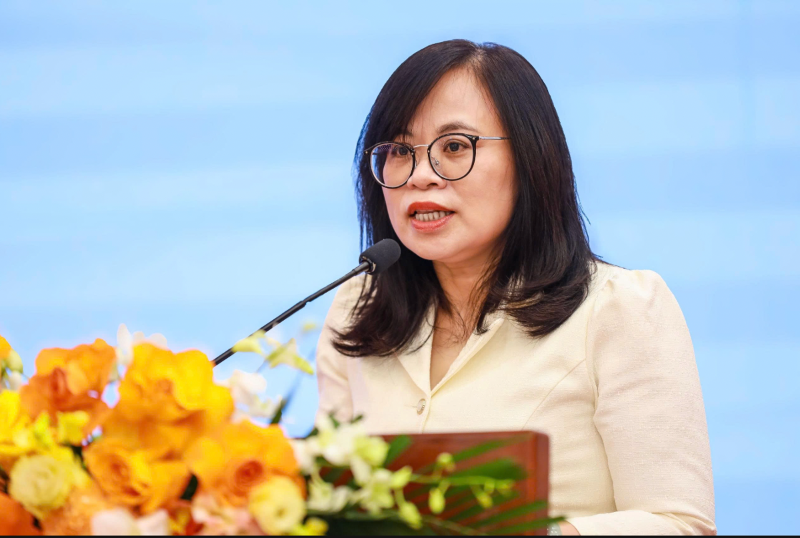
The stock market plays a vital role in mobilizing medium- and long-term capital for the economy, with initial public offerings (IPOs) serving as an essential market component, according to Le Thi Viet Nga, Vice Chairwoman of the State Securities Commission (SSC).
Speaking at the seminar "From IPOs to Long-Term Value," held on October 21, Ms. Le Thi Viet Nga, Vice Chairwoman of the State Securities Commission (SSC), emphasized that a primary focus moving forward will be developing the stock market into a key channel for medium- and long-term capital formation, satisfying escalating demand for manufacturing expansion, technological innovation, and digital transformation.
Accordingly, the market will pursue four primary strategic orientations:
First, cultivating a stable, safe, healthy, efficient, sustainable, and integrated securities market while expanding access for enterprises—particularly high-growth and innovative businesses.
Second, promoting public offerings of equities and corporate bonds closely linked to stock exchange listings.
Third, diversifying financial products to meet the economy's medium- and long-term financing requirements while aligning with the risk appetites of institutional investors.
Fourth, aggressively attracting long-term capital inflows, particularly from domestic and foreign investment funds and institutional players.
Six action pillars for market expansion
To deliver on these orientations, the Government, the Ministry of Finance, and the SSC are implementing six principal solution packages:
First, reviewing and standardizing legal normative documents to ensure statutory consistency, transparency, and alignment with international practices, thereby enhancing the overall business environment.
Second, addressing existing impediments in line with recommendations from global rating agencies and international investors to enhance market openness. Under the established roadmap, the central counterparty (CCP) clearing model is slated for operational rollout in early 2027.
Third, promoting public securities offerings tied directly to exchange listings, while establishing favorable conditions for financially sound, well-governed foreign direct investment (FDI) enterprises to list and trade.
Fourth, continuing the Ministry of Finance's blueprint to restructure the investor profile and cultivate the domestic fund management industry, accompanied by expanded financial education, outreach, and training for both domestic and foreign market participants.
Fifth, integrating modern, advanced financial technologies across market infrastructure.
Sixth, stepping up market supervision, inspections, and compliance audits while strictly penalizing violations to safeguard integrity.
Transparency: a mandatory imperative for businesses
On the corporate side, according to Ms. Nga, for the stock market to truly function as an effective capital conduit for the economy, internal corporate fundamentals play an exceptionally vital role alongside legal frameworks, market infrastructure, and institutional foundations.
First and foremost, enterprises must standardize corporate governance in line with international practices.
Second, enterprises must enhance transparency and improve the quality of mandatory information disclosures.
Third, enterprises need to consolidate their financial health and formulate robust, long-term development strategies.
Fourth, enterprises must proactively tap the capital markets, transitioning from a passive financing mindset to active capital mobilization and embedding the securities market into their core long-term growth strategies.







 Google translate