


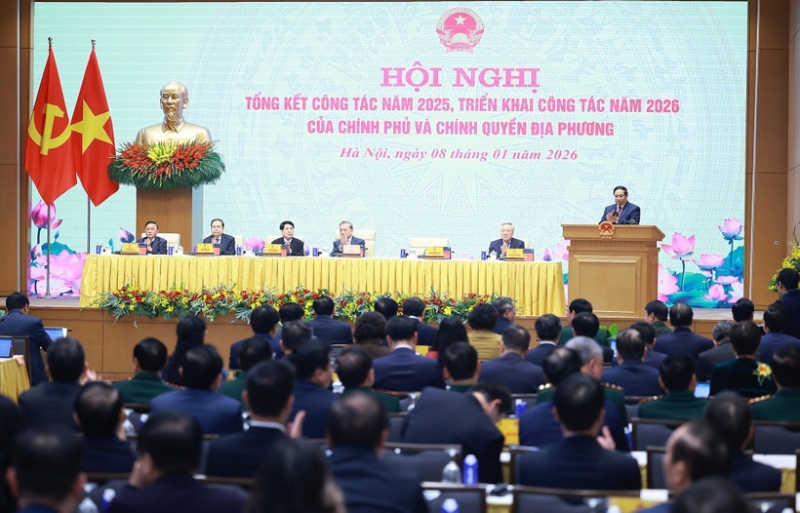
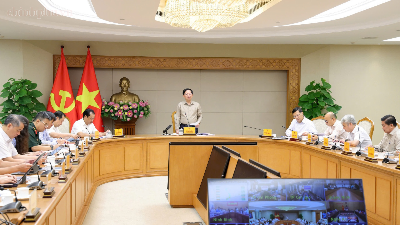
A nationwide conference to review the central and local governments’ 2025 performance and launching 2026 tasks was held on January 8 in a hybrid format connecting the Government Headquarters with all 34 provinces and cities.
Prime Minister Pham Minh Chinh was quoted by the Vietnam News Agency as stating at the conference that Vietnam will need radical economic restructuring and a fresh growth model powered by science – technology, innovation and digital transformation to deliver double-digit expansion starting in 2026.
PM Chinh said the Government will fully and seriously follow the “highly important, thoughtful, in-depth and hands-on” directions that Party General Secretary To Lam made earlier at the conference, including fixing eight shortcomings and focusing on seven key tasks head-on.
According to the PM, the achievements noted by the Party leader have generated momentum, power and confidence for the Government, ministries, agencies and local authorities to fulfill their upcoming duties.
High economic growth must be anchored in macroeconomic stability and major economic balances, he said, adding that fast growth must be sustainable and tied to social progress and equity, environment protection and higher living standards. He also underscored the need to bolster strategic autonomy, consolidate national defense – security, improve the economy’s self-reliance and resilience, and proactively respond to external shocks.
He wished for continued support from current and former Party and State leaders, particularly the close and regular guidance of General Secretary Lam, along with effective coordination from the Party bodies, the National Assembly, the Vietnam Fatherland Front and socio-political organizations, and active support and engagement from the public, the business community, and international partners in all aspects of the Government’s activities.
Across the Government’s 2021–2025 term, Vietnam met or exceeded 22 of its 26 key socio-economic targets. In both 2024 and 2025, all 15 key targets were achieved or surpassed. GDP expanded 8.02% in 2025, ranking Vietnam among the world's fastest-growing economies. Macro-economic stability held firm, inflation stayed contained, key balances were secured, and resilience to external shocks improved.
Traditional growth engines proved effective. Total social investment topped VND4.15 quadrillion VND ($159 billion) in 2025, or 32.3% of GDP. Over the five years, total investment exceeded VND17.3 quadrillion, a 44% jump from the previous term. Registered foreign direct investment during 2021–2025 reached $184.2 billion, up nearly 8.4% versus the previous period. Foreign trade volume grew from $545.4 billion in 2020 to a record above $930 billion in 2025, vaulting Vietnam into the world’s top 20 trading nations.
The three strategic breakthroughs were rolled out boldly and effectively, unlocking new development space and momentum. Lawmaking and law enforcement were renewed in both mindset and approach, clearing numerous entrenched obstacles. During the term, the Government submitted more than 178 laws, ordinances and resolutions to the National Assembly for passage, the most in any single term, and issued 936 decrees under its authority.
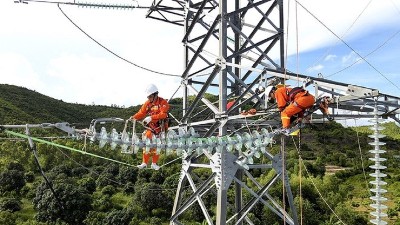
Infrastructure saw transformative leaps, with massive modern projects boosting connectivity and fueling long-term expansion. By late 2025, Vietnam had built 3,345km of expressways and more than 1,711km of coastal roads. Long Thanh International Airport was substantially completed; ring roads, urban rail, seaports, airports and 500kV transmission lines became operational. The three national groundbreaking and inauguration events alone marked the start of construction or completion of 564 big-ticket projects worth over VND5.14 quadrillion.
The labor structure shifted positively, while science – technology, innovation and digital transformation gained traction with meaningful early wins. Long-stalled and multi-term projects were tackled drastically, freeing resources for growth.
Socio-cultural progress advanced in awareness, action and results. Living standards improved, pushing Vietnam’s Human Development Index up 18 ranks to 93rd out of 193 nations. Policies for revolution contributors, social protection and poverty alleviation made solid gains under the principle of “leaving no one behind”. Makeshift and dilapidated housing nationwide were eradicated more than five years ahead of schedule. Social welfare spending during 2021–2025 totaled $11 quadrillion.
The Government also acted firmly to streamline its organizational structure and launch the two-tier local administration model, while accelerating the decentralization and delegation of authority. National defense – security capabilities were fortified on multiple fronts, and political stability endured. Diplomacy and international integration remained a bright spot, with Vietnam forging comprehensive, strategic or comprehensive strategic partnerships with 42 countries, including all five permanent members of the United Nations Security Council and 18 of the G20’s 21 members.

 Google translate